Thursday, April 13, 2023

Perceptions of Polarization in North Carolina

By Whitney Ross Manzo and David McLennan

Recently, Representative Marjorie Taylor Greene (R-GA) gained attention for a statement in which she argued for a national divorce between red and blue states. She argued that from “the sick and disgusting woke culture issues shoved down our throats to the Democrat’s traitorous America Last policies, we are done.” Although Greene was widely criticized for her remarks, even by members of the Republican Party, her comments reflected the belief that America’s political polarization is based on wildly divergent policy positions. Her comments also suggest that polarization has increased to the point that the country may be at a breaking point. 

Although there is evidence that policy differences exist, particularly on cultural war issues, and may contribute to political polarization, there is also a body of research that suggests that political polarization is based on social identity differences. As opposed to differences in ideology, affective polarization is the idea that we identify with people more similar in identity to us (political affiliation, race/ethnicity, gender, sexual orientation, etc.) and feel dislike and even disgust for those who are different from us. 

Using data from the Meredith Poll from 2017-2023, we set out to examine whether we find evidence of polarization among North Carolinians. Do North Carolinians perceive there to be high levels of polarization? And, are North Carolinians polarized, either by issue or by identity?

Monday, April 10, 2023

Putting Tricia Cotham's Party Switch in Context

By Christoper Cooper and Michael Bitzer

Donald Trump's indictment might have received the most political attention last week and Democrats won a critical state supreme court race in Wisconsin, but the most politically consequential event in the United States might have taken place eight hours away from the eye of the Trump storm. On April 5, 2023, Tricia Cotham, a Democratic lawmaker in North Carolina's State House, announced that she was switching political parties. Elected as a Democrat, Cotham is now a Republican.

Cotham's move essentially rendered Governor Cooper's veto ineffective. The Republicans now have supermajority control of both chambers of the North Carolina General Assembly and can override Cooper's veto without securing a single Democratic vote. 

The news about Cotham raised all sorts of questions about party switching in general, and how it potentially fits into a seismic shift in North Carolina politics.

Tuesday, March 28, 2023

Where Things Stand in the NC General Assembly

Blog contributor and Western Carolina University Professor Dr. Chris Cooper discusses the latest in what is happening at the North Carolina General Assembly with the Carolina Journal. 

You can find his interview at: https://www.carolinajournal.com/video/western-carolinas-chris-cooper-offers-2023-n-c-legislative-session-progress-report/ 

Tuesday, February 7, 2023

The Literacy Test in NC: Lessons from 1970

By Christopher Cooper

Last week Representatives Alexander (D), Saine (R), Brown (D), and Stevens (R) introduced a bipartisan bill in the North Carolina House to remove the literacy test from the NC State Constitution. This bill is just the latest attempt to send this racist vestige of the Jim Crow South packing; we've been down this road before.

I wrote about the literacy test in 2021 and 2022, but now that there is a new bill--and one that seems to be more likely to pass--I thought it would be a good time to reassess the issue but hopefully without tilling the same soil. Below, I briefly review the origins of the literacy test (spoiler alert: it's racist), briefly analyze the last statewide vote on the issue in 1970 and discuss what all of this means for the likelihood of repeal this year. 

Thursday, January 19, 2023

With Stein Officially In for NC Governor, Can He Replicate Cooper's Success?

By Michael Bitzer

With the official announcement by North Carolina's Democratic Attorney General Josh Stein of seeking the state's chief executive office, comparisons are being made to the current incumbent's performance and how Stein can replicate those two successful runs for governor.

In 2016 and 2020, Democrat Roy Cooper was able to unseat an incumbent governor (49 percent against Republican Pat McCrory's 48 percent) and successful defend (with some breathing room at 51.5 percent) his re-election against Republican Lt. Governor Dan Forest. In those same elections, Stein was able to secure the AG's office, but in 2020, he did so with the barest of margins of victory of any Council of State executive officer winning (50.13 percent). In 2016, Stein won his first bid with 50.3 percent of the vote. 

As Miles Coleman has noted, North Carolina's gubernatorial election will be one of the few in the nation in the presidential election, and will be the "marquee" contest. Sabato's Crystal Ball has already classified the contest as a 'toss-up.'

Thursday, December 29, 2022

Who Is In and Out for 2024 in NC Politics?

By Michael Bitzer

Updated: 3-27-23

Editor's note: well, since posting this on December 29, there's already updates to the spreadsheet. I'll be posted new dates in the above "Update" line whenever the spreadsheet is updated.

With the end of 2022's election cycle, thus begins the 'invisible primary' season for the 2024 election cycle and by all accounts, North Carolina will--once again--be in the competitive battleground state status. 

For those of us in the thick of NC politics, 2024 will bring a slew of election contests to the forefront: along with the presidential contest, all of the Council of State (read, state-wide) executive offices will be on the ballot, with several of them being open-seat contests (or having the potential to be an open-seat, with incumbents deciding not to run for re-election). 

As the rumor and polling mills begin to churn out possible candidates for various offices, we'll use this page as a "check-list" spreadsheet of those who are speculated/confirmed candidates for various state-wide offices that will be on the 2024 general election ballot, along with the source for the information.

You can access the spreadsheet here, which will be updated as more candidates consider and/or make their announcements.

Sunday, December 4, 2022

With Turnout Data Finalized, a New Assessment of 2022's Mid-Term Election in NC

By Michael Bitzer

With North Carolina's counties and state board of elections finalizing the results of the 2022 mid-term elections, and the subsequent completion of voter history data on the 3.7 million North Carolinians who cast a ballot this past November, we can now get an official portrait of the state's electorate and who showed up.

And based on this information, a reevaluation of the performance of one political party in 2022 is warranted. More on that later.

As a reminder: the voter history data file compiles each voter's casting of a ballot for an election, along with the party they were registered with and the method that the voter utilized to cast a ballot. Once you combine this data with the voter registration data file (I used the December 3, 2022 voter registration file), you can merge the voter history information with the registration data and analyze the electorate based on official records.

This post will focus on the turnout rates for various voter demographics, along with comparing the electorates to the voter pool; future posts will analyze other dynamics that the data tells us, especially for past voting trends and vote methods. 

Monday, November 28, 2022

Growing & Distinct: The Unaffiliated Voter as Unmoored Voter

The four contributors to this blog--Drs. Michael Bitzer, Christopher Cooper, Whitney Ross Manzo, and Susan Roberts--recently had their research on North Carolina's Unaffiliated voters published in the journal Social Science Quarterly.

Using data from North Carolina's voter registration and history files along with public opinion data from the Meredith College Poll, this academic study points to the idea that Unaffiliated registrants are not simply shadow partisans but, on average, are distinct from the two major parties in terms of demographics, political behavior, and political attitudes. 

The study concludes that voters who eschew party labels are best understood as unmoored voters--often hovering close to their ideological docks but with no institutional constraint to keep them from drifting as the political tides shift.

You can find a link to the full study (in PDF) here at the Social Science Quarterly website. 

Friday, November 18, 2022

A Purple State, with a Red Tint or a Blue Hue? What Is North Carolina, Politically?

By Michael Bitzer

Since the dust has seemingly settled on 2022, and already we're turning attention to 2024 (yes, I know, I know), the hot takes of what the 2022 mid-term elections are flying fast and furious before we shift our gaze to the next election cycle.

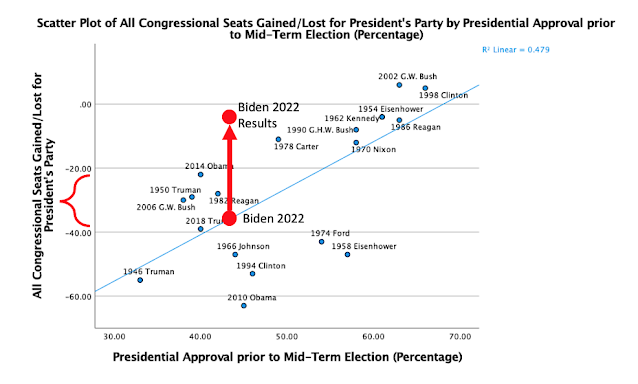
Needless to say, there's a LOT to digest and understand about what this historic election means in the context of what we know about mid-term elections in our politics. My fellow contributors and I have been bouncing ideas back and forth between each other, but the one thing (or more appropriately, the one 'model') that we political scientists tend to rely on for explaining mid-term election is the connection between a president's approval rating and the ultimate number of seats in Congress gained, or more likely, lost. 

In a couple of public presentations made over the election cycle, here's a chart of the president's approval ratings (on the horizontal, or X axis) compared to the number of congressional seats gained or lost (on the vertical, or Y axis):

Tuesday, November 15, 2022

5 Tentative Takeaways from the 2022 Election in NC

by Christopher Cooper

The 2022 election has mostly drawn to a close. I say mostly because we are still waiting on a few more ballots to be counted, provisional ballots to be sorted out, and perhaps a recount or two. Nothing is final until the state canvass on November 29 (county canvass on Nov. 18 is also a key date to keep in mind). See this Hansi Lo Wang piece for a good overview of why these details matter nationally and here for the NC-specific post-election procedures.

Soon after canvass the NC State Board of Election will release an updated voter history file that will include a row of data for everyone who cast a vote in November, 2022. At that point, we'll be able to answer questions about the patterns of who voted (what happened with youth turnout, female turnout, minority turnout, etc.). 

So, I'll pause on all individual level turnout conclusions, but there are a few things that I think are safe to conclude from the data we do have available. If you have not already, I encourage you to first read this excellent wrap-up from Michael Bitzer that lays out a number of important points that I try (with varying degrees of success) to stay away from in what follows.