Monday, June 20, 2022

Who Showed Up in May's Primary Election?

By Michael Bitzer

With the data finalized from the 100 counties and available via the NC State Board of Elections, we can now parse through who showed up to vote based on a number of factors. As reported in the Raleigh News and Observer recently, May's primary electorate had only two out of ten NC registered voters participate. But with the counties reporting their voter history data to the NC State Board of Elections and using the May 21 voter registration data file, we can see who showed up for May's primary. This blog post will look a variety of factors, specifically highlighting more detailed information based voter party registration, generational dynamics, and the location and type of precincts voters casting May primary ballots came from. 

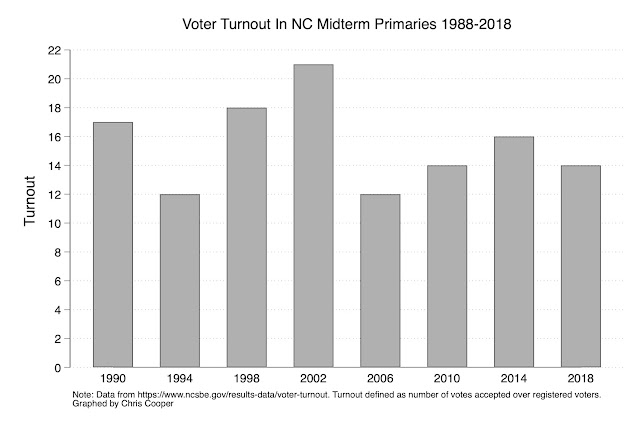
Slightly over 1.4 million registered NC voters cast a May 2022 ballot, amounting to almost 20 percent registered voter turnout. That's the highest turnout in twenty years, as my colleague Chris Cooper noted in a previous blog post and chart:
Thursday, June 16, 2022

ONSP on the Monkey Cage Blog

Drs. Christopher Cooper and Michael Bitzer look at the question of whether Democrats are being "strategic crossover voters" in Republican primaries and find that, at least in the Madison Cawthorn Republican primary for the NC 11th Congressional District, enough registered Democrats-turned-Unaffiliateds participated in the GOP primary to perhaps doom the first-term controversial congressman.

Their analysis is at: https://www.washingtonpost.com/politics/2022/06/16/democrats-republicans-primaries-georgia-colorado-voting/. 

Thursday, June 9, 2022

(Some) Primaries Aren't Over Yet: What Do We Know About Runoffs and Second Primaries in North Carolina?

by Christopher Cooper and Michael Bitzer

Like a dinner guest that just won't leave, we're not done with the 2022 primaries yet. As the inimitable Gerry Cohen shows in the map below, 15 counties have either second primaries (partisan elections where the top vote-getter didn't get above 30% of the vote), runoffs* (nonpartisan elections where the top vote-getter didn't get above a threshold amount of vote), or local elections to look forward to on July 26. Now that the list of July election is set, we thought it would be a good time to review what we know about runoffs and second primaries in North Carolina. 

Source: Gerry Cohen's indispensable twitter feed: https://twitter.com/gercohen/status/1532863664377716737?s=20&t=6q8diY2lDR5iqrGOdOJhng

A Brief History of Second Primary Rules in North Carolina

Thursday, May 19, 2022

Post-Primary 2022 Reflections

With some sleep (and probably more caffeine than sleep), here are some reflections and thoughts following the 2022 mid-term primary. Each of us will provide our own thoughts, and if we repeat each other, well, that may mean it is something others should be paying attention to. 

As a note: when the final voter data comes out after canvassing, we'll have a better set of empirical analyses to run, but here's what each of us are thinking following May 17's contest and preparations for the campaigns to November's general election. 

By Susan Roberts:

As we know, partisanship is perhaps the single most important predictor in voting. That’s one reason primary elections are intriguing. These races don’t provide the voter with a clear partisan cue, and voters must rely on other factors to make their choices. Perhaps one of the best and most recent reflections on these was a piece by Elaine Karmack of the Brookings Institution on lessons from the March 2022 Texas primaries. Karmack argues primaries are “the most consequential elections in American politics,” adding they have long been regarded as “the ugly stepchild of American politics; ignored by journalists and snubbed by political scientists.” We aren’t going to ignore them here in the Old North State.

Monday, May 16, 2022

With NC's early voting done, It's Election Time/Day for NC's Primary

By Michael Bitzer and Chris Cooper

With this past weekend's close of early, in-person voting for North Carolina's May 17 primary, we thought we'd revisit some of our thinking from last week and add in a few more data points (thanks to the great work by the N.C. State Board of Elections and the various counties with their public files) and observations (and questions) about what we might see come Tuesday's election.

Early Voting Sets a Mid-Term Primary Record

First, an overview of where things ended up with North Carolinians casting early votes, and boy did they ever. 

Tuesday, May 10, 2022

Tentative Lessons from Early Voting in NC One Week From Election Day

By Chris Cooper and Michael Bitzer

While election day isn't until a week from today, it's been more than 40 days since the first ballot was accepted in North Carolina and over a week since the first person walked into an early voting site and cast an in-person ballot. So, it seems like a good time to take an early, preliminary, provisional, tentative assessment of what we can glean from the data thus far. So, with all of the caveats we can muster, here are some observations that we think we know about the 2022 electorate thus far.* 

Thursday, April 28, 2022

What Can We Expect for NC's May Primary Election?

By Michael Bitzer

With the start of early, in-person voting beginning on Thursday, April 28 for the May 17th North Carolina primary election, we can look back at the past five elections to perhaps see what kind of trends are present when it comes to how many votes may be cast, and what method we should expect when voters cast their ballots. 

So How Many Will Show Up for May 17?

First, what might we expect when it comes to the number of voters likely participating in this year's primary elections?

For both parties, there are some distinct trends when it comes to primaries held in presidential versus mid-term years. In presidential years, generally North Carolina sees about one million registered voters participate in each primary (for about two million total), depending on the competitiveness of the top-of-the-ballot contest. 

Thursday, March 24, 2022

It Finally Happened: NC's Unaffiliated Voters Take Command

by Michael Bitzer and Christopher Cooper

Last week, the number of registered Unaffiliated voters passed the number of Democratic voters to make Unaffiliated the largest group of registered voters in NC politics. This is a topic that we've written about recently as have some of the state's best journalists. Given the importance of last week's partisan eclipse, we thought it would be a good time to take an overview of what the data tell us about Unaffiliated voters in North Carolina.

Overview

As you can see from the graph below, the rise of Unaffiliated voters has been a long build that has only recently come to fruition. Unaffiliated voters hovered around 5 percent of the North Carolina electorate from 1977 (when the Unaffiliated category was first established) until 1988 when the Republicans first opened their primaries up to Unaffiliated voters. Prior to 1988, registrants were welcome to register as Unaffiliated, but doing so would lock them out of voting in any primary. 

Monday, March 14, 2022

Understanding District Partisan Lean in 2022: A Case for Chilling Out

 by Christopher Cooper

At long last, we know the details of North Carolina's State House, State Senate, and Congressional districts. Soon after they were enacted, think tanks, academics and journalists began to analyze how these districts leaned according to various partisan metrics. Sometimes these competing metrics can get a little confusing, so I'll review a few of them below (note: not an exhaustive list), describing how they are calculated. The bottom line, however, is that which metric you choose doesn't matter much in how you understand the partisan lean of North Carolina's districts--a point that I'll review in greater detail below. 

Tuesday, March 8, 2022

Please Ignore Internal Polls

 by Christopher Cooper

As the primary season kicks into full gear, we can expect a barrage of internal polls purporting to show one candidate with a “commanding lead” in the upcoming primary. One such poll from Madison Cawthorn made the rounds yesterday. The press release reporting the results noted that Cawthorn “dominates” the NC-11 primary field and “holds an 80% GOP approval rating”(1).


My goal here is simple: to convince you to ignore internal polls. I’ll use Cawthorn’s recent internal poll as an example, but this is not a phenomenon limited to Madison Cawthorn or to the Republican Party. I’ve seen untrustworthy internal polls from Democrats, Republicans, and Unaffiliated candidates. The rare Green or Libertarian candidate who can afford internal polling is subject to the same critiques.


Primary election internal polling is unreliable and uninformative because of three factors: selection, lack of disclosure, and uncertainty.