by Christopher Cooper
Few places tell the story of the Democrats' decline better than the rocky, densely forested land known as Appalachia.
It’s not that the parties have flipped in Appalachia—it’s that the Republican strength in the region has become more entrenched and the Democrats are largely shut-out. The Republicans have long been ahead, but today they’ve left the Democrats in the dust.
What Even Is Appalachia?1
Before we can talk about Appalachian politics, we have to answer a harder question: what counts as Appalachia in the first place?
There are more ways to define Appalachia than there are days of the week, but the most popular definition comes from the Appalachian Regional Commission (ARC). In 1963, President Kennedy advocated for a program that would provide economic aid to counties in ten states in the region. Two years later, the Appalachian Regional Commission was passed by Congress and signed by President Johnson. After surviving the legislative process, the “official” ARC definition had ballooned to a 13-state region which included Mississippi and New York. Neither of them seemed to fit particularly well.
As scholar Justin Randolph noted, there were a few problems with the inclusion of Mississippi. Namely, it “lacked mountains” and “no one in Mississippi sincerely believed they lived in Appalachia.” You’ve got to admit—he’s got a point.
Over the years, the ARC definition grew even further, expanding from its original inception of 360 counties to 423 today. As Appalachian Studies scholars Stewart Scales, Emily Satterwhite, and Abigail August argue, the ARC definition is “the most flawed given that it is as much the product of political horse-trading as it is of any intellectual rationale.”
So the ARC definition is out, but which definition should we use?
I favor a definition originally offered by Appalachian historian John Alexander Williams and then modified by the aforementioned Appalachian Studies scholars Scales et al. Their argument is pretty convincing, and they’ve got a nifty web site that goes along with it, so it’s the definition I’ll be going with here.
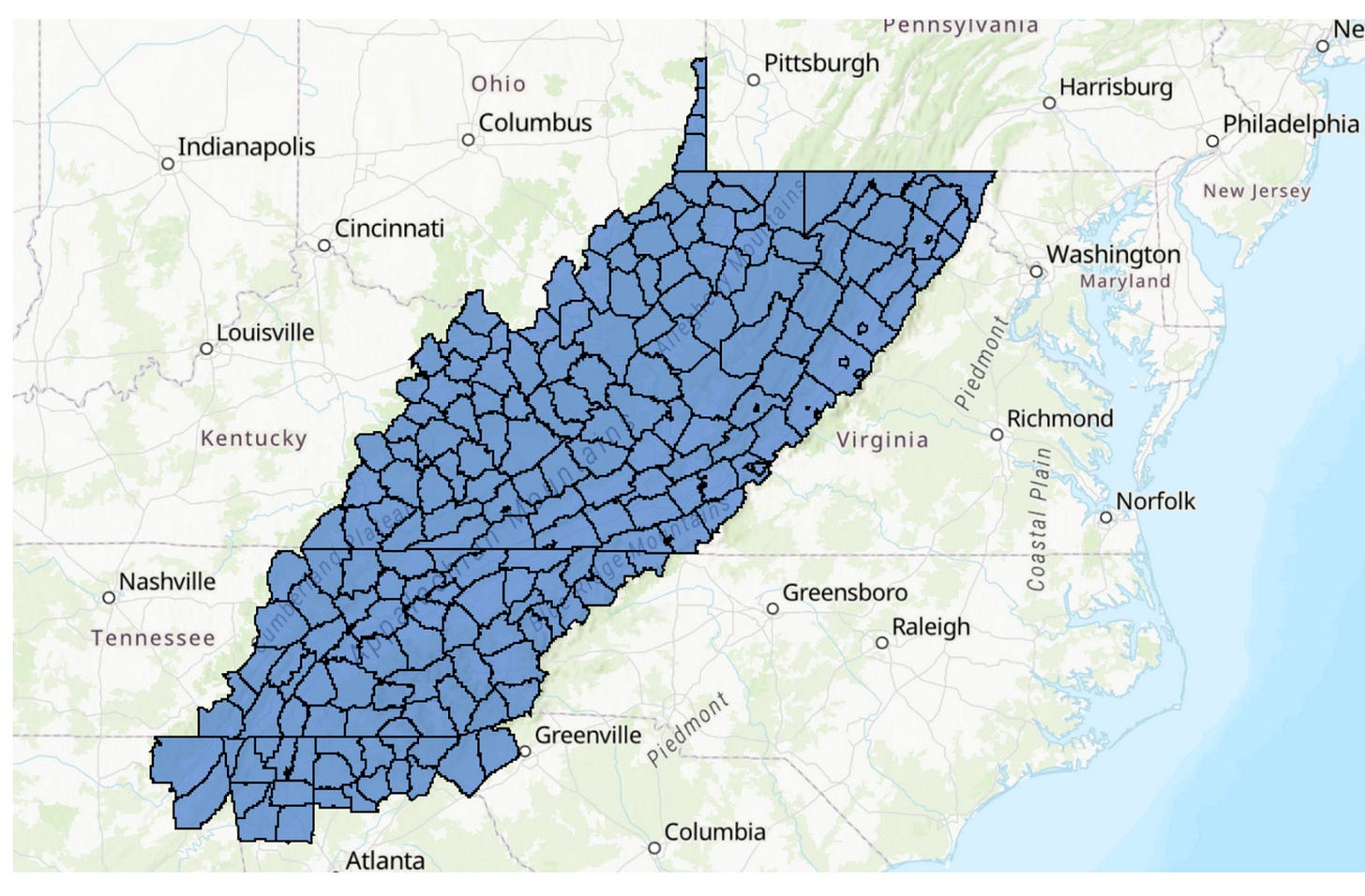
Notes: Map shows the Williams Consensus Definition (modified by Scales et al.). Map itself is from Scales et al.’s Mapping Appalachia web site.
The Calcification of a Republican Appalachia
Now that the definitions are out of the way, let’s get to the meat of it.
Figure 1 shows the percent of the Republican two-party vote share from Appalachian counties (solid line) and non-Appalachian counties (dashed line). In 2000, the average county in Appalachia was indistinguishable from the average county in the rest of the country—a difference of just .1 percentage point. Over the course of the next six Presidential elections, the gap grew. By 2024, the average Appalachian county gave 77% of its two-party vote share to Donald Trump, as compared to 67% in the average county outside of Appalachia—a 10 percentage point gap.2
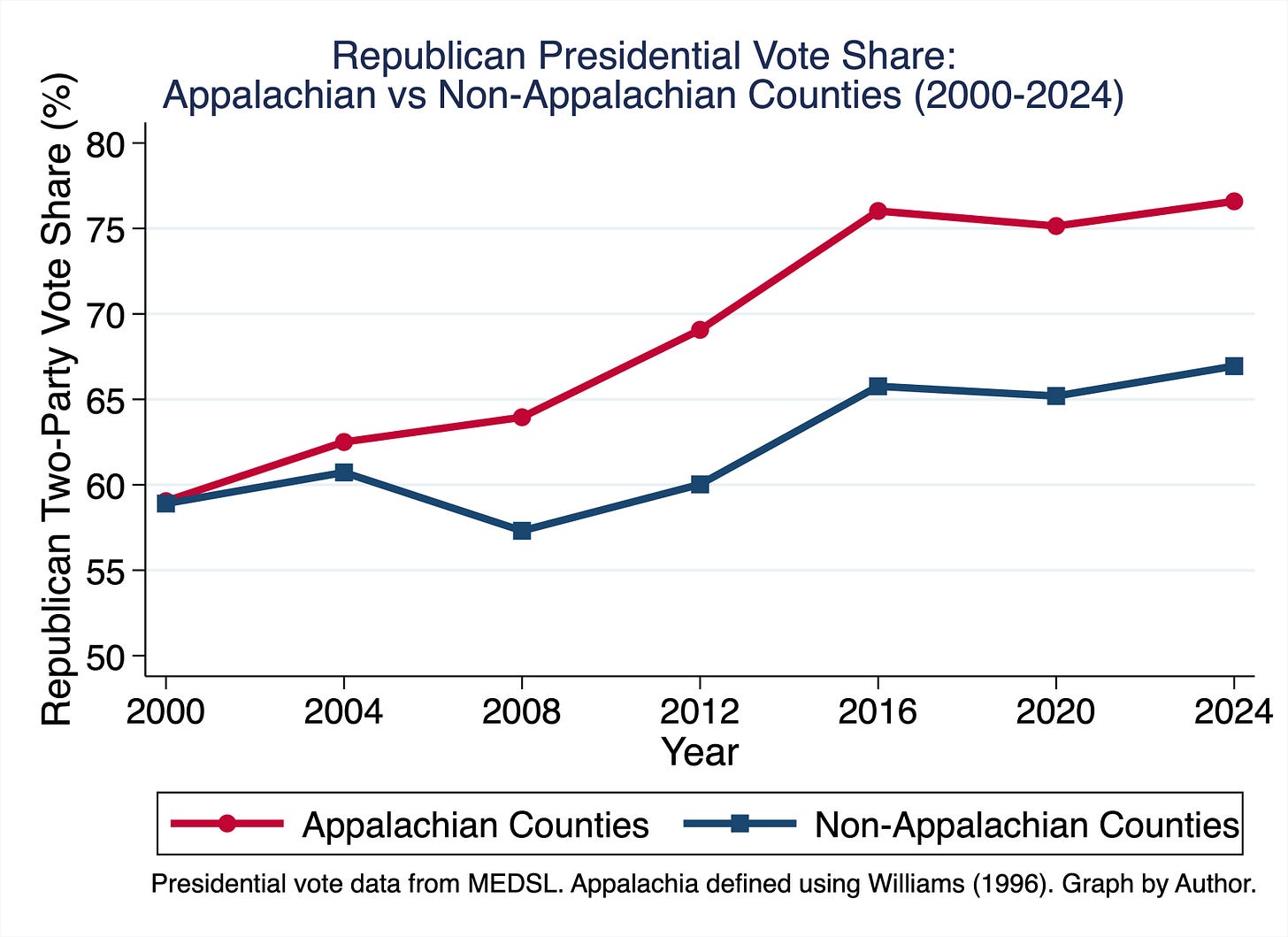
The rise in Republican support isn’t limited to a small number of places. Of the 214 counties defined as Appalachian, all but four3 gave the majority of their votes to Donald Trump in 2024.
In terms of trends, 203 counties—95 percent—moved toward the Republican Party from 2000 to 2024. The average shift was 18.6 percentage points, with a median shift of 17 percentage points. Four counties—Grundy, TN; Mingo, WV; Knott, KY; and McDowell, WV—shifted more than forty (!) percentage points in the Republican direction. Every Appalachian county in Kentucky, Tennessee, and West Virginia has become more Republican since 2000.
It’s not just that Appalachia isn’t voting for Democrats, it’s that—outside of a handful of fast-growing counties—that shift shows no signs of reversing.
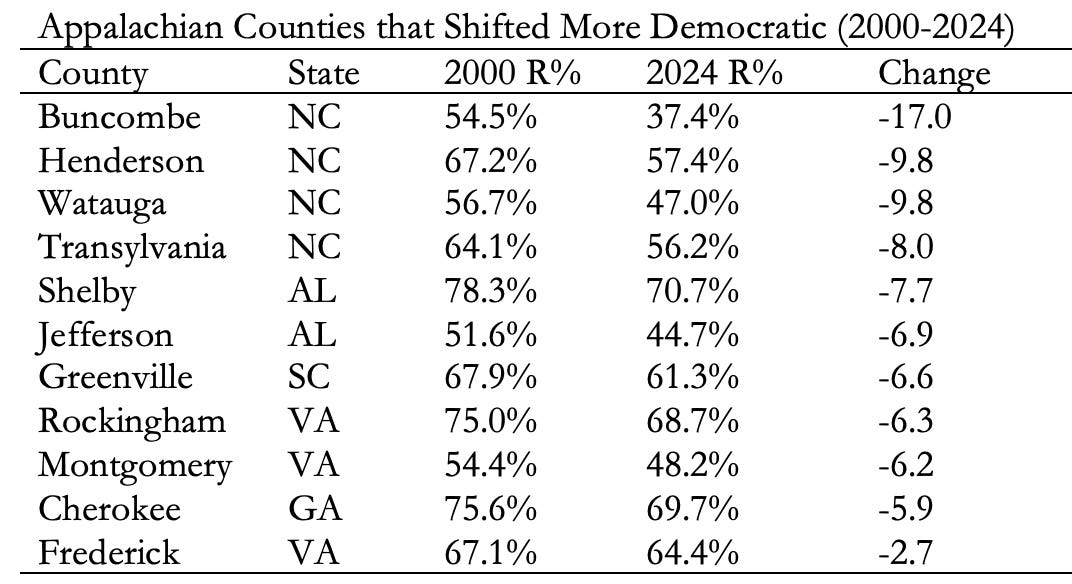
Examining the 11 counties that bucked this trend also reveals some important trends.
Every Appalachian county that shifted towards the Democratic party experienced significant population growth in this period. For example, Greenville (SC), Cherokee (GA), Frederick (VA), and Rockingham (VA) had at least twice as many voters in 2024 as they did in 2000. There was also growth of between 70 and 80 percent in the number of votes cast in Buncombe (NC), Shelby (AL), Henderson (NC), Watauga (NC), and Montgomery (VA) counties.
So what?
Republican dominance in Appalachia isn’t just a fun factoid, but an important determinant of national politics.
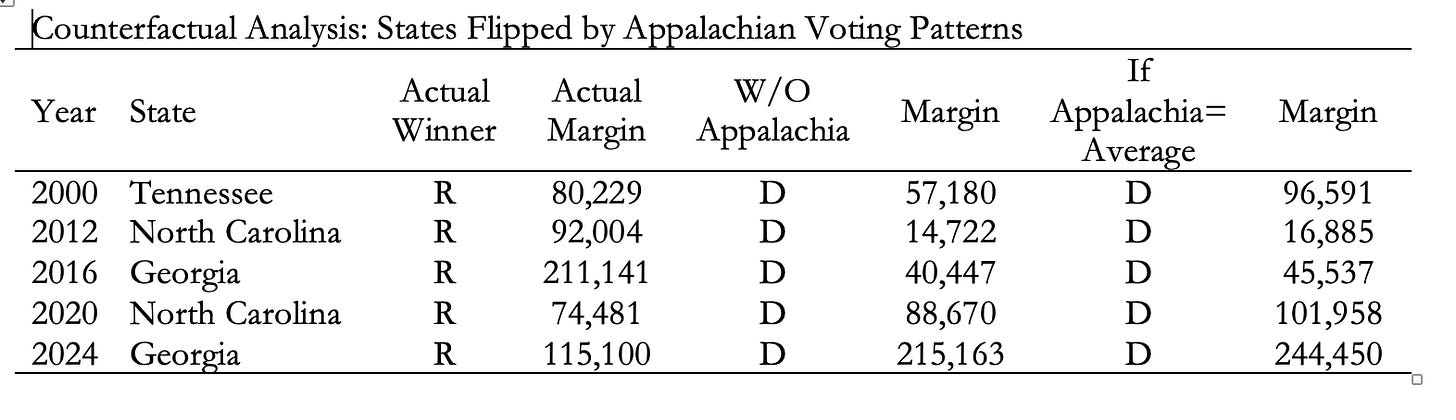
Let’s start with the presidency. If the Democrats had been able to mute Republican gains in Appalachia in 2012 and 2020, North Carolina would have supported Barack Obama in 2012 and Joe Biden in 2020. If voting patterns in Georgia’s Appalachian counties had matched the rest of the state, Georgia would have given all of its electoral college votes to Hillary Clinton in 2016 and Kamala Harris in 2024. And if Al Gore, Jr. had matched his performance in the rest of Tennessee in the Appalachian counties, he would have won Tennessee in 2000—and the Presidency.
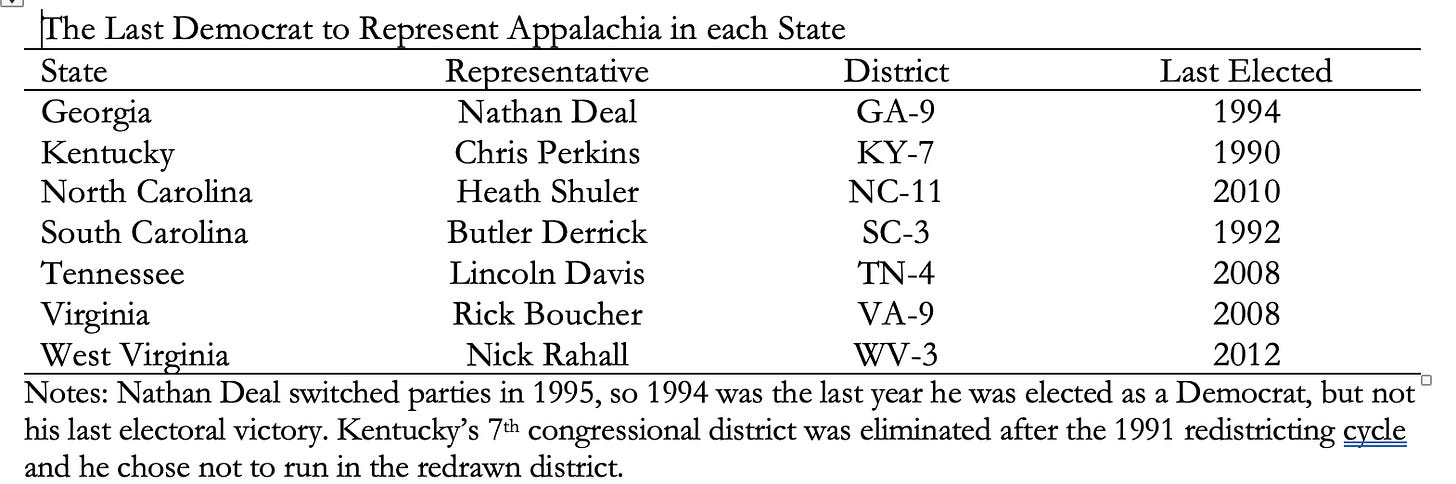
Let’s consider Congress. The Republicans control congress by a narrow 4 seat margin (218 to 214). The Republicans also control every congressional seat that includes substantial portions of Appalachia. As the table below demonstrates, a Democrat has not represented a district covering a substantial part of Appalachia since Nick Rahall was last elected as a Democrat in West Virginia in 2012.
A more competitive Appalachia for Democrats could mean a Democratic majority in Congress.
Hope for Democrats?
There’s not a lot of hope for turning things around for Democrats in Appalachia—at least in the near-term. The combination of slow economic growth, stagnant (or worse) population growth, and a large proportion of White voters has created a perfect recipe for Republican growth and Democratic decline in most of the region.
The best hope for Democrats in Appalachia is in Western North Carolina's 11th congressional district, where population growth in counties like Buncombe, Henderson, and Transylvania4 has created some opportunities for Democratic gain—at least in the areas around Asheville.
As a result, the Democratic Congressional Campaign Committee (DCCC) just named NC-11 and Democrat Jamie Ager (who has not yet won the primary) to its “Red to Blue” list. If Ager pulls off a victory, he will be the first Democrat to represent Appalachia since the Obama Presidency.
But even if this (possible, but certainly not probable) outcome occurs, it won’t solve the Democrats' Appalachian problem.
Until the Democrats can find a way to reach Appalachian voters outside of Western North Carolina, they will continue to have trouble in congressional and Presidential elections in this key region of the country—trouble with national implications.
Stuff that Works
My wife Jessie Swigger is a brilliant scholar of public history who avoids social media and self-promotion the way a celiac avoids a fresh baguette. She’s got a new book out with the University of Massachusetts Press called Please Touch. It’s a history of the first children’s museums and it’s terrific. If you’ve ever found yourself in a children’s museum (as a kid or a parent) and wondered where these things came from, check it out. Yes, I’m biased, but in this one instance, I’m also correct.
Had a great time on Charlotte Talks yesterday talking about the Primary with Mike Collins and Bryan Anderson. Struck me while I was on there that the producers of Charlotte Talks (and shows like it) don’t get nearly enough praise for all they do to make the shows happen. So, big thanks to Sarah Delia!
I was recently re-reading the history of how and when North Carolina abandoned the May primary in favor of a March primary. In brief, the North Carolina General Assembly temporarily moved our primaries to March in 2016 and then voted in 2017 to permanently move them to March, but the law delayed that action until 2019, so the 2018 primary was still held in May. Oh, and the 2022 primaries were moved to May as a result of court-ordered redistricting. But now we’re back to March, unless the Democrats are successful in their attempt to move our date earlier. Clear as mud, huh?
Early voting turnout in North Carolina is running about 30 percent ahead of the same day in 2022 and 16 percent ahead of the same day in 2024. Michael Bitzer has the details.
Defining the boundaries of Appalachia will, no doubt, be the most controversial part of this post.
I posted a version of this graph on social media last week and a smart reader/scroller asked what happens if we weight counties by population (therefore, not treating Graham County, NC the same as Buncombe County, NC, for example). The story isn’t quite as dramatic, but it’s basically the same take-home message. No matter how you measure it, Democrats are in trouble in Appalachia.
Buncombe County, NC, Jefferson County, Kentucky, Watauga County, NC, and Montgomery County, VA are the four. There are also some independent cities in the Virginia portion of Appalachia, but as far as the counties, that’s the full list.
Buncombe, Henderson, and Transylvania Counties are the first, second, and fourth biggest Democratic gainers in Appalachia.
