by Christopher Cooper
People often assume that decisions about voting are made in legislatures or courts—and many are. But many other critical decisions about voting are made not by these elected bodies but by appointed ones. For example, all 100 county boards of elections are currently deciding where to place early voting sites for the 2026 General Election.
Often these decisions are not particularly controversial. For example, in the 2026 primary, 88 county boards came to unanimous agreement. In the cases where the board disagrees, the decision then moves to the state board of elections where it’s a bit more controversial.
One of the more controversial decisions is happening in my home county of Jackson. While local and state journalists are doing an excellent job covering the story, the players, and the consequences, I thought I’d offer a complementary perspective based on my expertise as a political scientist who studies, among other things, state politics and elections.
Background
In 2016, a Republican majority on the five-member Jackson County Board of Elections voted unanimously to add an early voting site in the University Center on the Western Carolina University campus, leaving two sites with a Cullowhee address—the other being the Jackson County Recreation Center in Cullowhee.
From 2016 to 2024, the site didn’t draw much attention or controversy. Then, in Fall 2025, the Republican majority on the Jackson County Board of Elections voted to move to just one site in Cullowhee for the 2026 primary, eliminating the site at WCU. The North Carolina State Board of Elections, which has the final say on disputed early voting plans, voted to implement the majority plan
But decisions about where to place sites must be re-upped for every election, meaning that the board needed to decide about early voting locations again—this time for the 2026 General Election.
In Jackson County, those decisions have been controversial—and have even come with accusations of influence and pressure by “outside actors.”
For example, a week before the meeting to determine early voting locations, Republican Wes Hanemayer resigned from the board. Kyle Ingram at the News and Observer obtained the resignation letter, in which Hanemayer claimed that “his ‘moral position’ had been called into question by unnamed entities outside the board. ‘That is where I draw the line,’ he wrote. ‘If third parties feel they can demand that I take a completely illogical path, that means they are convinced they have control. With that being a clear conflict of conscience I choose not to be part of the (Jackson County Board of Elections) and submit to their control.’”
After Hanemayer’s resignation, there were then just four board members when the board met to discuss early voting sites—two Republicans and two Democrats. Ultimately, three board members voted for there to be one site in Cullowhee—neither at the Recreation Center or at the University Center at WCU, but rather in the Health and Human Sciences Building across the street and down the road from the “main campus.” Thompson, the board chair, was the lone dissenting vote and supported keeping the site at the Recreation Center.
In an interview with NC Local’s Lilly Knoepp (who attended the meeting), Thompson said “I told them I’d hold the line. They asked me. I said, ‘Okay, I’ll do it.’ And I did. And local party as well. I’m not a happy camper.”
Knoepp also reported that Republican Jay Pavey voted for the Health and Human Sciences Building. “My vote is not for a party. It’s not against the party. It is for the residents of Jackson County. I am convinced beyond a shadow of a doubt that the HHS is the better facility” said Pavey.
In an interview with WLOS’ Taylor Thompson, State Auditor Dave Boliek, whose office oversees election administration in North Carolina, offered his perspective, stating, “We expressed concern to the board chair over the elimination of the Rec Center.” According to WLOS’ Thompson, “Boliek maintained there was nothing inappropriate about sharing his opinion.” “This is about efficiency and common sense,” Boliek said. “It’s more efficient in my view to have the early voting site at the recreation center.”
As with all non-unanimous decisions, the ultimate decision about early voting sites in Jackson County will now move to the North Carolina State Board of Elections.
Before continuing with the specifics of the Jackson County case, it might be helpful to step back and assess what we know about the efficacy of voting sites on college campuses.
What Does the Evidence Tell Us About College Campus Voting Sites?
In a previous post, I review some evidence finding that the site: (1) serves a steady number of voters in every election—and the voters it serves are more diverse and younger than the average Jackson County voter, (2) increased youth early voting turnout in the county, (3) increased same day registrations in the county, (4) did not shift the electoral outcomes in the county towards the Democratic party.
These findings are consistent with other studies of college campus voting sites finding that placing a site on a college campus has a positive effect on youth voter turnout.
College student voting sites are also quite popular. Using survey evidence from a March 2026 Catawba-YouGov survey, Political Scientist Michael Bitzer shows that about 58% of North Carolinians support college campus voting sites, only 14% oppose, and 80% believe that making it easier for college students to vote is important. Supporters outnumbered opponents among Democrats, Republicans and Independents. Sometimes this is assumed to be a partisan issue, but even among Republicans, supporters (42%) outnumbered opponents (29%), and 76% of all respondents said campus voting sites are either fair or neither fair nor unfair to non-student voters.
These Sites Are Different Than They Were Before
Here’s where things get really confusing. From 2016-2024, the two early voting sites in Cullowhee were at the University Center on the WCU campus and at the Cullowhee Recreation Center. This time, the majority plan (2 Democrats and 1 Republican) are advocating for the Health and Human Sciences Building and minority plan (1 Republican) supports the Cullowhee Recreation Center.
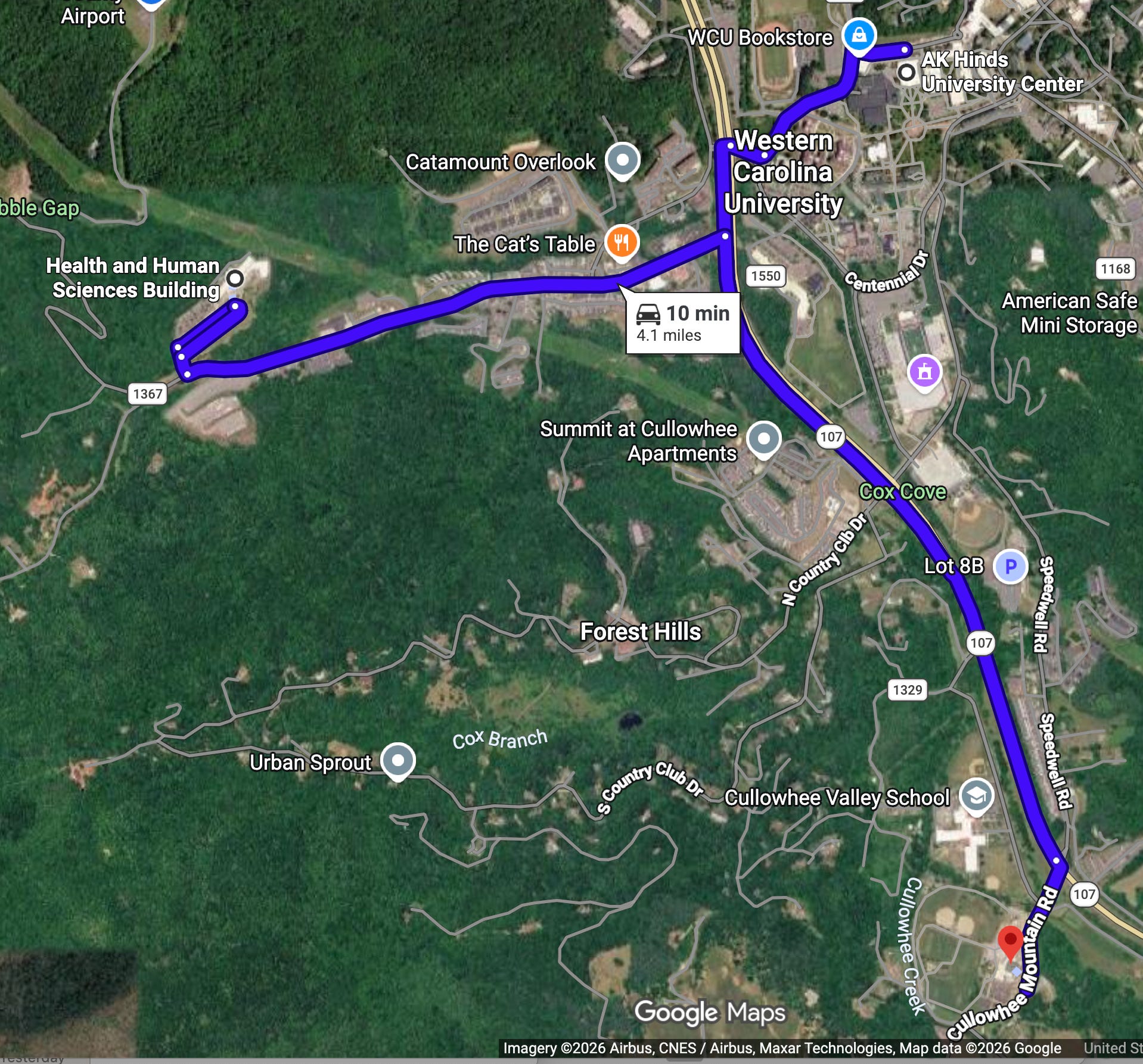
As you can see from the map below (copied and pasted from Google maps—nothing fancy), the Health and Human Sciences Building is technically on campus, but it is not particularly close to the central part of campus. It is located 1.6 miles from the University Center—across a major road (highway 107) and down another road with sidewalks only going part way.
The Cullowhee Recreation Center (red dot on the bottom right) is located 1.7 miles from the University Center. And while it has been used in every election since early voting began, it is a different place than it used to be. A few years ago, the county added a pool and revamped the fields. As a result, the building has gotten much more use. On weekdays there’s almost always plenty of parking; on Saturdays it can be tight.
Precincts Are Not the Same as Early Voting Sites
I’ve seen a few folks commenting on social media about the “Cullowhee precinct”— alleging that because that precinct is bluer than the other precincts in Jackson County that putting more sites in Cullowhee will lead to more Democratic-leaning election outcomes.
That’s just not true.
During the early voting period, voters can cast their vote at any site in the county—regardless of their precinct. In the 2024 election, about 27 percent of people who cast a vote at the site on Western Carolina University’s campus and over half (53 percent) of people who cast a ballot at the Cullowhee Recreation Center live in a different precinct.
In a small, rural county like Jackson, many people (blue collar, white collar, Democrat, Republican, young, old) cast their vote at the campus site or at the Cullowhee Recreation Center not because they live in Cullowhee, but because they work or recreate in Cullowhee.
If folks want to make that argument about election day voting, it holds water. For early voting, it does not.
What Happens Now
At this point, the decision about the location and number of early voting sites in Jackson County is in the hands of the State Board of Elections. The majority Republican board can decide to accept the majority position (one Cullowhee site at Health and Human Sciences), accept the minority position (one Cullowhee site at the Recreation Center) or go another way entirely.
In cases of disagreement, when county boards split along partisan lines, the state board — which shares the same partisan makeup as the county boards — typically adopts the majority plan.
But Jackson County presents an unusual wrinkle—one Republican seat is vacant and the Republican votes were split, so the minority plan is held by the Republican board chair. This makes the outcome more difficult to predict.
Statutorily, every county must have one site at the County Board of Elections (or nearby equivalent) but after that, they can do, essentially, anything they want.
Although they have a wide purview, the NCSBE is likely to keep the other sites in Jackson County constant (there is no disagreement about those). As for Cullowhee, in addition to adopting the majority or minority plan, there is always the possibility that they could simply go back to the two site plan for Cullowhee (one at the Recreation Center and one at the University Center at WCU).
Andy Jackson of the John Locke Foundation concluded that the two site solution might be the best one. According to Jackson, “Like most compromises, it would likely satisfy no one but is the best option available.”
The State Board will make its decision sometime late this summer. And, although Jackson County may be receiving most of the headlines at the moment, it likely won’t be the last county whose decisions on early voting sites generate controversy and headlines.
Such is the nature of politics in a purple state.
----
Chris Cooper is Madison Distinguished Professor of Political Science and Public Affairs and Director of the Haire Institute for Public Policy at Western Carolina University.
