by Christopher Cooper
At the beginning of the academic year, I got a poster-sized version of the United States Congressional districts printed out for my office. It wasn’t long before it was out of date.
Rather than pay to print a new map with every mid-decade redraw, I started to add sticky notes to the map, indicating, for example, that the Republicans in Texas had picked up five seats or that the Democrats in Utah had picked up one.
My makeshift map represents a pretty common way to think about redistricting—we add up Republican and Democratic gains to get a sense of how the current redraw will favor one party or another.
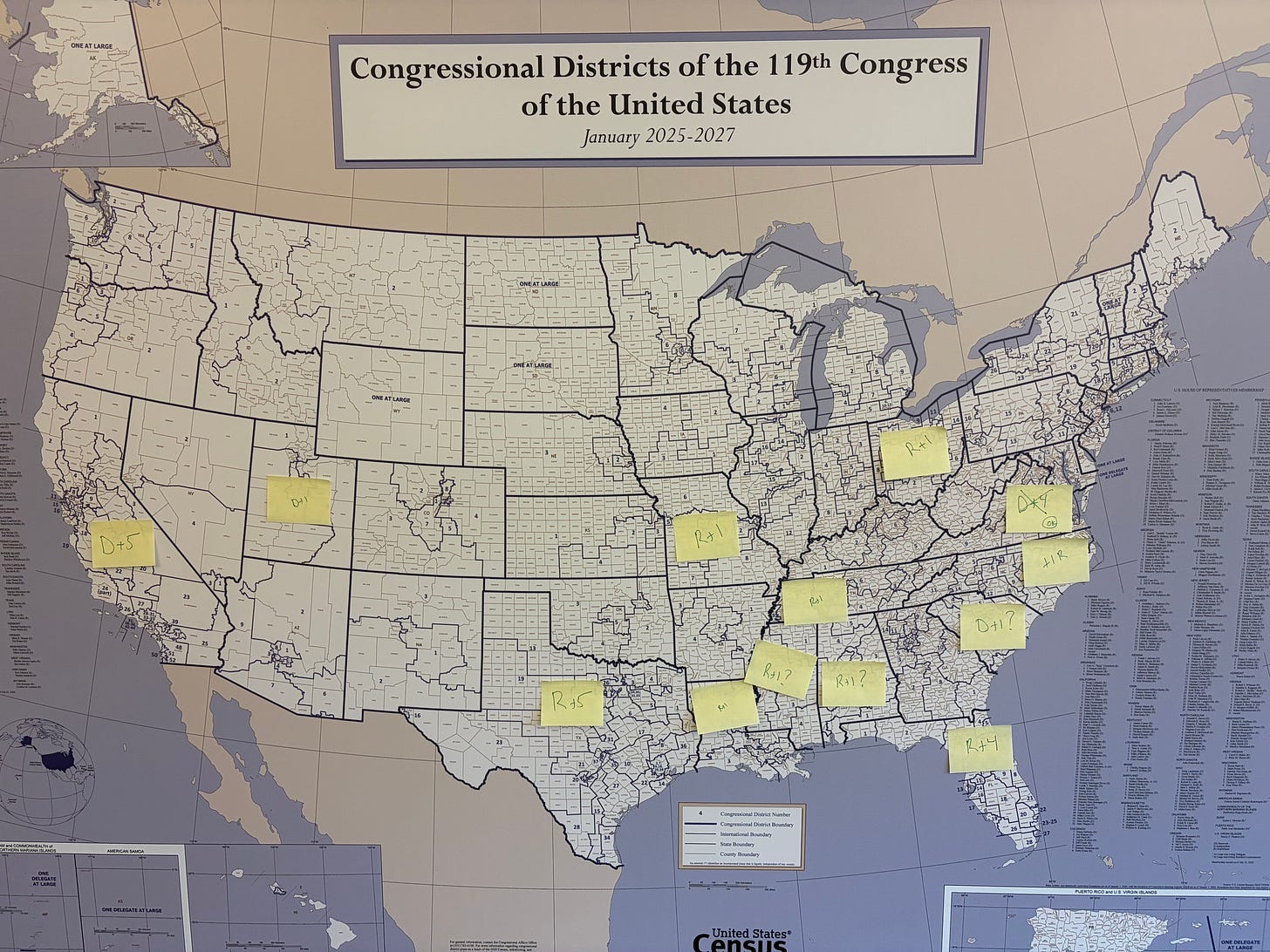
The problem is that electing members of Congress isn’t all that congressional districts do. Every time we redraw lines—as they’ve done in California, Texas, Utah, North Carolina, Ohio, and Missouri, as they are threatening to do in Louisiana, Mississippi, Alabama, and South Carolina, and as they tried and failed to do in Virginia—a lot more changes than just changing who votes in which district and who is likely to be elected.
I am not alone in noticing this. In 2020, Professor Derek Muller published a piece in the St. Louis University Law Review, where he argued that redrawing congressional lines alters “far more than the composition of the House of Representatives. And when they redistrict, legislators ought to think more seriously about how their redistricting can affect many other regimes in the United States.” “Congressional districts,” according to Muller, “can function like a chameleon—take a given law, or even a non-legal practice like a scholarship award, and the congressional district is there, with the hue to fit whatever regime may govern.”
Every tweak of the map increases the confusion voters experience, and the alienation they feel toward the entire enterprise of democracy. After all, the whole point of representative democracy is that people know who represents them, assess their performance, and then reward or punish them at the ballot box—all of which are less likely when a person’s district has been redrawn.
Sure, this “folk” theory of democracy is too stylized and unrealistic, but it at least gives us a model to subscribe to. And I can’t imagine anything more antithetical to that idea than the current tit-for-tat redistricting wars.
The negative downstream effects of redistricting aren’t even restricted to the relationship between people and their members of Congress. In two states (Maine and Nebraska) Presidential electoral college votes are determined by congressional lines. Every time the lines shift in those states, so does each person’s weight in electing the next President. Speaking of those electors, in some states, such as Washington, Minnesota, and Colorado, state parties also choose the electors themselves by congressional districts.
Redistricting also reshapes the parties themselves. For example, in North Carolina, both parties are organized around congressional districts—including chairs, secretaries, treasurers and the like. Those must be shuffled in every redraw—leading to more confusion about how people get involved in grassroots politics.
The consequences aren’t even limited to politics, but can extend to parts of life so far afield as college acceptance. As Muller points out, each member of Congress nominates up to five candidates to West Point, Annapolis, and the Air Force Academy—changes to the congressional lines alters who gets those precious nominations and who does not. College scholarships in some states are also determined by congressional districts.
In North Carolina, the North Carolina School for Science and Math determines acceptance by congressional districts. When a city like Greensboro is cracked into multiple districts, it increases the odds that Greensboro will be overrepresented at the NCCSM and that rural people and places may be drawn out of the opportunity to attend one of the best high schools in America.
In the end, we are right to pay attention to what this tit-for-tat redistricting war will do for the partisan composition in Congress and I’ll continue with my highly technical sticky note system on my map. But our attention—and concern—shouldn’t end there. Congressional districts organize many parts of public life. And the downstream effects of near-constant gerrymandering will have ramifications that extend beyond partisanship.
Other Items from this Week
Callais: Writing for the majority in the Callais case, Justice Alito wrote that “Black voters now participate in elections at similar rates as the rest of the electorate, even turning out at higher rates than white voters in two of the five most recent Presidential elections nationwide and in Louisiana.” A terrific new piece in the Guardian, which leans heavily on work by political scientists Kevin Morris and Michael McDonald, demonstrates why this statement is incorrect.
Virginia: Late last week, the Virginia Supreme Court ruled that the vote to change the state’s congressional maps and temporarily abandon the redistricting commission was unconstitutional. As predicted, the decision was focused on procedure and not the legality of gerrymandering itself. As I noted on April 29, “Anyone who listened to the debate hoping to hear discussion of the legality or ethics of partisan gerrymandering was disappointed. Instead, the arguments centered around the definitions of the words “election” and “session.” If the new maps are struck down, it will be on procedural grounds.”
And, that’s just what happened.
But now the Democratic Party is playing with the idea of putting in a 54 year old age limit on Virginia Supreme Court justices. If this became law, the theory goes, the current State Supreme Court justices who are 55 and above would be summarily fired and the Virginia state legislature could appoint new justices who would then overturn the ruling and the new gerrymandered maps would become law.
This is a dangerous idea.
Democrats in Virginia don’t have to like the opinion. They can appeal to the U.S. Supreme Court. They can work on the procedural issues and call for another vote in 2028. But kicking out judges because they disagree with their opinion would be a direct challenge to judicial independence.
The Bright Line Watch, a group based out of Dartmouth that “brings together a group of political scientists to monitor democratic practices, their resilience, and potential threats”, has asked experts for years whether “the elected branches respect judicial independence.”
Answering no is a sign of a deteriorating democracy.
