"To blog, rather than to seem": a public scholarship blog that focuses on North Carolina politics and other random political ramblings regarding the politics of the U.S. South and and the United States. Sponsored by Catawba College's Center for N.C. Politics & Public Service. #ncpol #ncga #ncgov
Wednesday, October 15, 2025
Meet the New Maps, Same As the Old Maps
Monday, October 13, 2025
In the words of The Joker: "And here we go..." yet again with NC redistricting
By Michael Bitzer
Fall breaks on college campuses are suppose to be quiet ones—students away, faculty getting some rest as well, all with the oncoming rush to the end of the semester looming ahead.
Well, at least on this Monday of Catawba’s fall break, news decided to interrupt that R&R with word that state legislative Republicans would follow the calls of their party leader and redistrict North Carolina’s congressional map to create “at least one” Republican pick up from the Old North State.
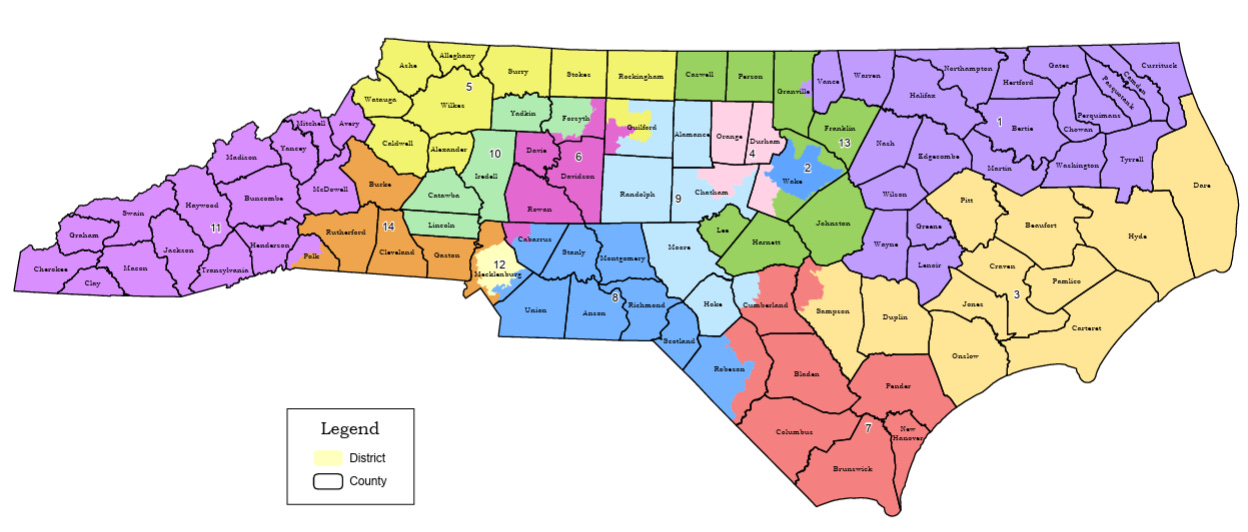
The GOP leaders’ announcement focused on trying to build some cushion in next year’s mid-term elections with shifting a map that is currently 10-4 Republican to 11-3. And the likely target will be the First Congressional District, located in the northeastern portion of the state with Democrat Don Davis. It’s a very 50-50 district currently (located in the upper northeastern portion of the state and ironically colored purple in the below map), with Davis having won with 49.5 percent of the vote in 2024.
Tuesday, August 26, 2025
Tit for Tat gerrymandering wars won’t end soon – what happens in Texas and California doesn’t stay there
Tit-for-tat gerrymandering wars won’t end soon – what happens in Texas and California doesn’t stay there
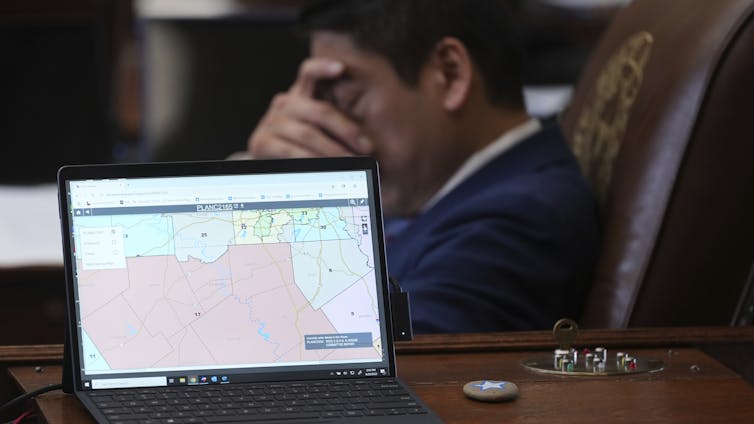
Congressional redistricting – the process of drawing electoral districts to account for population changes – was conceived by the Founding Fathers as a once-per-decade redrawing of district lines following the decennial U.S. census. Today it has devolved into a near-constant feature of American politics – often in response to litigation, and frequently with the intent of maintaining or gaining partisan advantage.
Monday, August 25, 2025
A Napoleonic moment in American Politics?
By Michael Bitzer
Of course, it can’t be a Monday morning without another crashing headline to start the week in politics. And this one gave me a pause to a past survey question that explored a concerning principle.
While in the Oval Office this morning, President Donald Trump was speaking about sending the military into American cities, and said the following:
Set aside if we can take his word that “he is not a dictator,” as soon as I saw this clip, I thought about a February tweet the president issued and a subsequent question that I had on the March 2025 Catawba-YouGov Survey of 1,000 North Carolinians.
Within a month of taking office, Trump sent out the following tweet:
This sentence is attributed to Napoleon Bonaparte, who created the Napoleonic Code of civil law before declaring himself emperor of France.
Monday, August 18, 2025
Trump Calls Mail Voting Unsafe. Actual Data & Opinion Shows North Carolinians Think Otherwise.
By Michael Bitzer
Just when you think it will be a quiet Monday morning before the start of classes in forty-eight hours, the President of the United States sends out a statement that nobody was expecting, attacking a particular vote method that North Carolina voters have utilized as one of three methods to casting a ballot.
Here's the full statement by the president attacking mail-in ballots, along with many other aspects related to election administration.
If you ask anyone who studies election administration and voting processes, you will get some very pointed pieces of information to the above statement:
Tuesday, August 12, 2025
Who is a Candidate for Office? The Answer is More Complicated Than You Might Think
by Christopher Cooper
On January 15, 2025, Andy Nillson announced that he would be a Republican candidate for United States Senate. On August 9, he suspended his campaign, noting that President Trump's "complete and total" endorsement of Republican Michael Whatley, "played a central role" in his decision.
Two weeks earlier, Democrat Wiley Nickel suspended his campaign for the Democratic side of the United States Senate race just a day after former Governor Roy Cooper entered the race.
Although all of these changes may seem odd (why would you declare and then pull out?), it's all completely normal. People routinely come in and out of candidacy at this point in the campaign season as part of what political scientists refer to as the "invisible primary." As distinct from the actual primary where voters have a direct say, no votes are cast in the invisible primary and the voters themselves may have no say so at all.
Sunday, August 3, 2025
85% of NCians Believe It is Important that Government Statistics Shouldn't Be Politicized
By Michael Bitzer
On Friday, August 1, after what most described as a lackluster employment report from the U.S. Bureau of Labor Statistics that showed only 77,000 jobs were added to the economy, with the unemployment rate at 4.2 percent, President Donald Trump directed that the BLS commissioner, who oversees the data gather and statistics reporting, be removed.
In doing so, Trump stated "'In my opinion, today’s Jobs Numbers were RIGGED in order to make the Republicans, and ME, look bad.'"
Government statistics and data have traditionally been seen as apolitical--collecting and reporting as best as the government agency can, with traditionally adjustments with further data provided to previous months. A core belief is that government-researched and produced data is free from political influence.
Friday's BLS Employment Situation Summary report is one of thousands of government reports that track a variety of topics and issues in American society, produced typically by non-partisan experts and provided to the public and policy makers to help inform, understand, and ground debates around facts.
In its Survey of American Democracy, the June 2025 Catawba-YouGov Survey of 1,000 North Carolinians asked about the importance of a variety of principles to American democracy, one of them being how North Carolinians viewed the importance of "Government statistics and data are produced by experts who are not influenced by political considerations."
Friday, August 1, 2025
It's Show Time in NC: Whatley vs. Cooper for the U.S. Senate
By Susan Roberts
As my colleagues at the ONSP Blog have written and observed, North Carolina’s U.S. Senate race will turn out to be hugely expensive, perhaps the most expensive in the country if history repeats itself. One of many questions to ask is: are the candidates diametrically opposed and in what ways? Here are some ways that I’m considering how this critical race will play itself out heading towards November 2026.
The Midterm Cycle Divide
Characteristics of midterm elections are widely recognized. Turnout is routinely lower, while voters of higher socioeconomic classifications tend to dominate. In general, mid-term voters are most often strong partisans and highly attuned to politics. Most political scientists, journalists and pundits would agree that midterms can be seen as a referendum on presidential performance, measured primarily by the number of seats won or lost by the party of the sitting president.
Wednesday, July 30, 2025
Excerpt from forthcoming "Almanac of American Politics" on North Carolina
Special Contribution from Louis Jacobson:
For more than five decades, the Almanac of American Politics has set the standard for political reference books. In September, the Almanac will be publishing its 2026 edition, with more than 2,000 pages offering fully updated chapters on all 435 House members and their districts, all 100 senators, all 50 states and governors, and much more.
Below are excerpts from the new chapters in the 2026 Almanac on the state of North Carolina and Gov. Josh Stein, written by Louis Jacobson. Jacobson — a senior correspondent for PolitiFact, a senior columnist for Sabato’s Crystal Ball at the University of Virginia Center for Politics, and a contributor of political coverage for U.S. News & World Report — has written for eight editions of the Almanac since 2000. For the 2026 edition, he served as chief author.
Readers can receive a 15% discount if they purchase the new Almanac at its website and use the code ONSP2026 at checkout.
NORTH CAROLINA:
Few states have more political polarization between rural and populated areas than North Carolina does—and few states have margins between the two major parties so consistently narrow. But for several election cycles running, Republicans have come out ahead in federal races, although in 2024 Democrats put up stronger performances in downballot races.
Monday, July 28, 2025
Now That Roy's Runnin'...What's His Electoral Coalition Like?
By Michael Bitzer
In the midst of this heat wave, things are officially heating up in North Carolina politics.
This morning, former Democratic governor Roy Cooper finally put to bed all the speculation and anticipation by formally announcing his run for the open U.S. Senate seat in the Old North State.
Much analysis will be made over the coming days, weeks (heck, even months to November 2026), but I thought I would add to the discussion the "Cooper-electoral advantage": the strengths he appeared to demonstrate in 2016 and 2020 and that many Democrats hope he brings to 2026.