by Christopher Cooper
“Freedom’s just another word for nothing left to lose.” - Kris Kristofferson
Two Democratic members of the North Carolina House —Carla Cunningham and Nasif Majeed—recently changed their party registration from Democrat to Unaffiliated. With these switches, Cunningham and Majeed became just the third and fourth members of the General Assembly to serve under the Unaffiliated label and the 10th and 11th legislators to switch party while they are in office.
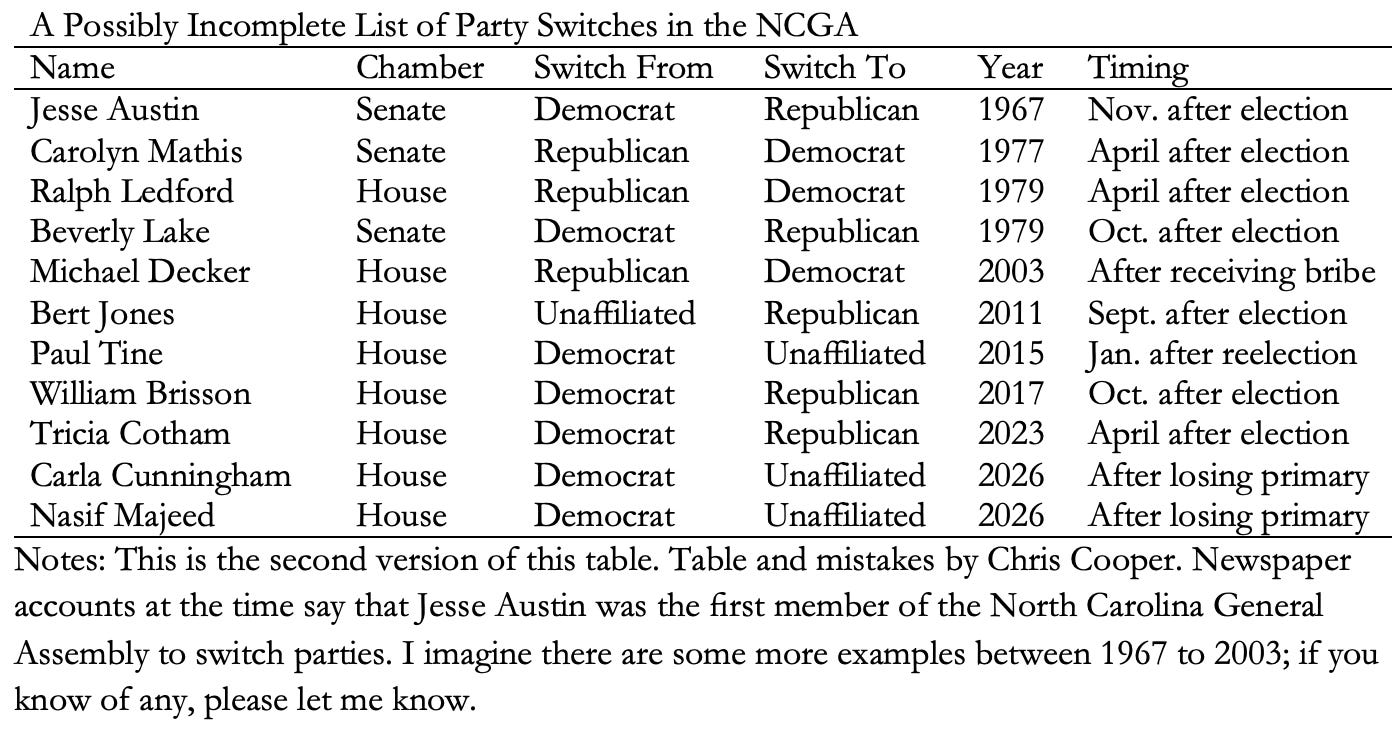
A lot has been made about these switches and to some degree, that makes sense. It’s historic whenever any sitting legislator switches parties.
At the same time, unlike the switches of Cotham in 2023 (which gave the Republicans a supermajority for the better part of an entire term1) or Decker (which produced a tied House and a co-speakership arrangement), Cunningham and Majeed’s defections don’t really signify any big changes in the Democratic Party or in legislative voting patterns to come.
This is because they are lame ducks—the only lame duck party switchers I can find in the history of the General Assembly.2 And they are lame ducks precisely because they consistently bucked the will of the Democratic Party by voting with the Republicans and voting to override Governor Stein’s veto.
Cunningham, for example, has voted with the Republican majority 84 percent of the time this session—the most of any Democrat in the North Carolina House. Readers may also remember Cunningham’s speech on the floor of the House where she proclaimed that “all cultures are not created equal”—not exactly the kind of person we would expect to vote with the Democrats on issues like immigration.
So, once the Democratic Party and groups aligned with the party successfully defeated Cunningham and Majeed, the surprise wouldn’t be if they switched parties, but rather if they hadn’t.
There are still six pending veto overrides where their votes could make the difference—including one on permitless carry that's worth watching.3 But the party switch is beside the point. They were already the Democrats most likely to vote with the Republican majority, then the Democrats voted them out in a primary. The party switch doesn’t change that.
Switching to Unaffiliated rather than Republican also implies that the switch won’t have them taking a full-throated endorsement of Republican principles. Sure the Republicans have invited them into their caucus but, at least thus far, neither Cunningham nor Majeed have said that they will do so. The radio silence on who they will caucus with is a conscious choice with real meaning. If they were prepared to follow along with Republican orthodoxy, they would have done so.
As a result, their switch is unlikely to mean much in terms of public policy. They were already more apt to vote with the Republicans than most of their Democratic counterparts, regardless of their party switch. Formally leaving the party that worked to defeat them just makes sense.
Sounds like freedom to me.
A Few Other Items and Links
On Monday, the Virginia Supreme Court heard arguments that will determine whether last week’s referendum on congressional maps that would likely bring the state’s congressional delegation from 7 Democrats and 6 Republicans to 10 Democrats and 1 Republican, will stand. Anyone who listened to the debate hoping to hear discussion of the legality or ethics of partisan gerrymandering was disappointed. Instead, the arguments centered around the definitions of the words “election” and “session.” If the new maps are struck down, it will be on procedural grounds.
After the Virginia Supreme Court heard arguments on Virginia’s map, Florida Governor Ron DeSantis released a draft map intended to squeeze four more Republicans out of the Sunshine State. Putting aside for a minute, the merits of this map and whether mid-decade redistricting is a good idea (it’s not), some analysts have already levied charges that it might be a “dummymander.” The Texas map and the Virginia map have been the subject of similar accusations.
The problem is that many people are misusing the word. A “dummymander” is a word coined by Political Scientists Bernie Grofman and Tom Brunell in a book chapter, “The Art of the Dummymander.” According to Grofman and Brunell, a Dummymander is a “gerrymander that, over the course of a decade benefits the other party and looks as if it was designed by that party rather than the party in power.” If Democrats win the four districts the Republicans drew to benefit them, that is not a dummymander. If the Democrats win those four and an additional district or two that were created because the Republican mapmakers had spread their voters too thin, that would be a dummymander.
This may seem like a pedantic point—and maybe it is. But pedantic doesn’t mean unimportant. Even if this mid-decade gerrymandering-palooza doesn’t benefit the mapdrawers in the short-run, they haven’t lost anything unless they’re in a worse position because of the maps they drew. That’s incredibly unlikely. And it’s even more unlikely that that position would hold in 2028 and 2030.
Unfortunately, the incentive is to gerrymander.
Lilly Knoepp has an excellent piece in NC Local about Unaffiliated candidates on the 2026 General Election ballot.
Michael Bitzer and I wrote a bit about the context of Cotham’s switch. I also wrote about it in Anatomy of a Purple State (the book).
It’s harder to generate a definitive list of party switches in the North Carolina General Assembly than you’d think. I searched newspaper archives, checked the indexes of various books on North Carolina politics, asked for tips on social media, and texted friends. Against my better judgement, I even asked Claude and Chat GPT (both of which not only generated no new names, but provided me with names of people who were not in the North Carolina General Assembly). If you know of any other switches that should be on this list, please let me know.
Both were absent for the vote on eliminating DEI in public higher education.
