by Christopher Cooper
We’re a week out from the 2026 Primary in North Carolina, and the dust is settling — slowly. We still don’t know who won the most consequential legislative race in the state and we won’t know who actually showed up to vote until canvass closes and the voter history file drops. But with a little distance, a few things are coming into focus.
Maybe Some Elections Are Still Local (Berger/ Page):
In the most consequential primary in modern North Carolina politics, Rockingham County Sheriff Sam Page leads Senate President Pro Tem Phil Berger in State Senate District 26 (Rockingham & Guilford Counties) by a scant 23 votes.
Neither the remaining UOCAVA votes nor a recount are likely to flip that margin. What happens after that is anyone’s guess. More than $10 million was spent on Berger’s behalf, and it’s hard to imagine some of that money won’t find its way towards a lawsuit.
But let’s step back from the vote-counting details for a moment. Win or lose, the fact that the most powerful politician in North Carolina is in a race this tight must mean something, right?
If voters were responding primarily to national politics, they would have voted for Berger because he came with the Trump endorsement. If they were swayed by state power, they would have voted for Berger because he is the most powerful politician in the state and, if elected, Sam Page will enter as a back-bencher with very little formal power in the institution.
This race is close because of local dynamics—local issues, local relationships, and the turnout patterns they produced.
Consider the political geography: Berger won 68% of the vote in the Guilford County portion of SD-26 and he won 33 percent of the vote in Rockingham County. In a normal election, that would have been enough for a Berger win. After all, there are more registered voters in the Guilford portion of SD-26 than in the Rockingham portion and in 2022, 60 percent of the Republican primary vote in SD-26 came from Guilford.
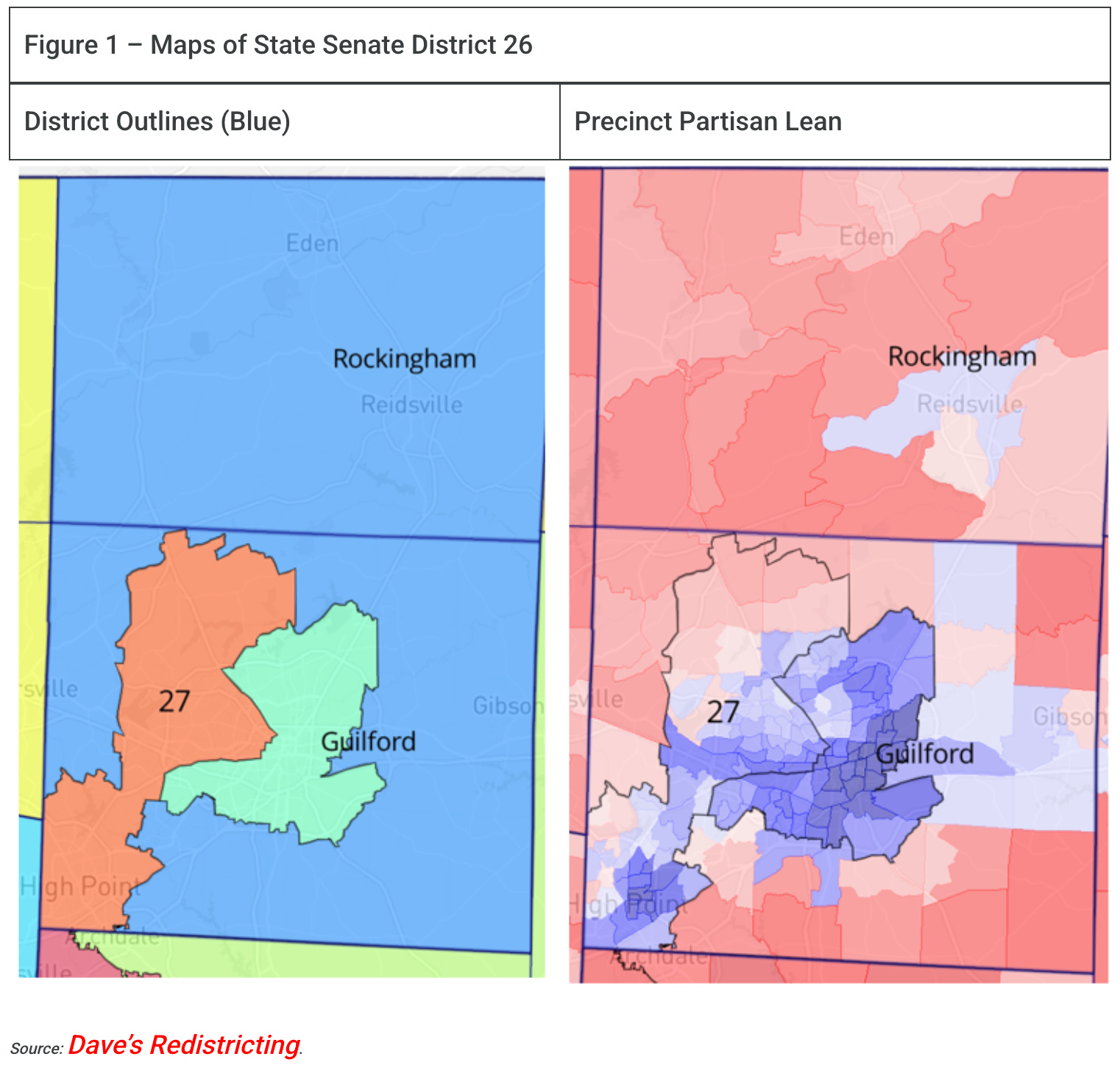
But in 2026, that pattern was reversed—a slight majority (52 percent) of the votes cast in the Republican primary came from Rockingham. If Guilford voters had turned out at the same rates as expected (relative to Rockingham), Phil Berger would be on his way to another term in office.1
A few folks have speculated that perhaps Berger’s lack of success2 is because Democrats in Rockingham County acted as agents of chaos and left the Democratic party for Unaffiliated, just to vote Berger out.
This idea is easy to debunk.
In January and February 2026, there were 64 Rockingham county voters who switched from Democrat to Unaffiliated—46th highest rate of switching in the state (adjusting for the numbers of registered voters). When comparing to previous patterns in previous years, it becomes clear that Rockingham County did not have elevated levels of party switching.3
In the end, the closeness of this race is a reminder that, even in an era of nationalized politics, state legislative primaries can still turn on local dynamics. Relationships and local turnout patterns—what Political Scientist V.O. Key once called “friends and neighbors voting”—still matter, and occasionally they decide who holds power.
Other Republican Losses Were About Local issues As Well
Five other incumbent Republicans lost; those outcomes were also largely about local issues.
After all, some Republican incumbents who were facing well-financed quality challengers like Mike Clampitt (NC-119—Transylvania, Swain, Jackson Counties), and Jake Johnson (NC-113—Polk, Rutherford, Henderson, McDowell Counties), won by sizeable margins. Others, however, like Mark Pless and Keith Kidwell, who had drawn ire from local constituents, were defeated at the ballot box.
At least on the Republican side of the ledger, local politics still mattered in this primary.
Democratic Incumbent Losses Tell a More Unified Story
On the Democratic side of the house, the incumbent losses tell a more unified story. The incumbent members of the General assembly who lost—Carla Cunningham, Nasif Majeed, and Shelly Willingham—were all Democratic members of the General Assembly who sit to the right of their party. In fact, Cunningham and Willingham voted with the Republican majority more than any other Democratic member of the General Assembly.
This is not simply a one cycle strategy for the Democrats. Beginning with the primary defeat of Kirk Deviere in 2022, Democrats who challenged the Governor’s veto have faced tough primary challengers. As I remarked to the New York Times,
“It’s been coming for a while...It’s sort of like pushing over a Coke machine. You’re not going to knock everybody out the first time. It’s going to take you a couple of times to rock it back and forth before you get it where you want to go.”
The Democratic Party’s denial of vote-builder access to some candidates was a clear sign of a more coordinated strategy to oust these moderate Democrats. Third-party progressive groups like Carolina Forward also endorsed Rodney Sadler (who defeated Rep. Cunningham) and Veleria Levy (who defeated Majeed),4 highlighting the likelihood that the unified message that was driving some of these results.
Democrats Shouldn’t Get too Excited About The Total Votes Cast
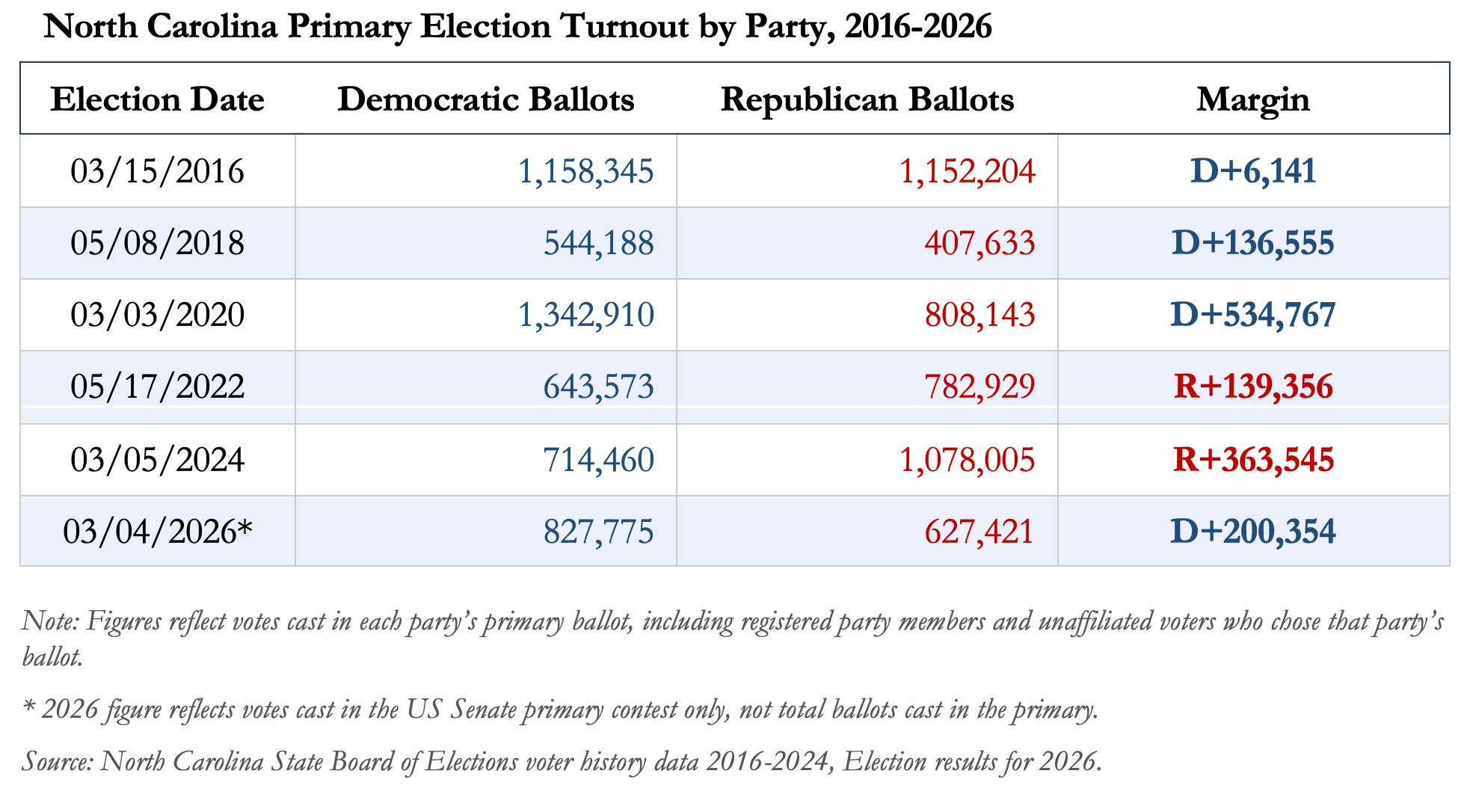
More ballots were cast in the Democratic Senate Primary than the Republican Senate primary (the top of the ticket). While that’s certainly not bad news for Democrats, as recent history demonstrates, it’s not necessarily a harbinger of things to come, either.
To highlight the obvious example, in 2020 Democrats turned out more than half a million more voters than the Republicans, yet Donald Trump won North Carolina’s Electoral College votes and Thom Tillis won the US Senate election against Cal Cunningham.
The Next Election Will Feature 6 Voters and 100% Turnout
A few days ago, Graig Meyer announced that he is stepping down as a State Senator from District 23 (Orange/Caswell/Person Counties) on March 31, 2026. The next Senator will be chosen by a six person committee (2 people each from the Democratic leadership teams in Orange, Caswell, and Person Counties).
Watch this one closely. These appointments (which are common) are, in some ways, politics perfectly embodied. At least one candidate, Jonah Garson, is already campaigning far and wide to get the nod.
And, best part—with just six votes, it’s unlikely that we’ll need a recount.
And he still might be. It’s just too early to know for sure.
I’m choosing my words carefully here. I say “lack of success” because this election is definitely not over. But certainly Berger would have anticipated winning by a larger margin.
For comparison, in January and February 2025, 35 Rockingham voters switched from Democrat to Republican, and it was ranked 45th in the state—essentially no change in comparative turnout. This is far different, for example, from the situation in North Carolina’s 11th congressional district in 2022, as Michael Bitzer and I demonstrated in a piece for the Washington Post a few years ago.
Carolina Forward also endorsed Rodney Pierce, who survived a challenge from former legislator Michael Wray.
