by Christopher Cooper
Five states—New Hampshire, Iowa, Nevada, South Carolina, and North Carolina—are battling for the coveted first slot on the 2028 Democratic Party presidential primary calendar, hoping to gain the power and attention that comes with it.1
While some of these states, like Iowa and New Hampshire, represent the usual suspects, North Carolina is a newcomer to this battle for first.
North Carolina has a lot of advantages as a first state. It’s a purple, growing and diverse state with a large number of urban, suburban, and rural voters. It’s proximate to the Washington, DC press corps and has multiple media markets. As a bellwether for the country, you could do a lot worse.
While this might appeal to the national Democratic Party, North Carolina should let other states duke it out. The first slot would bring power and attention, but the financial costs and voter confusion aren't worth it.2
How We Do it in North Carolina
The law governing the presidential primary process in North Carolina states that “On the Tuesday after the first Monday in March, 2020, and every four years thereafter, the voters of this State shall be given an opportunity to express their preference for the person to be the presidential candidate of their political party.”
Currently, North Carolina puts the vast majority of its primary elections on one day. For example, my 2026 primary ballot will include local (county commission), state (NC House), and federal (US Senate, US Congress) offices. There are distinct ballots for Republicans and Democrats, but all of these elections occur on the same day and voters have one set of rules and one calendar to follow.
This is a good thing.
Coordinating our primaries is less expensive and less confusing than splitting them up—whether separating presidential from other contests, or worse, holding Democratic, Republican, and down-ballot primaries on different days.
How A New System Would Work
If the national Democratic Party wanted to place North Carolina first, it would have to either create a separate system not sanctioned by the state that would somehow allocate delegates to their national convention, or convince the Republican General Assembly to change state law.
The first is unwieldy. The second is unlikely.
But, let’s assume for a second that the Democrats convinced the Republicans in the General Assembly to change state law to allow the Democratic presidential primary to be first in the nation. After all, the North Carolina Democratic Party, in their application to be the first in the nation, said they had gotten “positive indications” in their “limited” conversations with the Republican majority.
If the Republican General Assembly agreed to change the law, the state would be faced with four options. They could either: (1) separate the Democratic presidential primary from all other primaries—holding two separate primary processes; (2) put the Republican and presidential preference primaries on one day and the rest of the primary ballot on another day; (3) hold the Republican and Democratic presidential preference primaries on different days and the rest of the primary elections on a third day, or (4) move all of the primaries up to this new date—presumably in late January or early February.
Options one, two, and three are, to be frank, confusing as hell. Yes, South Carolina pulls off a version of the third and other states do the first or second, but a real advantage of North Carolina’s current system is that we put the vast majority of our even-year primary ballot on the same day. It’s clearer and cheaper. We’d be throwing all of that out.
The first, second and third options become even more unwieldy once we consider what it would mean for the largest group of voters in our state—the Unaffiliated voters. In our semi-closed primary system unaffiliated can choose either the Democratic or Republican primary (but not both). Imagine the confusion if unaffiliated voters could vote in the Democratic presidential primary on Day A, and then show up to vote on Day B to vote in the rest of the Democratic primary ballot.3 This is a good recipe for lower voter turnout in other primaries.
Then there’s the cost. Elections aren’t free and if we had multiple primary election cycles, we would have to print more ballots, pay for more poll workers, and assume all of the costs of running another election. While the state would incur some of these costs, the majority of it would be borne by the counties—most of whom aren’t exactly flush with cash at the moment.
What about the fourth option? We could move all of the primaries—Republican and Democrat, presidential, congressional, state and local—to the same date in January or early February.
Even if the Republican General Assembly would agree to this, it would create a number of administrative problems.
We already have one of the earliest filing periods in the country—candidates file in the December before the election year. Do we want to have candidates for county commission, school board or clerk of courts file even earlier? Do we want our campaigns to be even longer?
I don’t think so.
In the end, I understand and appreciate the desire to be first. North Carolina is a critical state and is a good microcosm of the rest of the country. On paper, the Old North State makes as much or more sense than Iowa or New Hampshire to be the nation’s first Democratic primary.
But there are too many negative consequences for this to be a good idea. North Carolina is already a relatively early state and a critical one on the national map.
Someone else should have the first slot.
Other Stuff That Caught My Eye This Week
Through Friday, 149 ballots have been cast in the 2026 North Carolina Primary. I will be updating more on these data over the next few weeks.
The Virginia House of Delegates voted along party lines to pass a constitutional amendment allowing mid-decade redistricting. If a majority of Virginia voters approve of the initiative, Virginia’s congressional delegation will likely move from its current 6 Democrat, 5 Republican make-up to 9 Democrats and two Republicans, or possibly 10 Democrats and two Republicans. And, Florida will soon follow suit. The tit-for-tat gerrymandering wars are here to stay.
Andrew Dunn makes the case for more debates in the North Carolina primary elections. I agree. In my neck of the woods, the Democrats running for NC-11 seem to be heeding Dunn’s advice. They just finished one in Clay County and have more coming up in Macon and two in Buncombe Counties (including one that will be live-streamed on the WLOS web site).4
Nineteen Buddhist monks and one dog are walking from Fort Worth, Texas to Washington, DC on a walk for peace. If you read one thing about this journey, make it this, by Michael Graff, w/ extraordinary photos by Logan Cyrus.
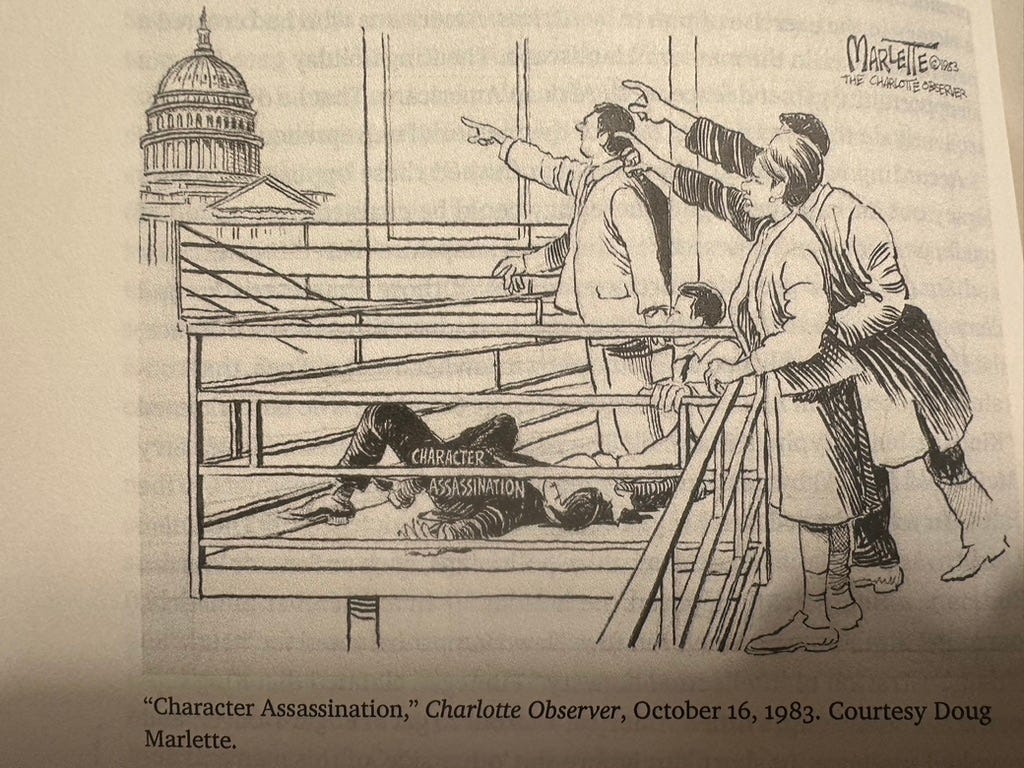
On MLK Day, I recommend a book not so much about King himself, but about the struggle for the King Holiday—Daniel Fleming’s Living the Dream. The first proposal for a King Holiday emerged days after his death, but it didn’t become federal law until 1983 and the last state (South Carolina) didn’t recognize MLK Day as a state holiday until 2000. Flemming tells us how we got there and why it matters. Somewhere along the way, Fleming includes this political cartoon from Doug Marlette5, then with the Charlotte Observer. A good one to remember on a day that is likely to bring out some beautiful and, unfortunately, some truly terrible takes on King and his legacy.
New Mexico, Georgia, Tennessee, Virginia, Illinois, Iowa, Michigan and Delaware have also applied to go early, although they were not explicit in their desire to go first. To follow all of these goings on, I recommend following Frontloading HQ, run by political scientist Josh Putnam.
This conversation is taking place because our presidential primary system is neither fish nor foul. States and state governments administer elections and state laws govern participation, but the national political parties decide the order of the primaries and how the primary votes translate into delegates at the party conventions. For example, through the action of one particularly crafty New Hampshire Secretary of State who made a state law declaring that New Hampshire must be the first presidential primary, we’ve been in a multi-decade discussion about whether New Hampshire is representative of the nation (it’s not) and whether it makes sense to put such weight on the Iowa Caucus (not in my mind).
New Hampshire also has a semi-closed primary system and manages to make it work. But they’ve also got a lot of practice with this system. Voting habits are real and breaking them has consequences.
There may be more; those are just the ones I’ve heard about.
