Last Thursday (February 12, 2026) marked the beginning of in person early voting in North Carolina. So, where do we stand and what should we watch?
Monday, February 16, 2026
NC's Partisan Stability vs. Independent Uncertainty
By Michael Bitzer
One of the interesting things I found in the generic ballot questions in last month’s Catawba-YouGov Survey was a consistency of voter intentions across the five contests asked (U.S. Senate, U.S. House, N.C. Supreme Court, N.C. State House, and N.C. State Senate).
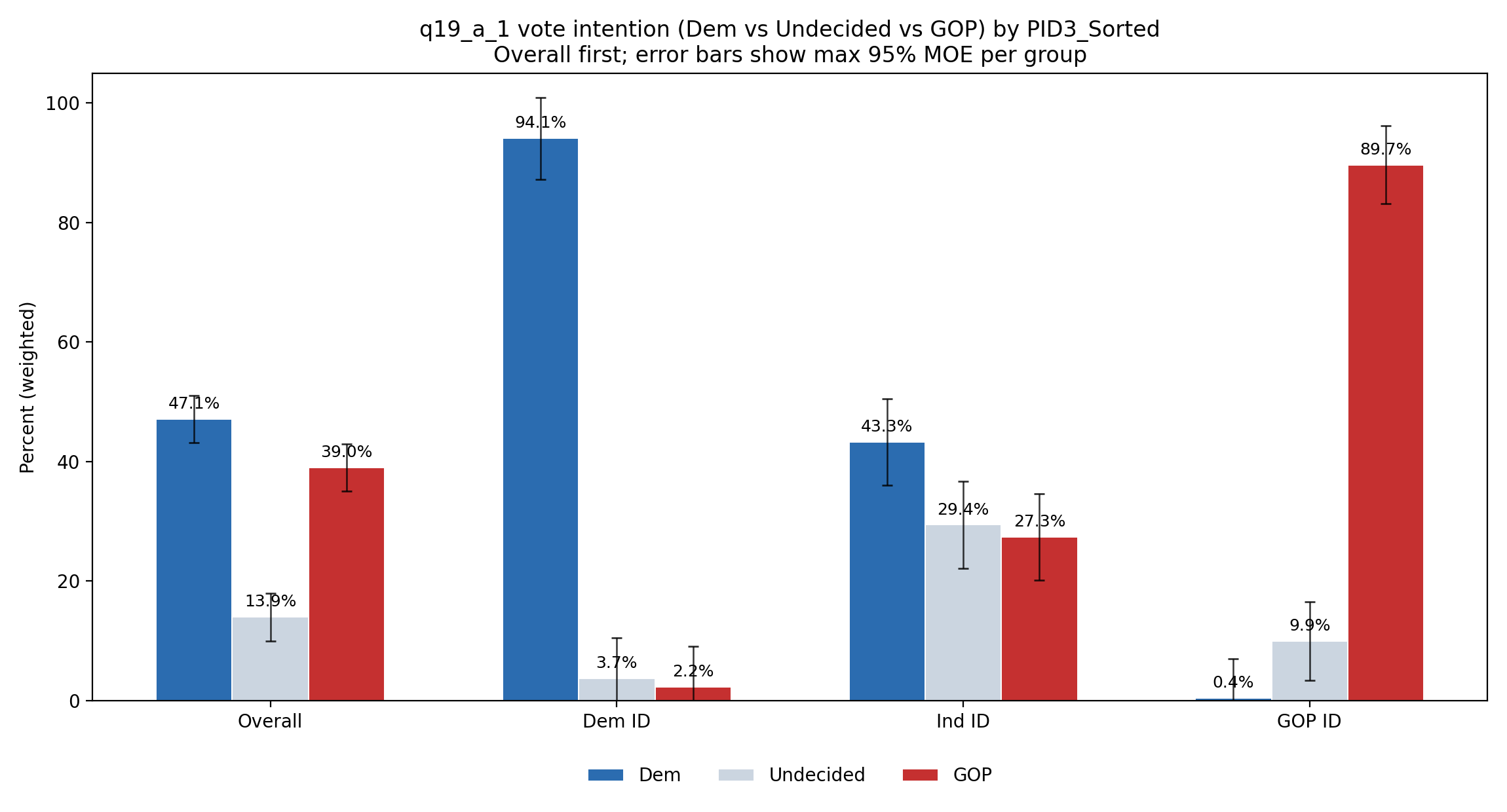
As noted in the release, Democratic candidates generally received about 45 percent of the vote to Republicans receiving 38 percent, with less than 15 percent undecided.
But when looking at the partisan identification, we see some distinctiveness when it comes to voter intention. Take for example the U.S. Senate generic ballot contest (broken into “definitely/likely voting for Democratic candidate vs. undecided vs. definitely/likely voting for Republican candidate”1): we see clear partisan loyalty among those who self-identify as Democratic and Republican, while those who said they were ‘independent’ are more divided, but lean towards one party.

Monday, January 26, 2026
The Early Voting Sites are Set for the 2026 Primary in North Carolina. How Does the 2026 Plan Compare to Previous Primary Elections?
by Christopher Cooper
North Carolina’s 2026 early voting plans for the primary election, which determine when, where and how easily North Carolinians can cast their ballots before election day, are now set and the final list of sites is posted to the North Carolina State Board of Elections web site.
What does the 2026 primary plan say and how does it compare1 to previous years?2
Monday, January 19, 2026
The Battle to Be First in the Democratic Presidential Primary Isn't Worth It for NC
by Christopher Cooper
Five states—New Hampshire, Iowa, Nevada, South Carolina, and North Carolina—are battling for the coveted first slot on the 2028 Democratic Party presidential primary calendar, hoping to gain the power and attention that comes with it.1
While some of these states, like Iowa and New Hampshire, represent the usual suspects, North Carolina is a newcomer to this battle for first.
North Carolina has a lot of advantages as a first state. It’s a purple, growing and diverse state with a large number of urban, suburban, and rural voters. It’s proximate to the Washington, DC press corps and has multiple media markets. As a bellwether for the country, you could do a lot worse.
While this might appeal to the national Democratic Party, North Carolina should let other states duke it out. The first slot would bring power and attention, but the financial costs and voter confusion aren't worth it.2
Monday, January 12, 2026
The 2026 Election Begins Today
by Christopher Cooper
Sometime today, the first mail ballots for the 2026 primary were sent out to North Carolina voters, marking the official beginning of the 2026 elections.
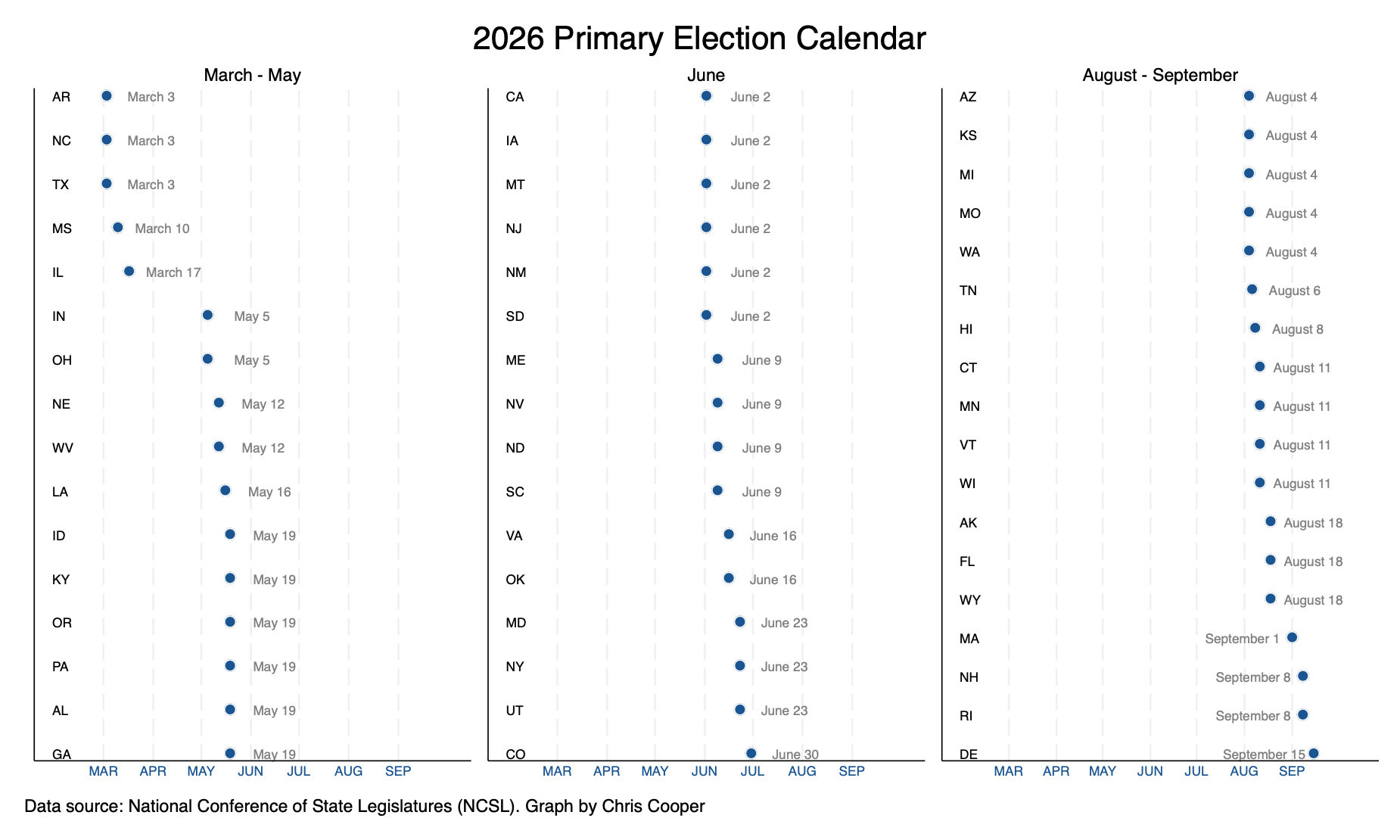
If this seems early, that’s because it is. North Carolina, Arkansas, and Texas hold their elections on March 3—the first in the nation. North Carolina sends out the first match of mail ballots 60 days before the election, whereas Texas and Arkansas wait until 45 and 46 days before the election, respectively. In person early voting begins in North Carolina on February 12, four days before Arkansas and five days before Texas.
No matter how you slice it, the 2026 election election begins in North Carolina. And it begins today.
Tuesday, January 6, 2026
Please Ignore Internal Polls (Again)
by Christopher Cooper
Over the last few weeks, two internal polls have made news in North Carolina politics. The first purported to show President Pro-Tempore of the North Carolina Senate, Phil Berger down by ten percentage points to Rockingham County Sheriff Sam Page in the Republican primary for Senate District 26. The second (released today) showed Democrat Jamie Ager up one percentage point against Republican Chuck Edwards in the General Election for North Carolina's 11th congressional district
Please ignore those internal polls. Please also ignore the ones that will inevitably come from their opponents that offer a different look.
Regardless of whether those results reinforce or challenge your preferred outcome, they are not giving you reliable information, nor is that their goal. Their release is intended to help their candidate. I don’t blame the candidates or their campaigns for releasing these polls. It’s smart politics.
And, if you follow elections solely as a window into palace intrigue, or as a way to reinforce what you want to be true then, by all means, have at them. But, if you follow politics and elections news to get a better understanding of how we are governed, then paying attention to internal polls will do you more harm than good.3
I wrote about this back in 2022 when an incumbent member of Congress named Madison Cawthorn released an internal poll showing him with a commanding lead in the Republican primary—the very same primary he ultimately lost.
Rather than re-hashing all of this again with new examples, I'll point you to the 2022 post on this blog. The names may have changed, but rationale remains.
-----
Dr. Christopher Cooper is the Madison Distinguished Professor of Political Science and Public Affairs and Director of the Haire Institute for Public Policy at Western Carolina University
Sunday, January 4, 2026
There are now more Republican registered voters in North Carolina than Democrats. What Does This Mean for Our State's Politics?
by Christopher Cooper
Normally, the weekly voter registration updates on the North Carolina State Board of Elections are met with a collective shrug from all but the most dedicated, data oriented, and dorky observers of the state’s politics.1
There have really only been three notable exceptions to that rule: September 2017 when Unaffiliated crossed Republican to become the second largest group of registered voters in the state, March 2022 when Unaffiliated became the largest number of registered voters in the state and yesterday when, for the first time in the state’s history, registered Republicans outnumbered registered Democrats in North Carolina.

In October I wrote a piece for The Assembly about this shift—what it means and why it matters. I encourage you to read it in the context of what just happened.2 Some primary things to keep in mind are:
Friday, January 2, 2026
A Softening, But Not a Flip: North Carolina's Partisan Identification Shifted Late in 2025
By Michael Bitzer
With 2025 concluded and the start of what will be an intense 2026, I was reviewing the past year’s Catawba College-YouGov surveys of North Carolinians (1) to see what interesting patterns or trends occurred over the year.
One thing that stood out to me (because of its potential implications for electoral volatility in a presidential-to-midterm transition year) was a fairly consistent pattern of the state’s partisan identification—that is, until the final survey of 2025.
As part of a standard set of questions asked in each Catawba-YouGov poll, respondents can initally say what their partisan identification is: Democrat, Republican, Independent, other, or not sure. Another question asks for the respondents’ ‘strength’ of their initial partisan identification, meaning for partisans ‘are you strong or not very strong’ in your identity, while among those who initially say they are ‘Independent,’ do they lean to one party or the other, or do they consider themselves a ‘pure’ independent.
Starting with the first Catawba-YouGov Survey in August 2024, the partisan self-identifications of the surveys showed a pretty consistent pattern over the past year, until the last survey.

Figure 1: Catawba-YouGov 2024-2025 Surveys with initial partisan identifications among North Carolina Respondents.
Subscribe to:
Comments (Atom)