By Michael Bitzer
News of the passing of former North Carolina Governor Jim Hunt came as I was driving home yesterday. Stuck in rainy traffic on I-85, I had time to reflect on the impact of this titan of North Carolina politics—one of two politicians who shaped not just the final decades of the twentieth century in this state, but whose legacy continues nearly a quarter-century after his last days in elected office.
During the 1960s and 1970s, North Carolina—and the once Solid Democratic South—was undergoing profound political transformation, as were the nation’s two major parties. Unlike many other Southern states (save Tennessee), North Carolina had long experienced a measure of political competitiveness. From the beginning of the twentieth century through its midpoint, the state featured a dominant Democratic Party alongside a meaningful Republican opposition, largely concentrated in the upper northwestern mountain counties and extending into the central Piedmont.
By the time Jim Hunt came of political age, however, the national parties had fundamentally shifted their coalitions, primarily due to positions on race. The Democratic Party moved from its segregationist, Southern-aligned roots to become the party that advanced the Civil Rights Act of 1964 and the Voting Rights Act of 1965—legislation enacted under President Lyndon B. Johnson, who defied many fellow Southerners and worked with moderate Republicans. The Republican Party, long identified as Lincoln’s party and the architect of the Reconstruction Amendments, began to reorient its base around a states’ rights foundation, a shift crystallized by Barry Goldwater’s 1964 presidential campaign.
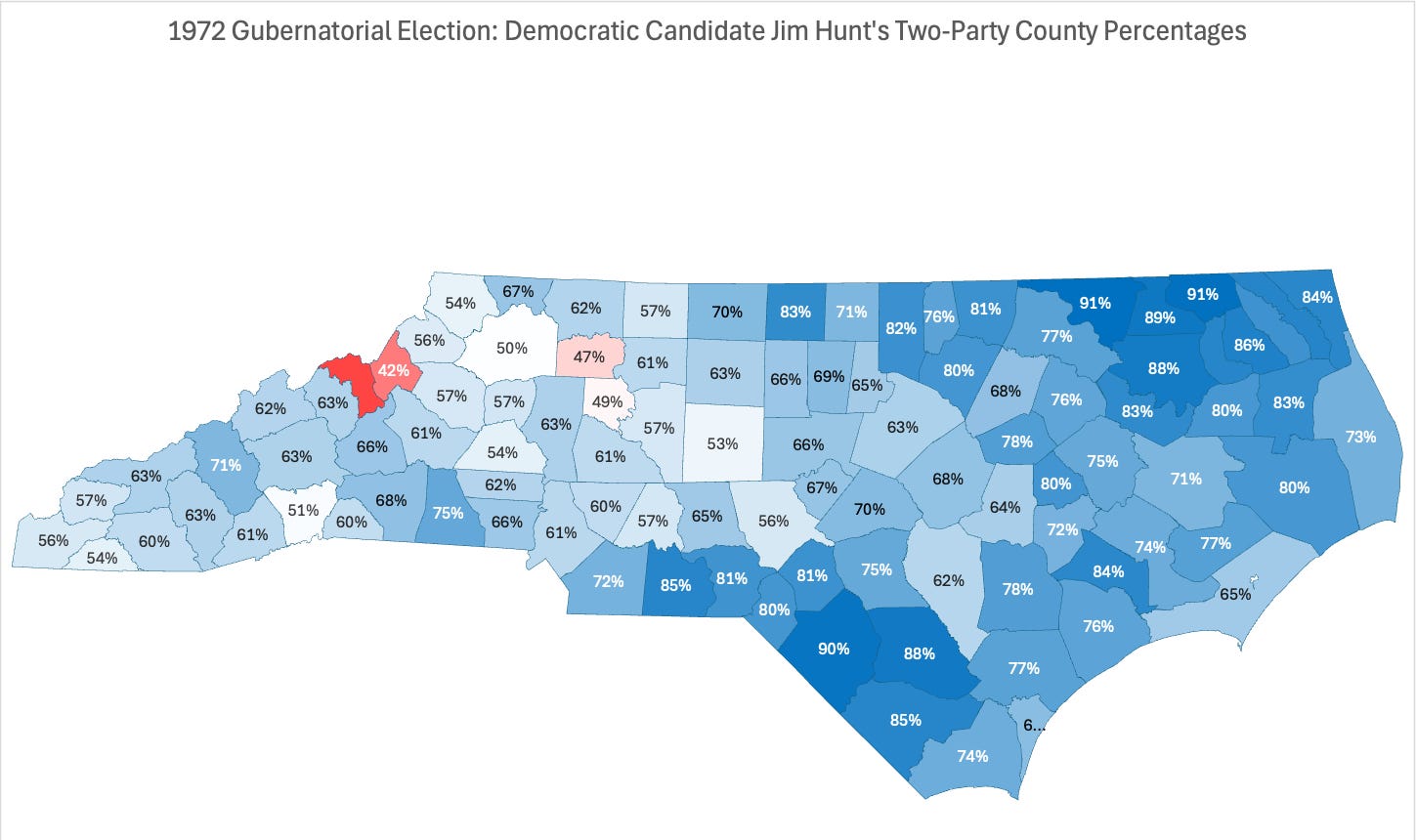
By the 1970s, Southern realignment was well underway. Hunt secured his first statewide victory in 1972 as lieutenant governor, serving under the state’s first Republican governor elected since the nineteenth century. Four years later, in 1976—when North Carolina governors were still limited to a single four-year term—Hunt ran for governor and won an astonishing 97 of the state’s 100 counties, as shown on the accompanying map.1
Yet by the time Hunt entered his final statewide race in 1996, seeking a fourth term as governor against Republican Robin Hayes, North Carolina looked very different.
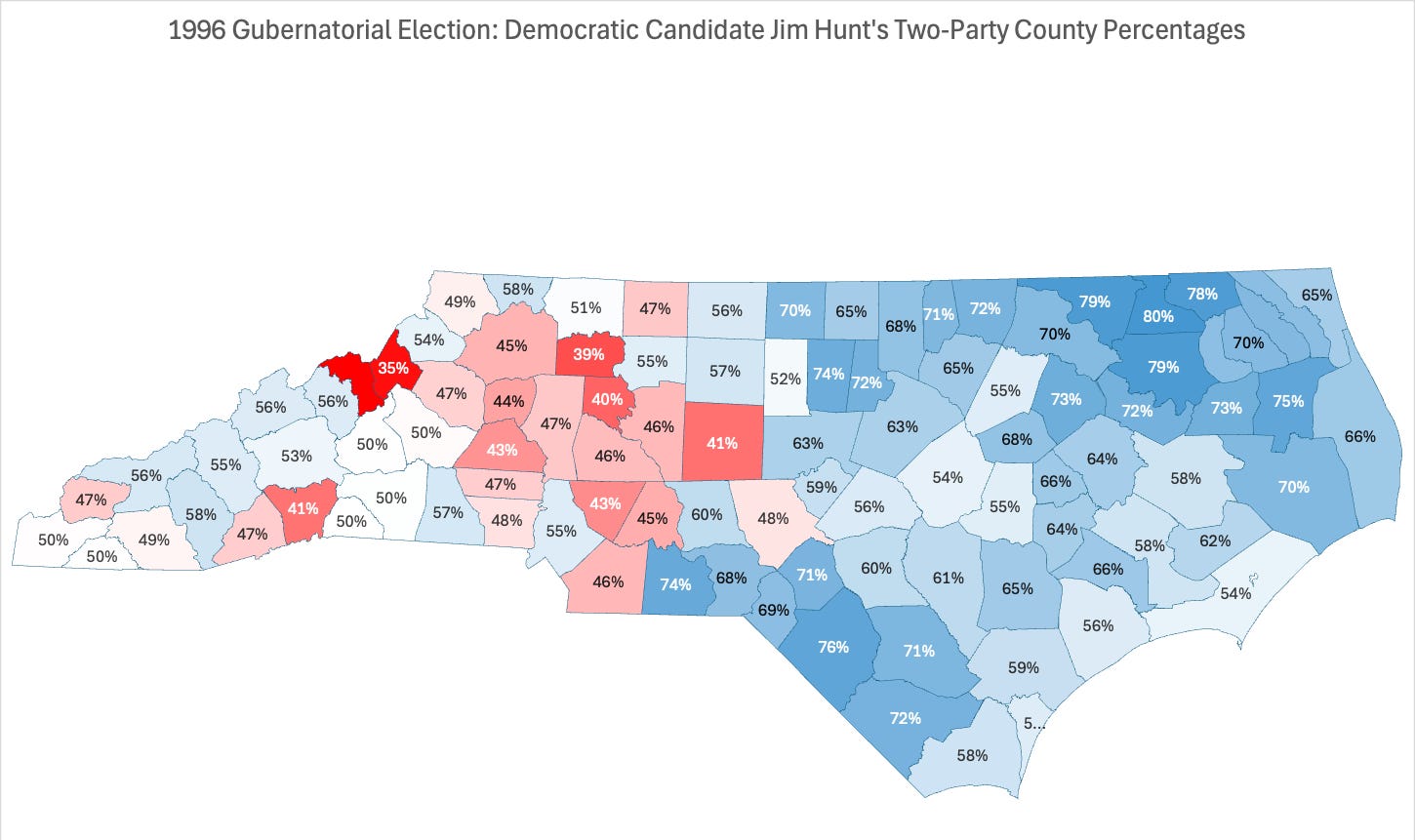
Still, Hunt proved remarkably resilient in the face of growing Republican strength at the federal level. He withstood Republican presidential victories in North Carolina during Reagan’s win in 1980, George H. W. Bush’s victory in 1992, and Bob Dole’s strong showing in 1996.
Hunt’s policy agenda was equally consequential. He championed early childhood education through pre-K and kindergarten initiatives, most notably the Smart Start program, and he was among the state’s most aggressive advocates for economic development, actively courting businesses and corporations to North Carolina.
Equally significant—though often overlooked—was Hunt’s role in strengthening the governorship itself. Under his leadership, North Carolina moved away from having one of the weakest chief executives in the nation, granting governors both the power to succeed themselves in office and the authority of the gubernatorial veto. Yet it was the force of his personality that made Hunt one of the strongest governors in recent history, even though the office is still considered one of the weakest in institutional power.
The one statewide race Hunt was unable to add to his win streak was the 1984 U.S. Senate contest against conservative Republican Jesse Helms. Fought amid Ronald Reagan’s national landslide reelection, the Helms–Hunt race remains one of the most bitterly contested campaigns in state history—and one that still draws comparisons in today’s polarized political climate.
Even so, Hunt showed Democrats a viable path to victory in North Carolina: persuading voters to split their tickets between federal and state races. That formula has since served Democratic gubernatorial and other statewide candidates well, even as the state has grown more competitive and divided, thanks to the clear sorting of voters into respective political tribes.
Beyond the policy achievements of his sixteen years as chief executive, Hunt’s most enduring political legacy may be the North Carolina swing voter. In the 1980 general election, Ronald Reagan won the state with more than 915,000 votes, while Hunt simultaneously secured reelection to a second term with over 1.1 million votes. North Carolinians—particularly in the eastern part of the state—were willing to split their tickets between Republican federal candidates and Democratic state leaders in the final decades of the twentieth century.
That willingness to cross party lines was cultivated by Hunt’s political strategy. And while split-ticket voting has declined sharply over the past twenty years, the cross-partisan electoral pattern Jim Hunt helped establish has endured into the twenty-first century and made North Carolina the competitive battleground we experience today.
Dr. Michael Bitzer is a professor of politics and history at Catawba College, where he directs the Center for N.C. Politics & Public Service.
Data for Hunt’s two-party county percentages are from the invaluable N.C. Manual.
