By Christopher Cooper
Phil Berger has spent more than a decade and a half as the most powerful politician in North Carolina. Last week, he conceded that he lost his primary election to challenger Sam Page by 23 votes—a loss that has been called a political “earthquake” and covered by national press, including the New York Times.
North Carolina political insiders are positively apoplectic about what may come next. But you can be forgiven if you're still unsure why this is such a big deal. It is a state senate race, after all.
A Different Era
The political reality of North Carolina when Phil Berger entered the North Carolina State Senate in 2001 couldn’t be more different than it is today. Berger was one of only 15 Republicans in the upper chamber and his party had been in the minority in the State Senate for more than 100 years. He was initially elected in a multimember district that spread across parts of seven counties. The other Senator from that district was none other than Virginia Foxx.
In what will be Berger’s final term, he represents a single-member district that includes just two counties and it is the Republicans, not the Democrats who hold the supermajority (30 seats v. 20 for the Democrats). There are a host of reasons for that shift, but no one can doubt that Phil Berger was, at the very least, in the room where it happened.1

Note: advertisement above is from Berger’s initial run for office in 2000.
The Republican Takeover
The key inflection point in Berger’s career and in the shape of North Carolina politics was the 2010 election when the Republicans flipped the North Carolina House and Senate, along with 18 other chambers. Overall, the Republicans netted a record 680 seats, including 11 seats in the North Carolina Senate and 16 in the House.
After the 2010 victory, there was a brief question about whether Paul Stam, Thom Tillis, Mitch Gillespie or Ric Killian would become Speaker, but there was no question about who would get the nod for the top spot in the Senate. Then Mecklenburg County senator Bob Rucho told the AP, “we’re unified around Senator Berger, and more importantly we’re unified around our agenda.”2 Not much room for negotiation there.
Phil Berger has been in charge ever since. No living person has known a Republican-controlled North Carolina General Assembly without Phil Berger at the helm.
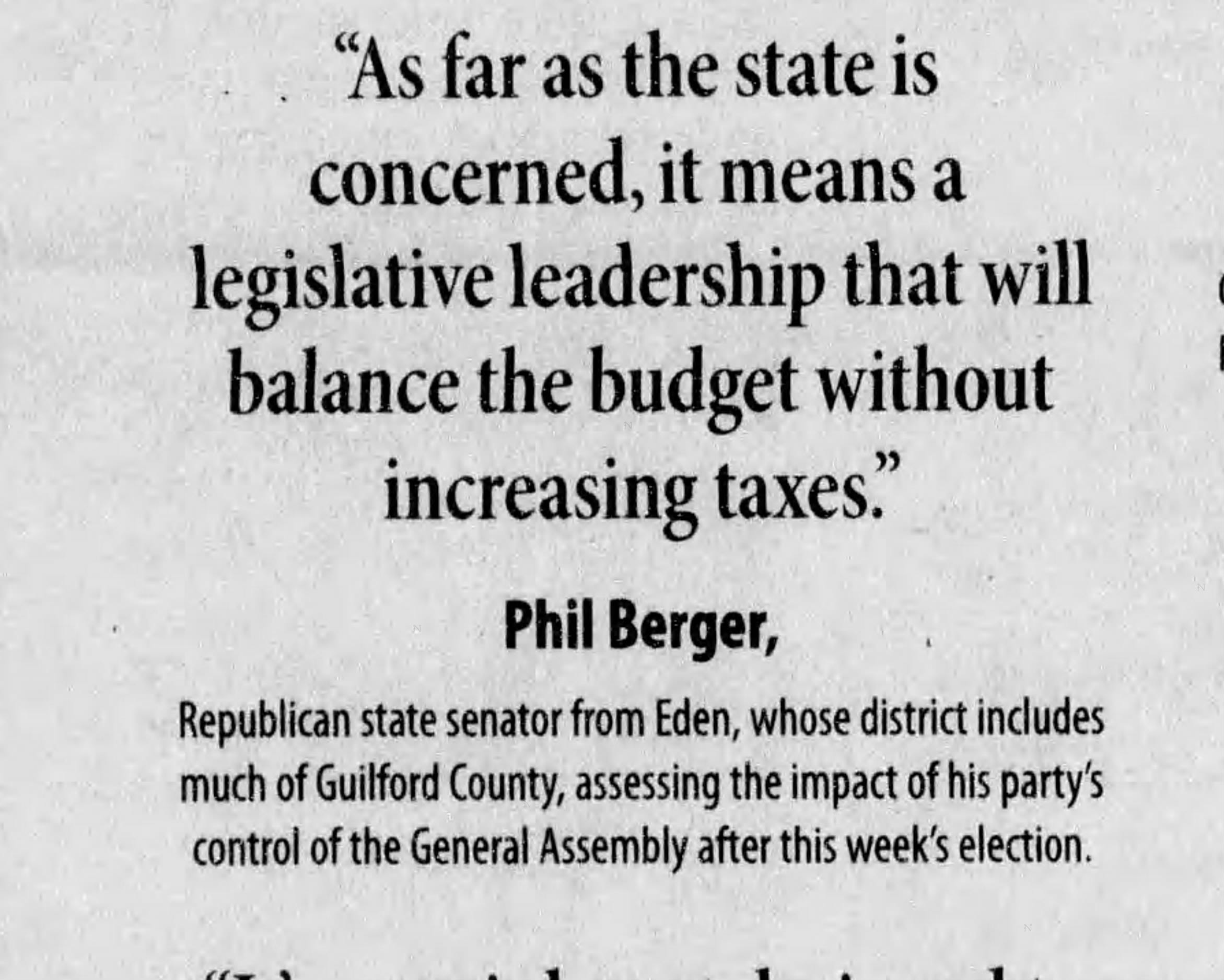
Note: Quote above is from the News and Record in November, 2010.
The Context
North Carolina, unlike states like Illinois and New York, does not place any limits on legislative leadership. Despite the lack of a formal limit for the better part of North Carolina history, there was an understanding that leaders wouldn’t wear out their welcome.
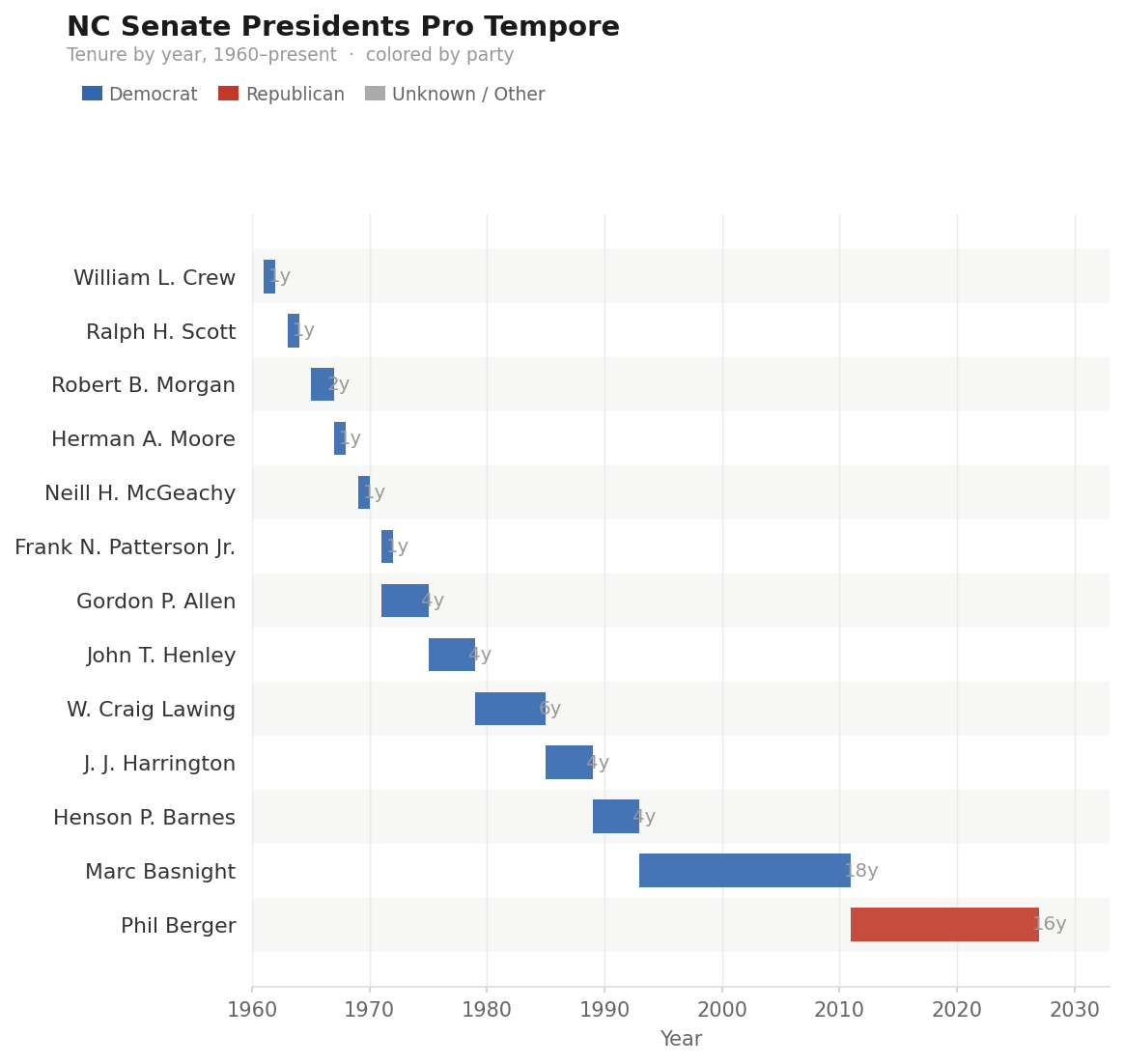
Democrat Marc Basnight changed all of that, serving a record 18 years.
Berger then followed up with sixteen years in charge. In the other chamber, Thom Tillis, Tim Moore, and Destin Hall all served as Speaker of the House during Berger’s uninterrupted tenure as Pro Tem.
Phil Berger is not just the longest serving state legislative leader in North Carolina, he is the longest serving leader anywhere in the United States. Berger’s lengthy tenure in leadership is part of the reason he is so powerful and the reason why his primary defeat has attracted so much attention.
Berger himself seemed to understand that his tenure was unusually long and that his time might be drawing short. In 2024, Berger told Taylor Huhn of the National Conference of State Legislatures “you will continue to see folks that hang around [in leadership] for a decade. But beyond that, I think it gets more and more unlikely.”
The Institution
This long tenure in office would be important anywhere, but particularly in North Carolina where the General Assembly is the most powerful branch of government. In many states, executives and legislature compete for power. As I explain in Anatomy of a Purple State (the book), in North Carolina the legislature dominates.
North Carolina has always had a weak Governor, but the gap between legislative and executive power has increased even more in recent years. Most recently, SB 382 took even more power from the Governor.
Being a legislative leader in North Carolina equates to more power than it ever has before.
Given the power of the President Pro Tempore, it shouldn’t be surprising that at least three senators have already expressed interest in the position.
Despite the power of the position, whoever comes next is unlikely to wield as much power as Phil Berger. Berger’s influence extends well beyond the chamber itself, with former allies now occupying influential positions throughout state government.
Beyond the difficulty of replicating Berger's network, the times have changed. Phil Berger came to power along with the biggest Republican wave in North Carolina history—a wave that fundamentally changed governance in the Tar Heel State and throughout the South.
The next President Pro Tem will come into power not as the architect of the majority, but rather as the next in line.
Stuff That Works
Man, the Haywood County tax collector is fascinating. No, seriously. As Cory Vaillancourt with the Smoky Mountain News has been reporting, Haywood is the only county in North Carolina with an elected tax collector. That’s weird enough. But then a 21-year-old UNC Asheville student named Sebastian Cothran who ran as a Republican beat a successful incumbent Democrat named Greg West in 2022 (I say successful because he had a 99.35% tax collection rate—the equivalent of hitting .400 in MLB). Cothran then decided not to run again, and West—who switched to the Republican party after his defeat—won in the primary earlier this month and is not facing any Democratic opposition in the Fall. In case that wasn’t enough to make you pay attention, Cothran resigned his position last week, leaving the position open, and creating some low-key drama over whether the local Republican party should appoint the replacement for the remainder of the term, or whether it should be the county commission.
There’s a lot to unpack there, including the increasing value of the Republican party label in certain counties and whether Haywood should have an elected tax collector in the first place.
As to the reason why Haywood still elects a tax collector, the history is a little murky. Here’s what we know: the elected Haywood tax collector was established by local law in 1931 and re-upped in 1943. During this time period, some counties elected their tax collectors and others didn’t. The Machinery Act of 1971 altered tax collection laws and prohibited counties from changing from appointed to elected tax collectors. But it included a carve-out so that Haywood and a number of other counties who were already electing their tax collectors could continue to do so. And, some did. For example, Buncombe continued to elect tax collectors through 1992. And today, Haywood is the one in one hundred exception to the rule of appointed tax collectors.
That’s about all I can piece together. As for the full story, we’ll have to wait until Jeremy Markovich deems it Rabbit Hole worthy.Austin, TX musician Jon Dee Graham, the rare artist who was both a punk-rocker and a widely admired songwriter, died last week. If you don’t know Graham’s music, please take a moment to read this piece in the Bitter Southerner by Chuck Reece. Reece captures Graham’s brutally efficient word choice better than anything I’ve ever read. Check out this quote: “But I did figure something out pretty early on. I'd write something and go, ‘Wow, that's just so clever or beautiful.’ Or, ‘Look at the internal rhyme here.’ And then I’d go, ‘It has to die.’ I had to take it out. Because as beautiful as it is, it doesn't carry enough information.”
Representative from North Carolina’s 119th state legislative district Mike Clampitt passed away last week after a long battle with a rare blood disease. His memorial service will be held at WCU on April 4 at 1:00.3
Mike Clampitt was my representative and I had the good fortune of spending time with Representative Clampitt from time to time. All of these interactions revealed him to be a kind and committed public servant who cared about his constituents, his district, and the General Assembly itself. He will be missed.
Not only was he in the room, but he was one of the most powerful—if not the most powerful person in that room.
Rucho had challenged Berger for minority leader two years prior to Berger taking over as Pro Tem.
For more on what happens to their seat and their spot on the ballot when a legislator passes away, see this from Lilly Knoepp of NC Local.
