By Michael Bitzer
One month into the U.S.-Israeli war with Iran, North Carolinians have grown more negative in their views of President Donald Trump, according to a new Catawba-YouGov survey. A plurality say the U.S. was wrong to attack Iran, and as the Pentagon signals a potentially prolonged conflict with ground operations, a strong majority oppose deploying troops.
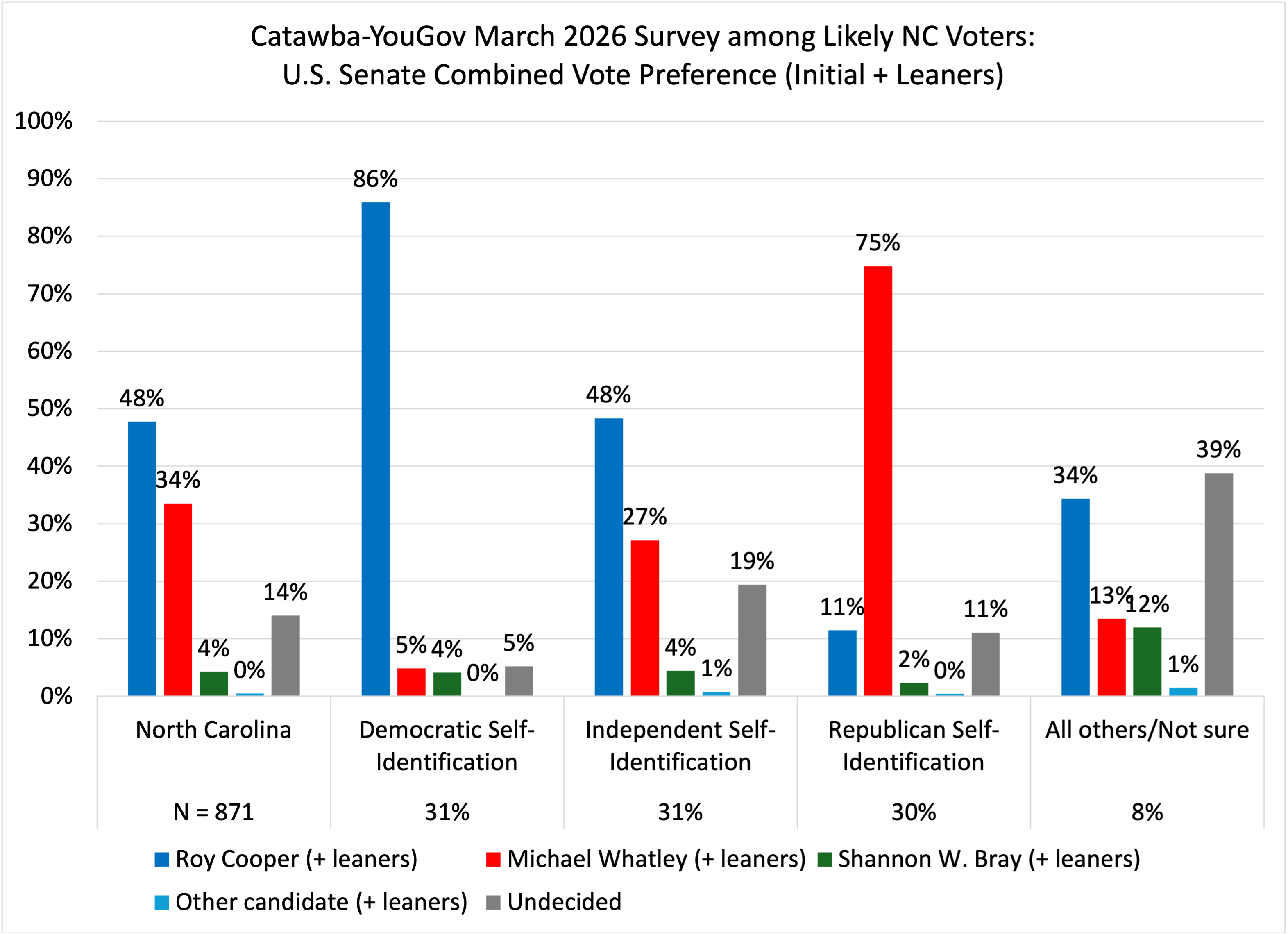
The survey also finds that Democrat Roy Cooper leads Republican Michael Whatley in the early horserace numbers for the U.S. Senate election, 48 percent to 34 percent among likely voters (including those who initially said they were undecided but lean toward a candidate), with 14 percent undecided.
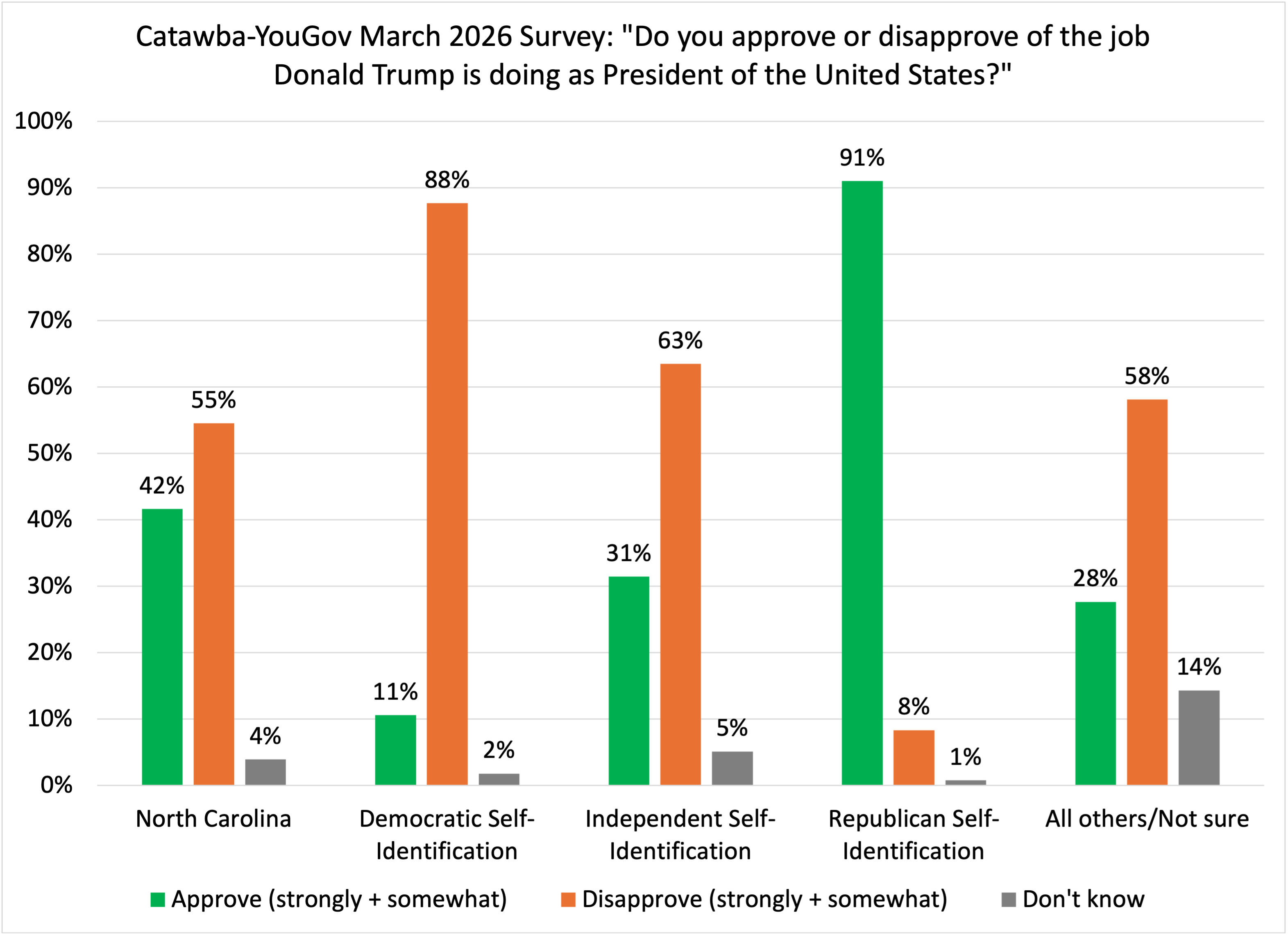
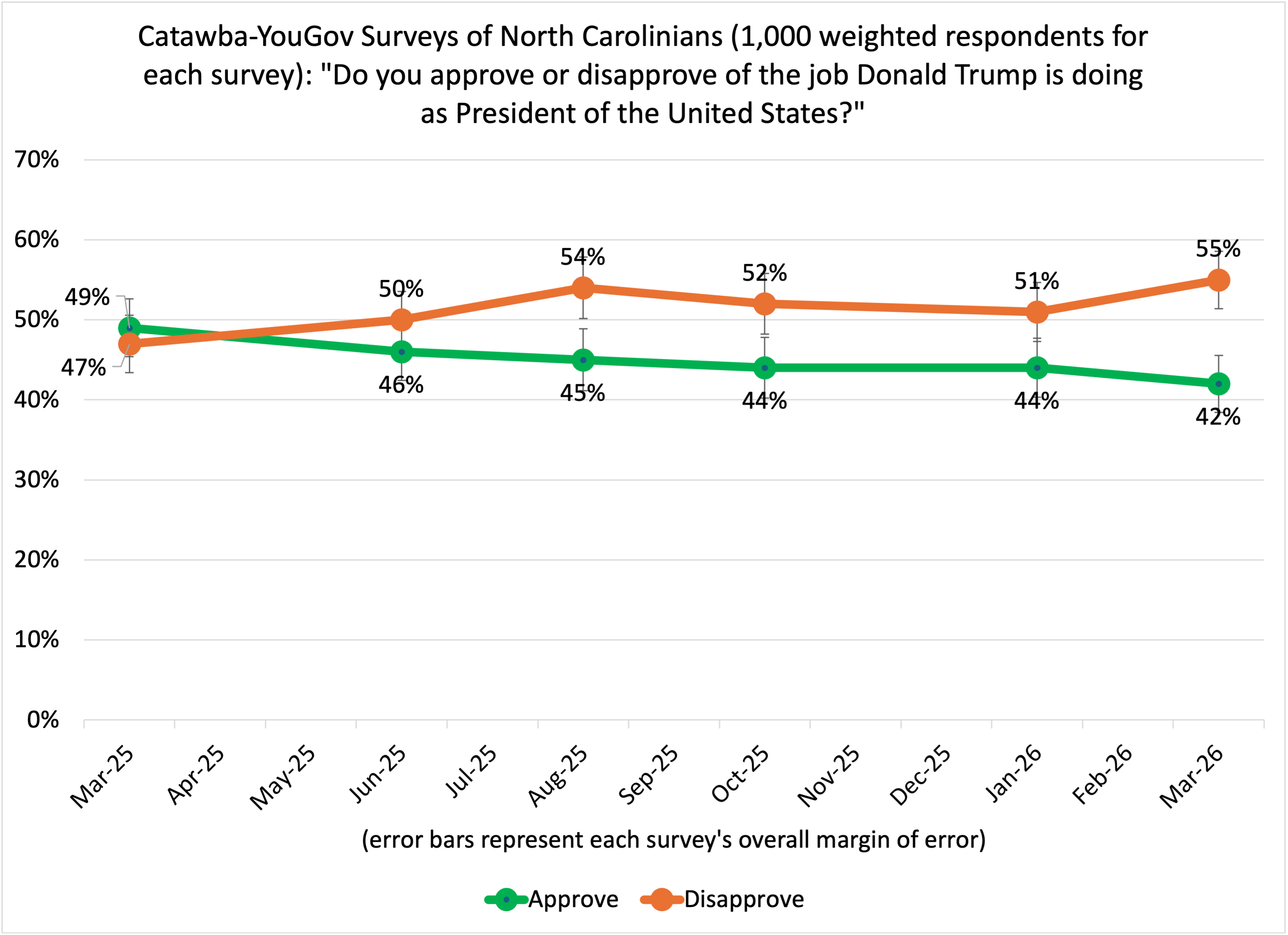
“President Trump has registered the lowest approval rating in the Catawba-YouGov Surveys since last March, at 42 percent, with his highest disapproval at 55 percent,” said Dr. Michael Bitzer, professor of politics and history and director of the Center for North Carolina Politics & Public Service, which wrote and paid for the survey. The online survey was conducted by YouGov of 1,000 weighted North Carolinians from March 9 to 18, 2026, and has an overall margin of error of plus/minus 3.58 percent.
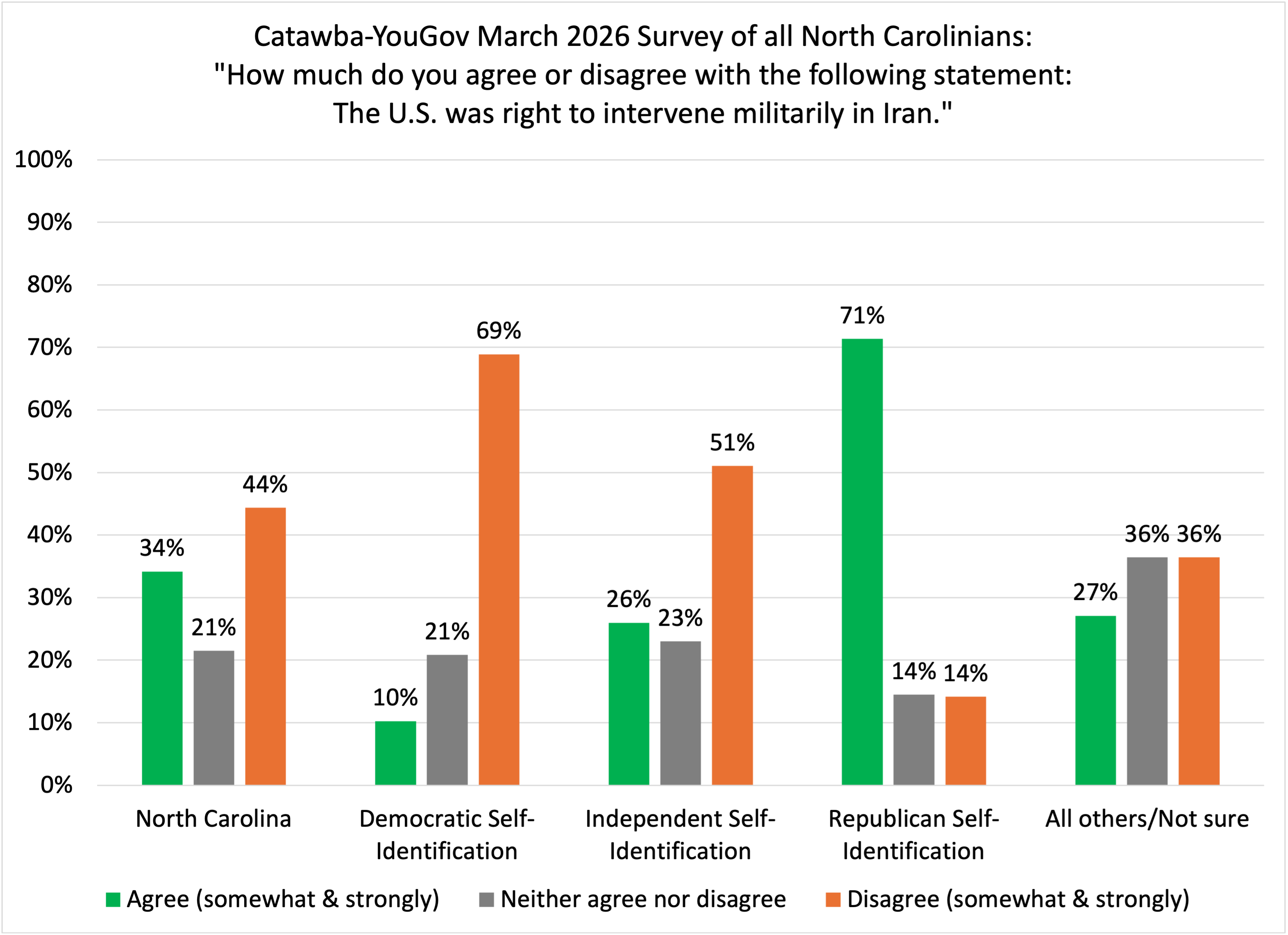
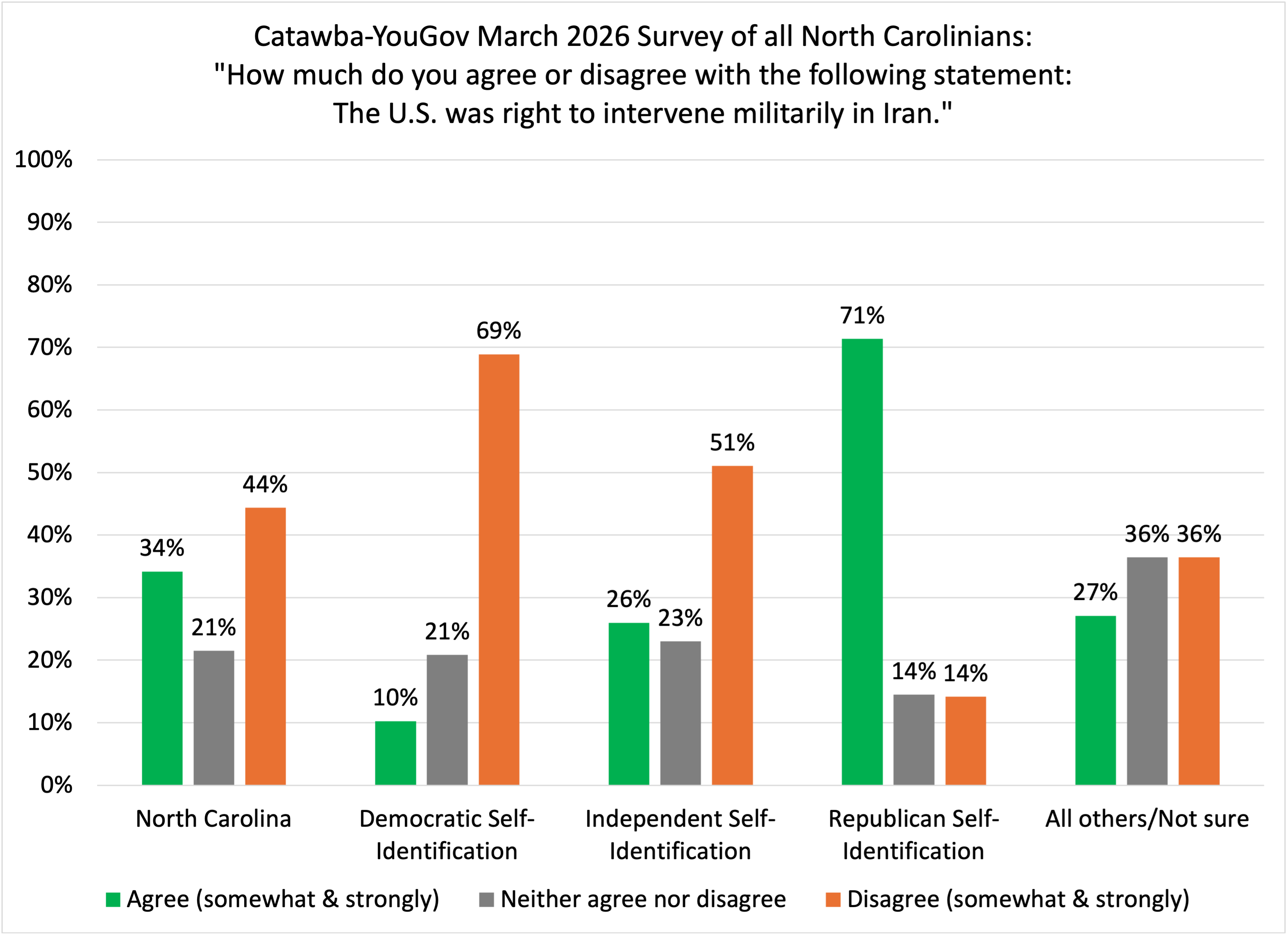
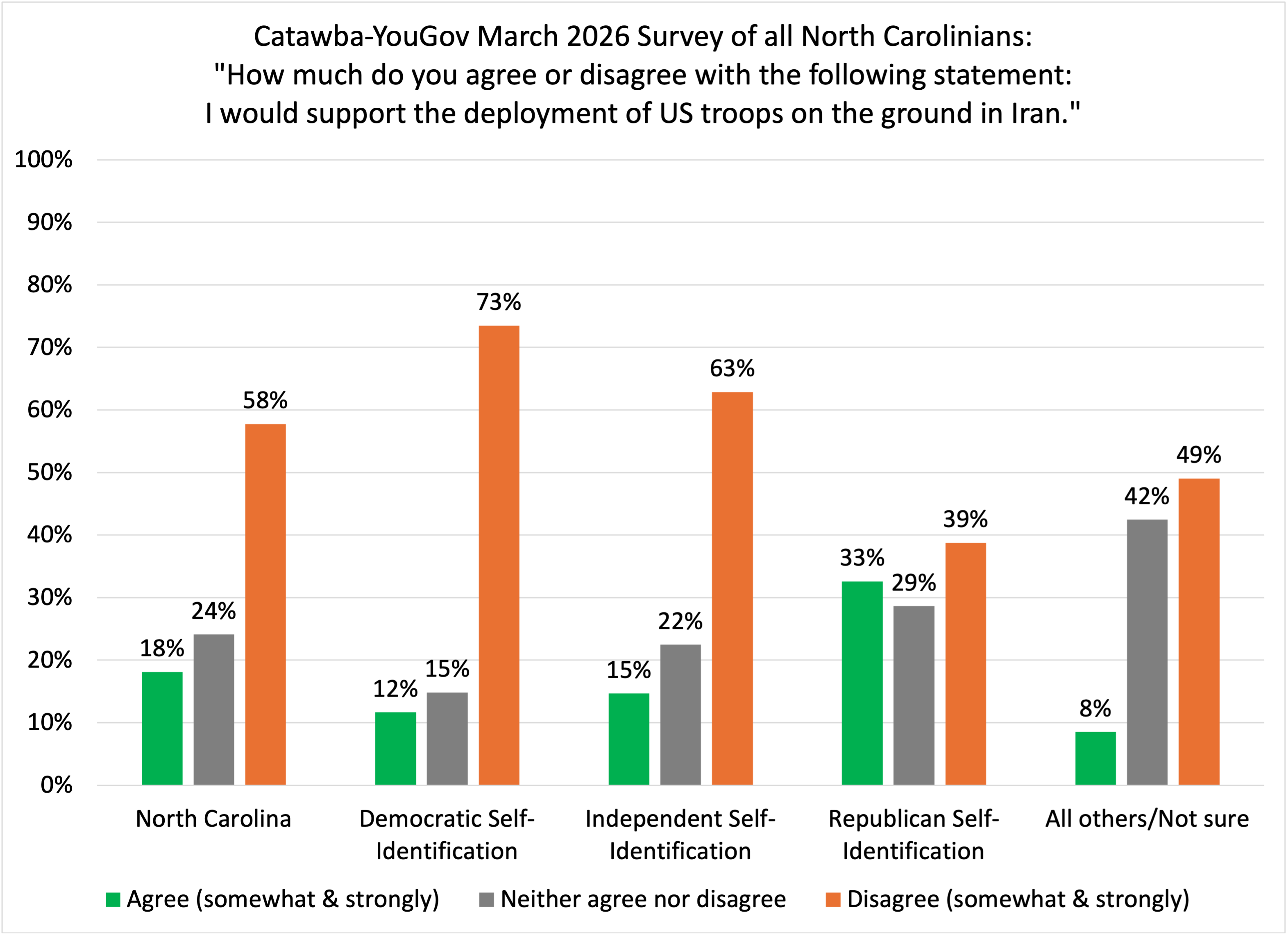
“With the role of North Carolina military personnel and operations in the month-long U.S.-Israel-Iran war, only one-third of North Carolinians agree that the U.S. was right to militarily intervene in Iran, while 44 percent disagree,” Bitzer said. “And with troops from the 82nd Airborne Division at Fort Bragg already deployed, 58 percent of North Carolinians are against land forces on the ground in Iran, with only 18 percent supporting such a move.”
Trump’s 42 percent approval and 55 percent disapproval mark the widest gap recorded in the past year, with both figures outside the survey’s margin of error.
NORTH CAROLINIANS WEIGH IN ON U.S. MILITARY ACTION AGAINST IRAN
Beyond the topline numbers, the U.S. and Israeli war with Iran garners striking divides. Seven out of ten Republicans agree that the United States was right to attack Iran, while 50 percent of independents and nearly seven out of ten Democrats disagree. Over seven out of ten Trump 2024 presidential voters support the action, while 78 percent of Kamala Harris’ voters disagree with the action.
When it comes to supporting U.S. troops in military engagement in Iran, 58 percent of North Carolinians opposed troops on the ground, with only 18 percent supporting. Only among Republicans is there a level of considerable support—one third—while a plurality is opposed. Among independents and Democrats, 63 percent and 73 percent, respectively, are against American troops on the ground in Iran.
Another clear divide over Iran is whether the president has a plan for the conflict with Iran. Only 36 percent of North Carolinians believe the president has a clear plan for the conflict with Iran, driven largely by Republican respondents.
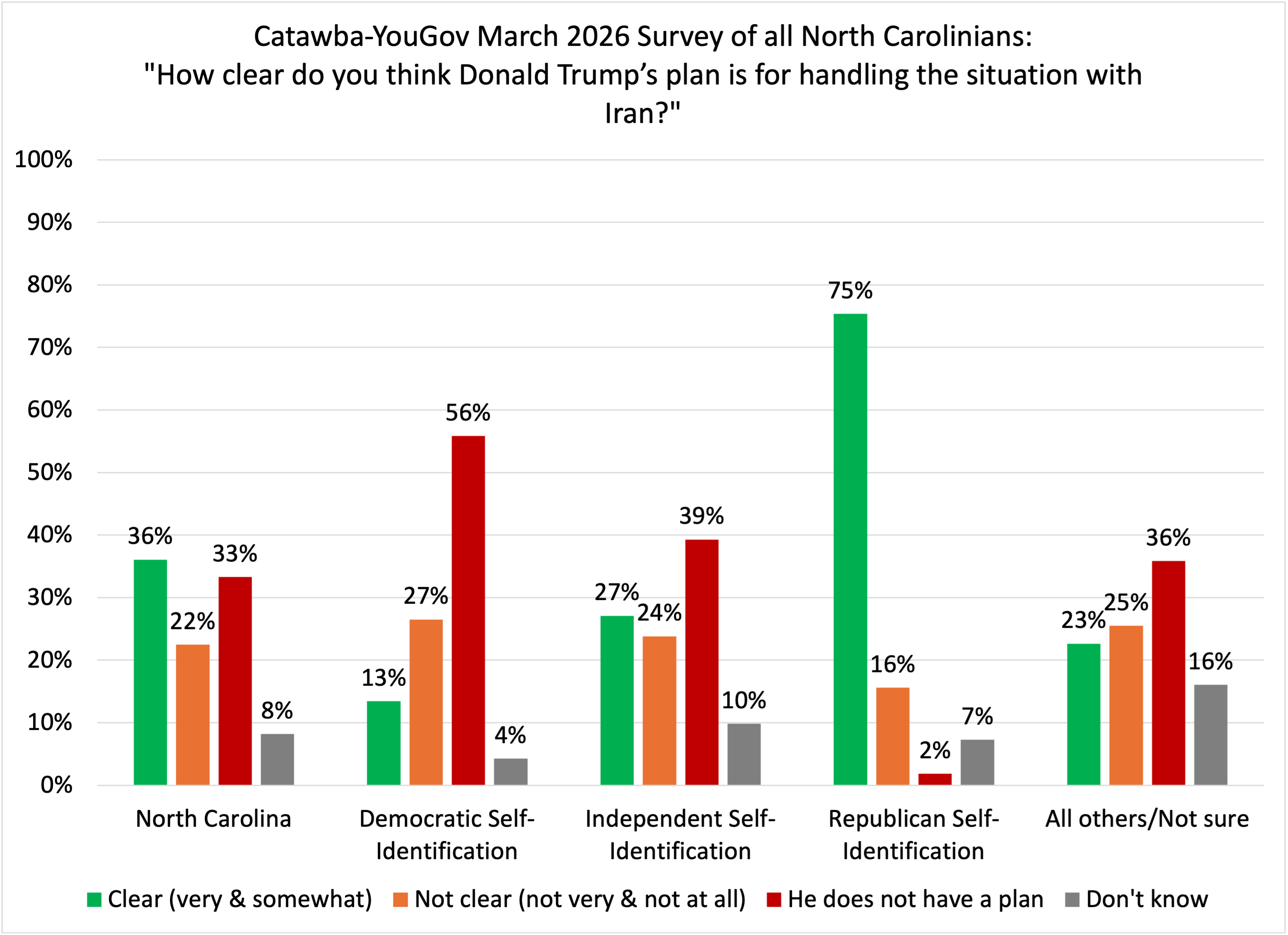
One-third say he does not have a plan at all for Iran, while another 22 percent say his approach is unclear.
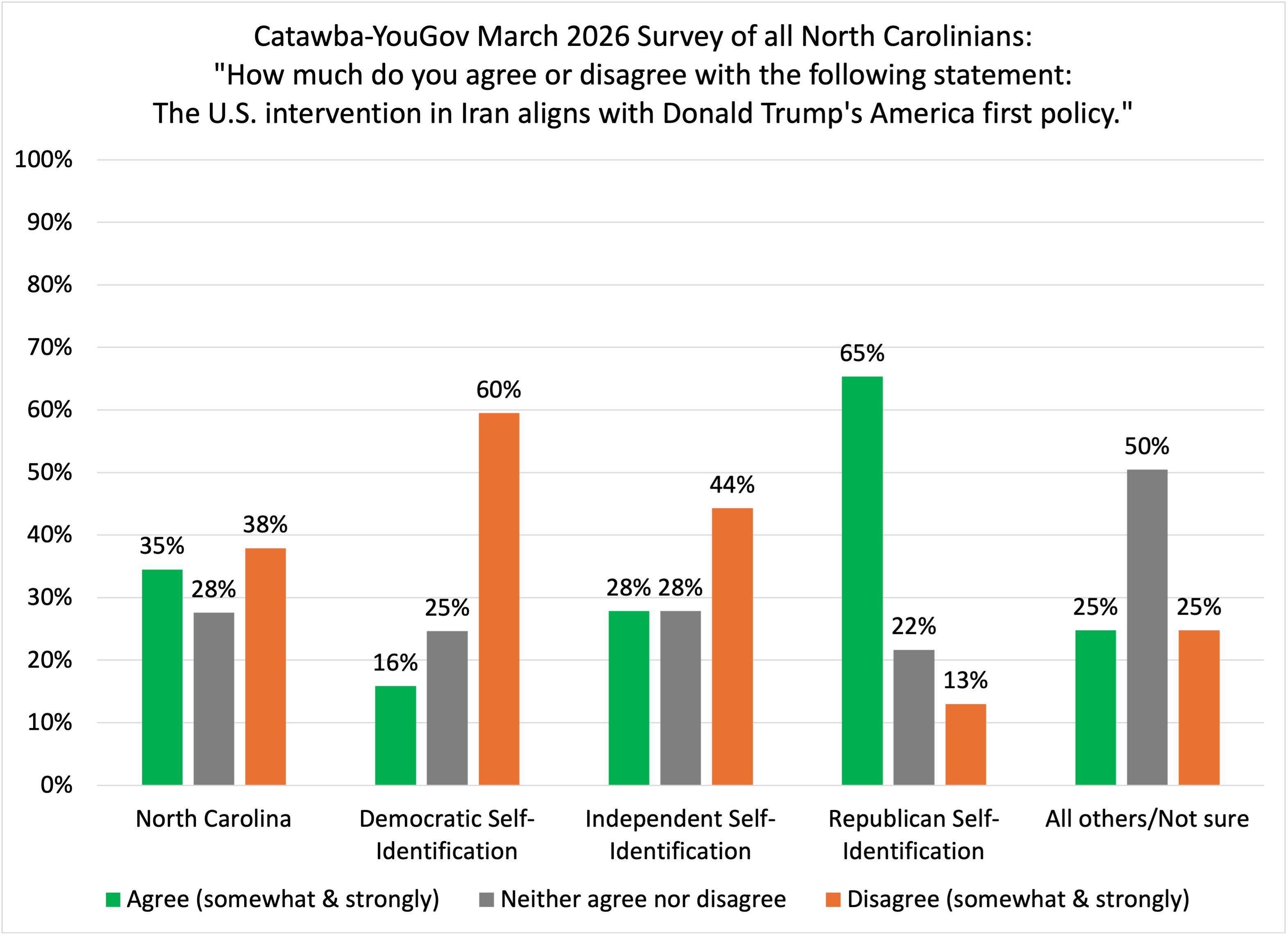
North Carolinians are almost split evenly when it comes to whether the Iran attacks align with the president’s ‘America First’ doctrine. Nearly two-thirds of Republicans say it does, while six out of ten Democrats and a plurality—44 percent—of Independents say it doesn’t align with ‘America First.’
Finally, the survey asked North Carolinians about their opinions regarding both financial and military aid towards two allies involved in military conflicts: Israel and Ukraine. Notably, North Carolinians express greater support for aiding Ukraine than Israel across both financial and military assistance.
Four out of ten North Carolinians agree that the United States should continue to support Ukraine in its fight against Russia, while only 35 percent of respondents said the U.S. should support Israel with military assistance and 28 percent with financial assistance.
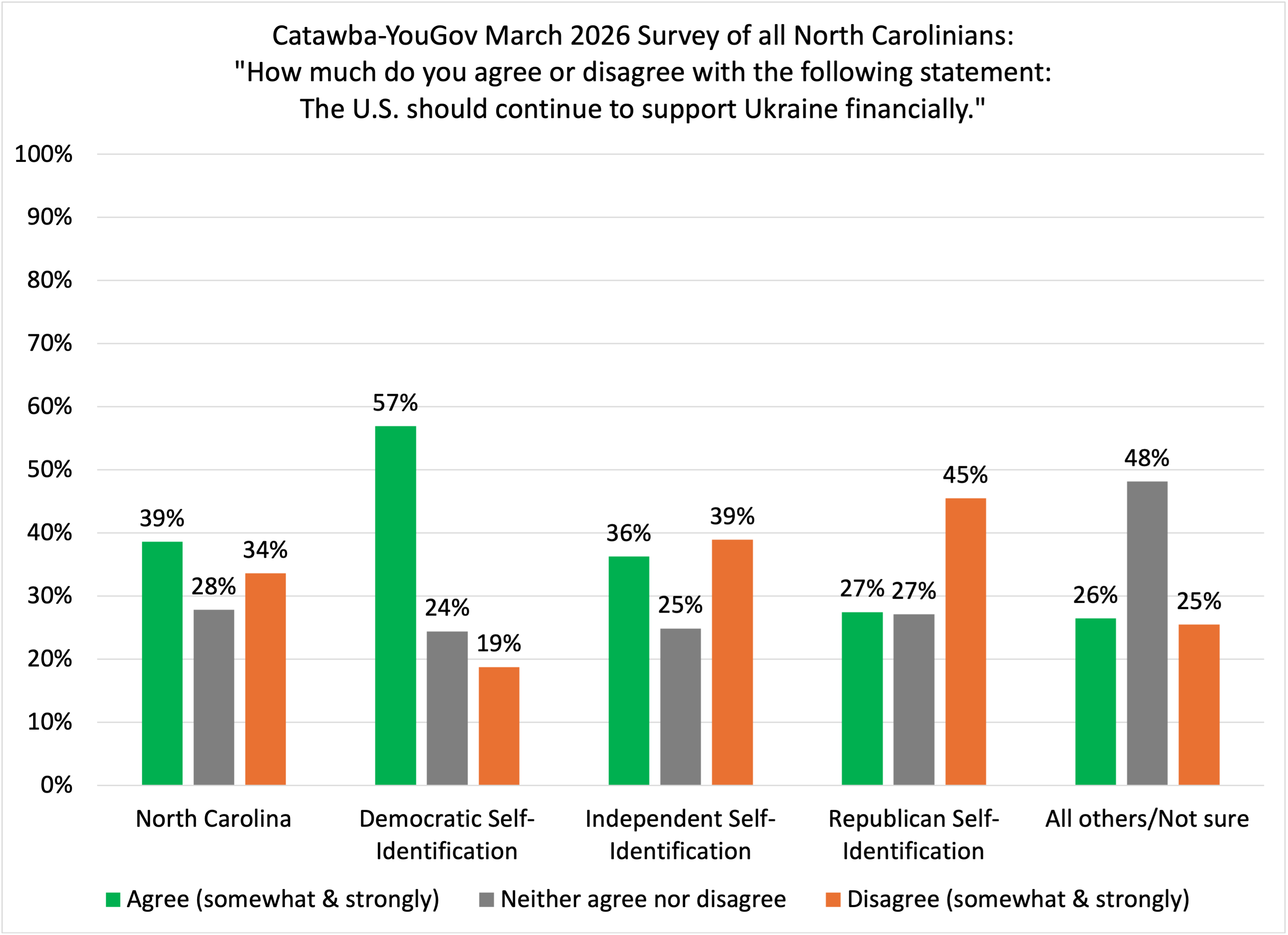
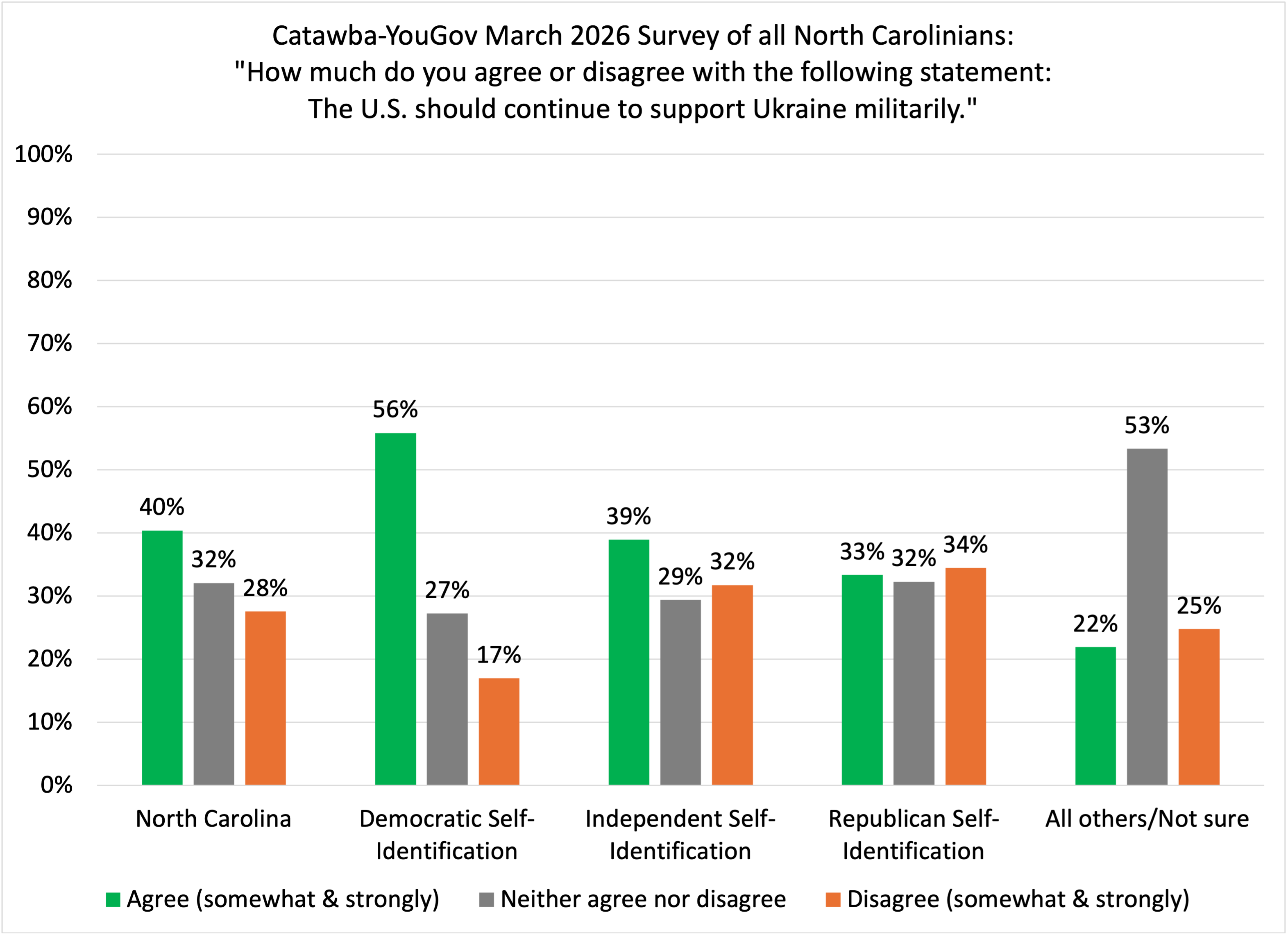
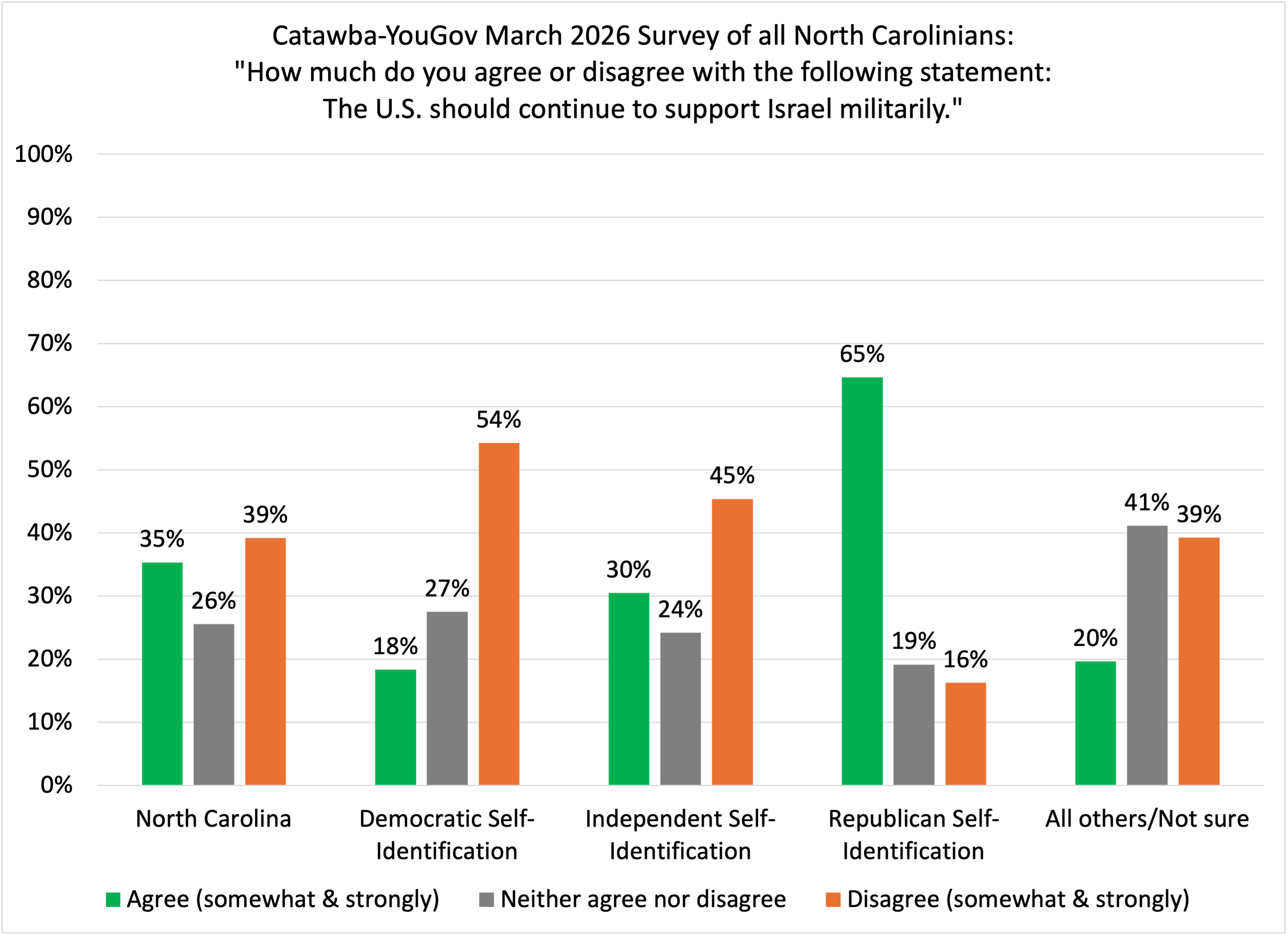
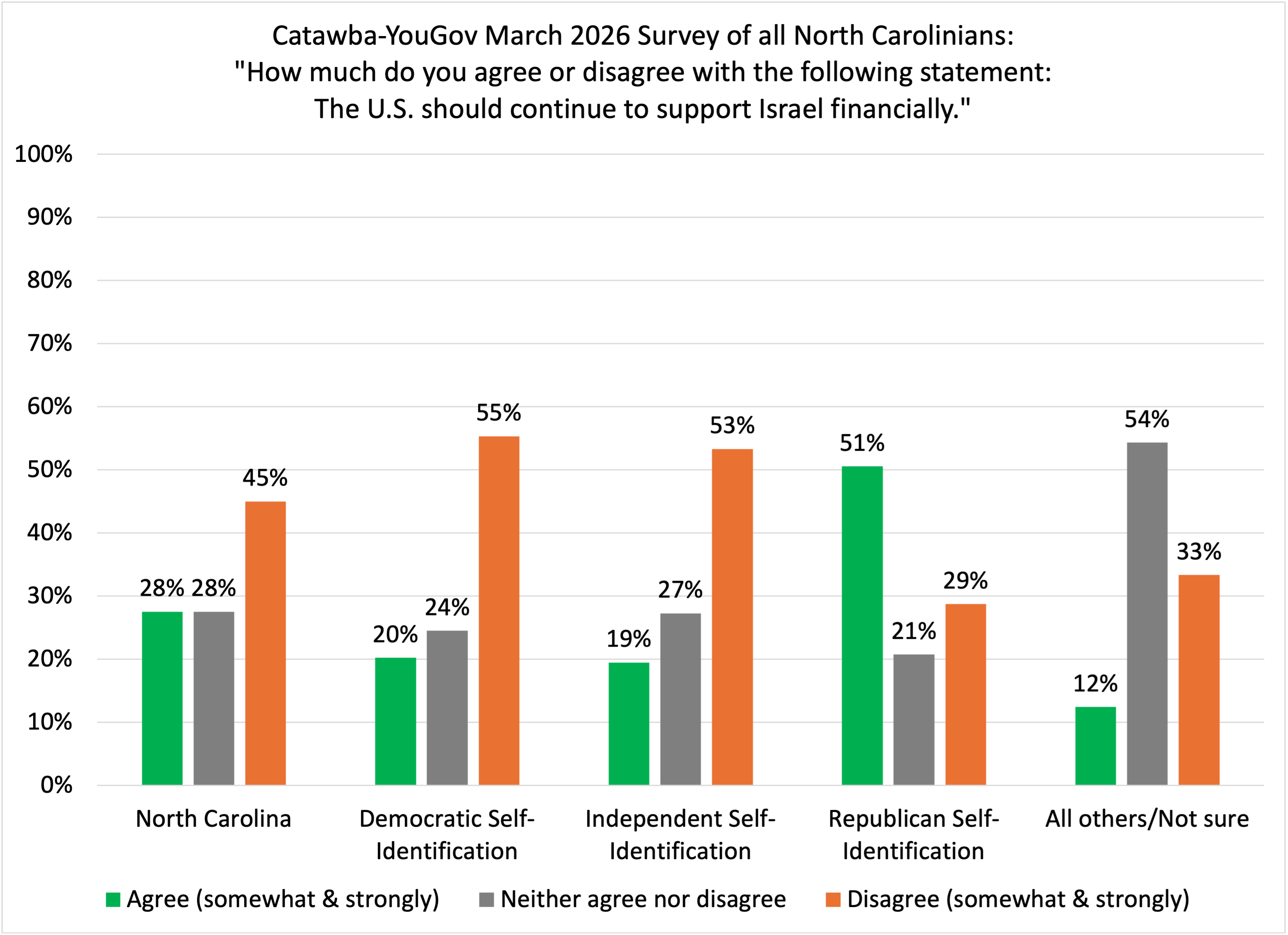
Not surprisingly, it’s Republicans who are more likely to favor assistance to Israel, while Democrats support aid to Ukraine.
These views on the Iran conflict may also be shaping the state’s political landscape, including early preferences in the U.S. Senate race.
EARLY SENATE HORSERACE REFLECTS CANDIDATE STRENGTH OVER PARTY LOYALTY
In the first test of the U.S. Senate race, former Governor Roy Cooper leads Republican Michael Whatley by fourteen points, 48 percent to 34 percent among likely voters (including those who initially said they were undecided but lean toward a candidate), with 14 percent undecided. Without leaners, Cooper holds a 47 percent to 31 percent advantage.
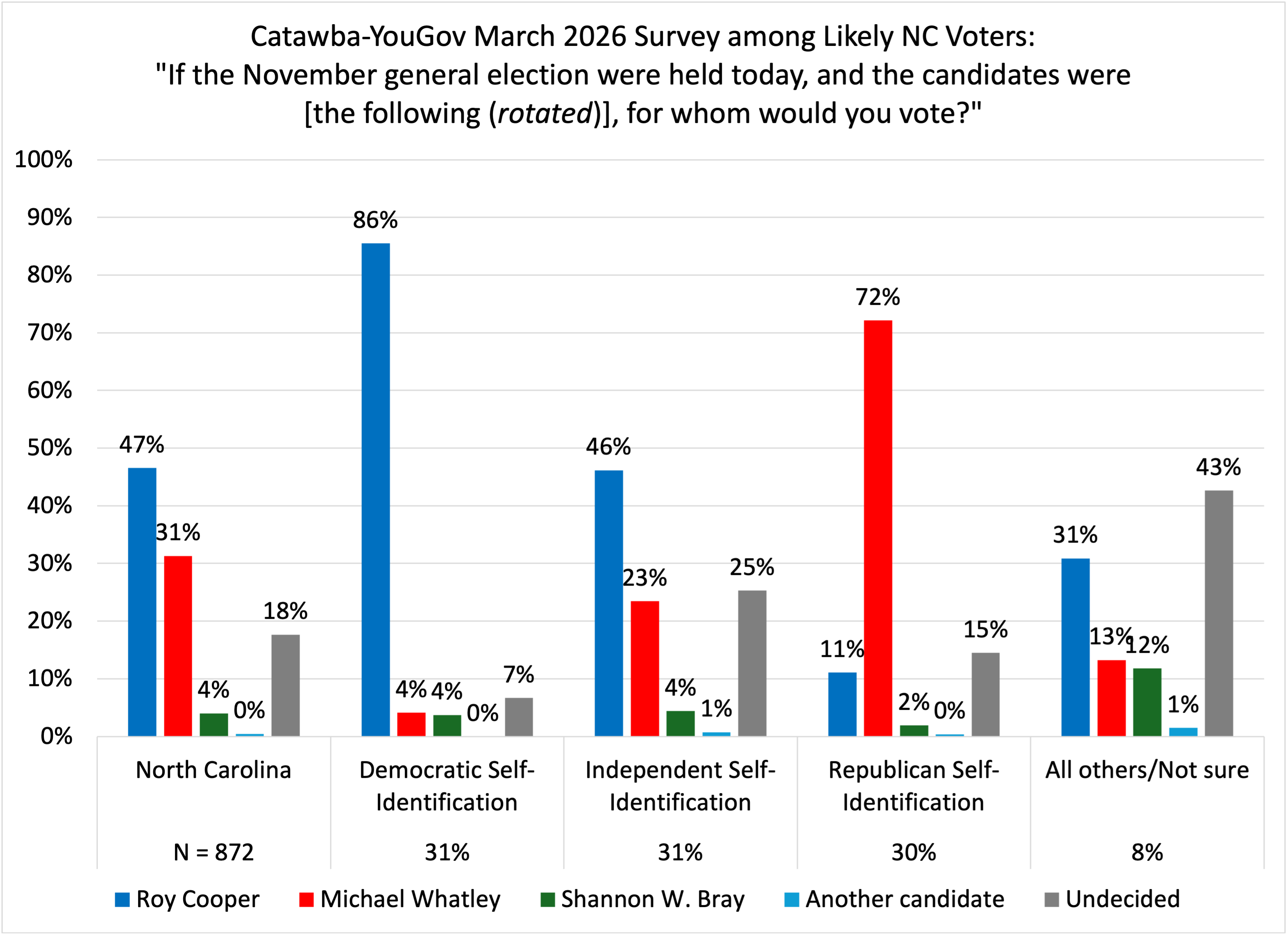
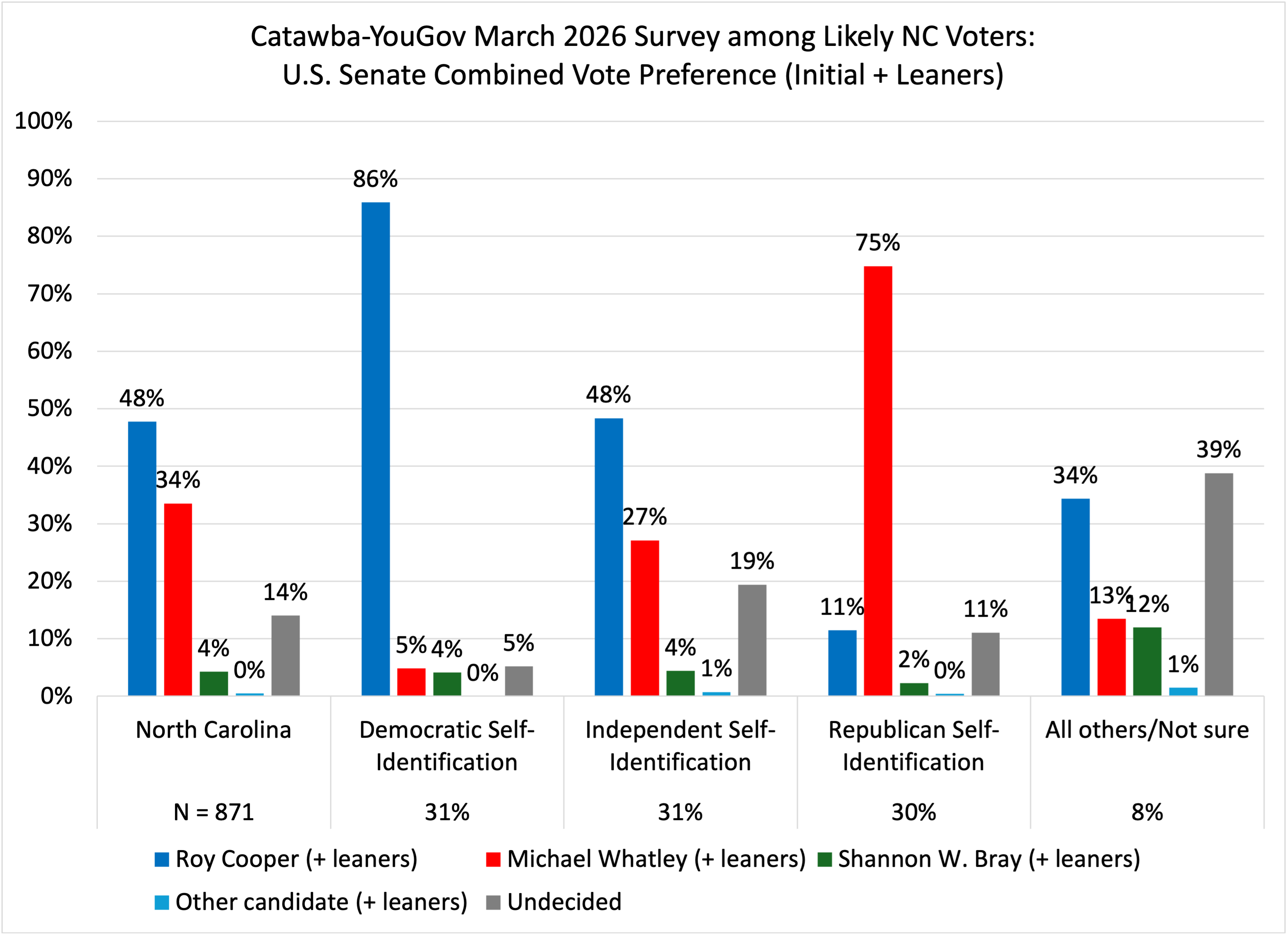
“What stands out is the contrast between the Senate race and the broader partisan environment,” Bitzer said. “Cooper’s double-digit lead, even as both parties have relatively weak standing, suggests voters are potentially responding more to the candidate’s familiarity and profile than to party labels alone, with some openness to crossing party lines. Cooper has shown this in his past runs, and early on it looks like he is continuing this trend.”
“The former governor also benefits from a strong Democratic base of support, while almost half of independent likely voters are inclined to vote for Cooper. While Whatley has three-quarters of Republican likely voters supporting him, only 27 percent of independents support him at this point in the contest.”
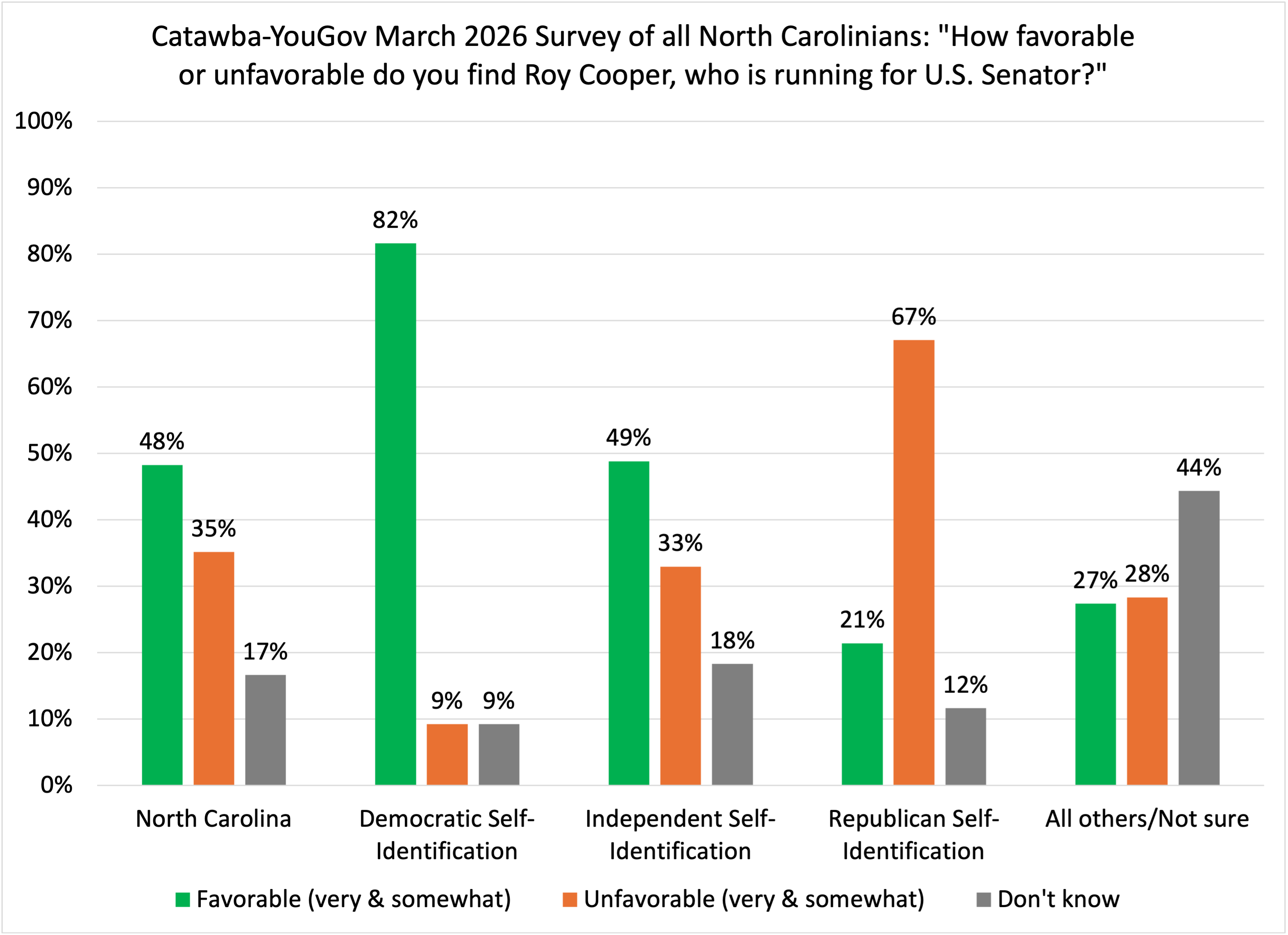
Differences in candidate familiarity may help explain the gap. Cooper’s approval stands at 48 percent statewide, with strong support among Democrats and nearly half of independents.
By contrast, 44 percent of North Carolinians say they are unfamiliar with Whatley. Among those who do recognize him, opinion is evenly split: 28 percent favorable and 28 percent unfavorable. Notably, a significant share of Republicans and nearly half of independents report not knowing enough about Whatley to form an opinion.
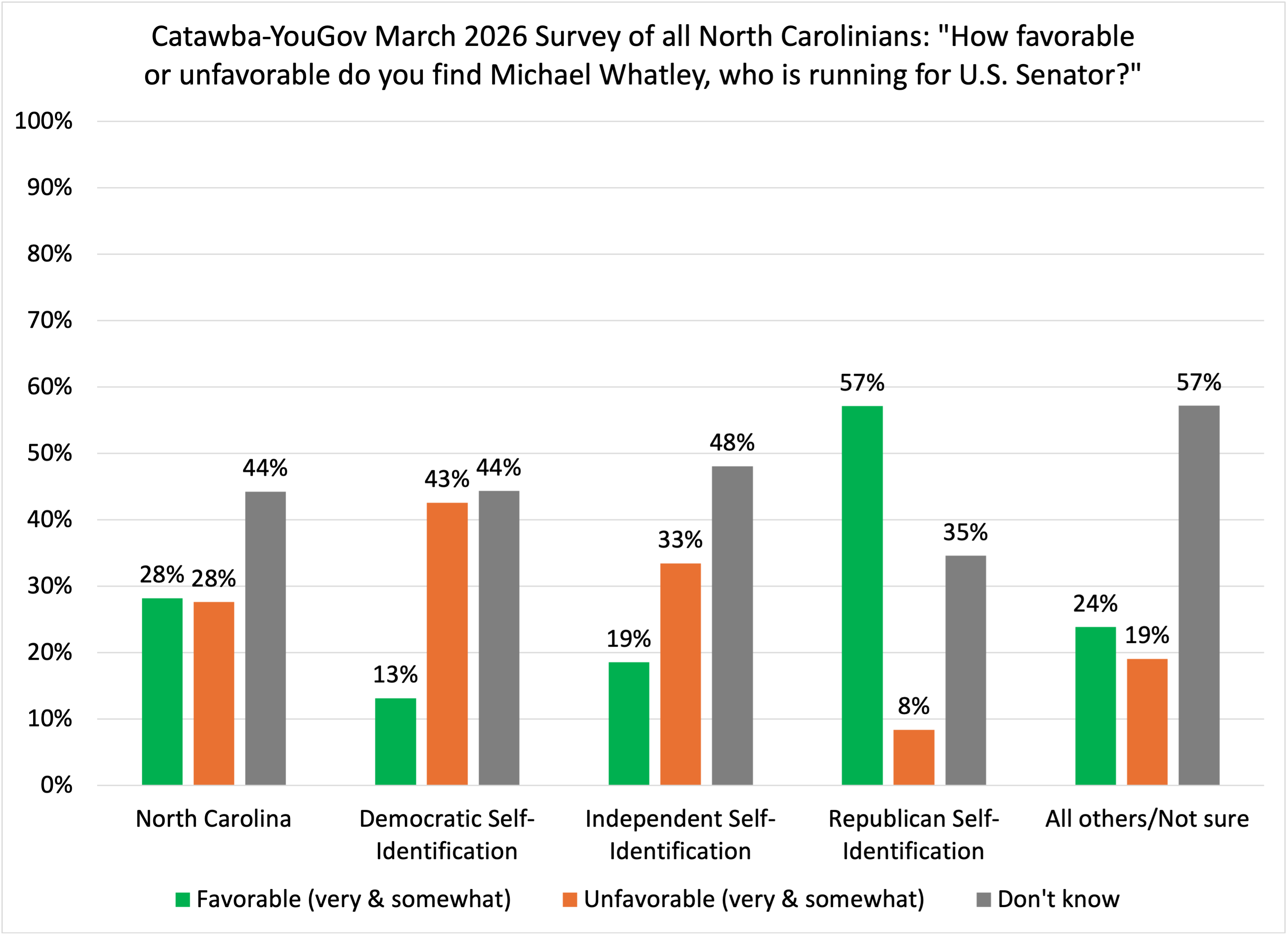
“When it comes to Whatley’s standing, there is still a sizable portion of his own party and independents who are unfamiliar with him,” Bitzer said. “And yet, he still garners strong support from Republican identifiers, which underscores the role of partisan loyalty in shaping early preferences.”
STEIN REMAINS POPULAR IN NC; TILLIS SLIGHTLY UNDERWATER; GENERIC BALLOTS SHOW CONSISTENT PATTERNS
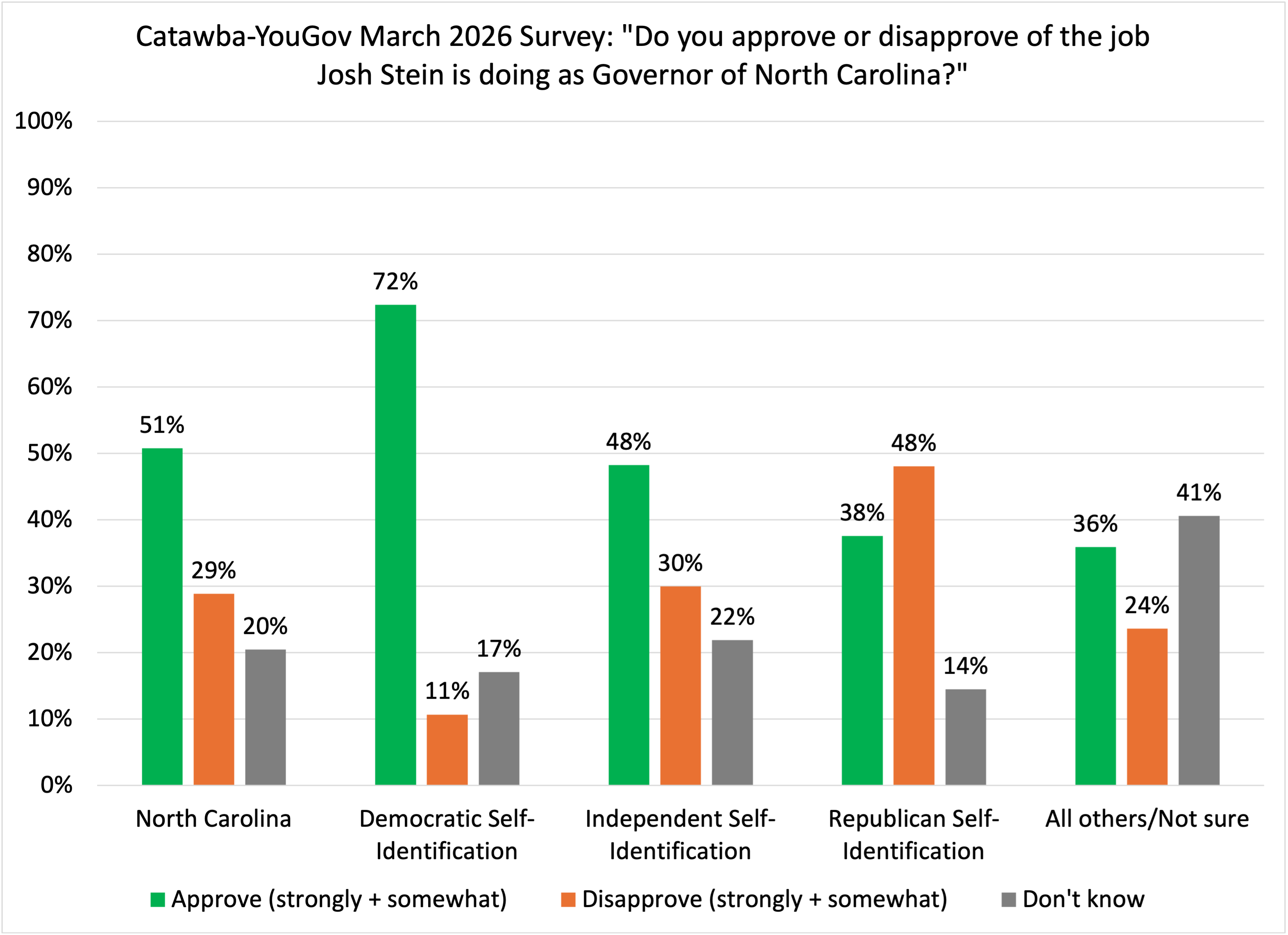
Governor Josh Stein continues to command a positive approval rating among North Carolinians, with half approving to 29 percent disapproval. Notably, 38 percent of Republicans approve of Stein, with almost half of independents and seven out of ten Democrats doing so.
U.S. Senator Thom Tillis, who is not seeking re-election this fall, is slightly underwater with his approval ratings: overall, 39 percent disapprove to 34 percent approving. Over one-third of Republicans disapprove of him, while almost one-third of Democrats approve of Tillis.
Both congressional parties share similar marks in approval among North Carolinians: 35 percent approve of the Democratic Party in Congress, while 37 percent approve of the Republican Party.
When it comes to the generic ballot for November general election for the U.S. House of Representatives, Democratic candidates hold a five point lead over Republicans, 43 percent to 38 percent. Bitzer notes that “with the partisan advantage the G.O.P. has in creating the congressional districts, Democrats could need more than a five point advantage going into November to hold, or possibly swing, some U.S. House seats in the state.”
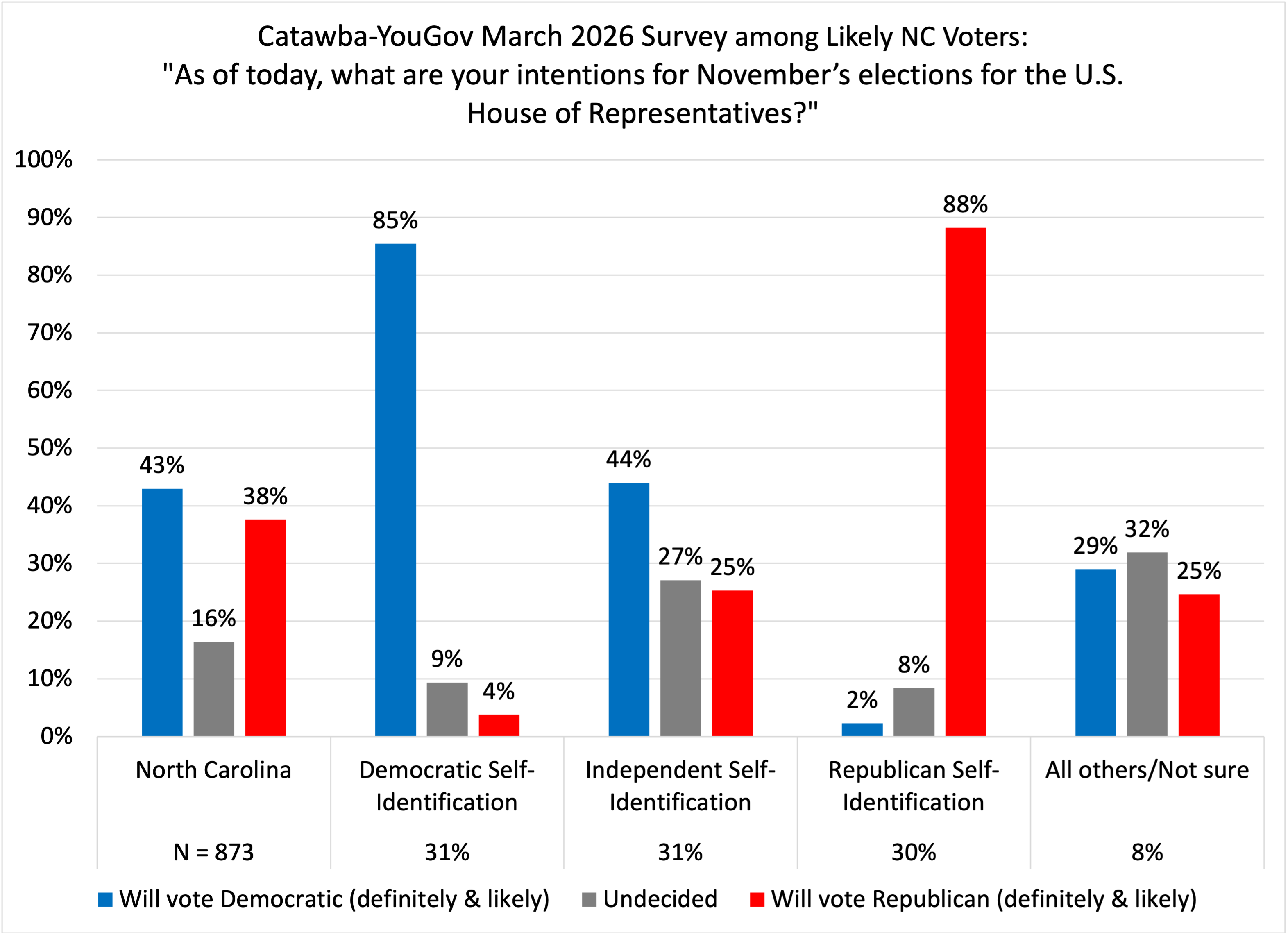
Seven months out, both parties have their base supporters firmly locked in for the congressional generic ballot: 85 percent of Democrats say they will vote for their party’s congressional candidate, while 88 percent of Republicans will vote for their candidates. Among North Carolina independents, Democrats have the advantage, 44 percent to 25 percent, with 27 percent of independents undecided.
Among the state-level generic ballot contests this fall, all show a very similar pattern: 43 percent Democratic to 36 percent Republican for the state supreme court, the N.C. state house, and N.C. state senate.
This is the first release from the Catawba-YouGov March 2026 survey. Future releases will focus on issues such as ICE, legal and undocumented immigrants, voting site locations and federal takeover of election administration, along with knowledge of U.S. constitutional powers and when there is noncompliance with constitutional authority.
SURVEY METHODOLOGY:
Catawba College’s Center for North Carolina Politics & Public Service wrote and paid for the survey. Between March 9 and 18, 2026, YouGov interviewed 1,266 18+ year-old residents of North Carolina who were then matched down to a sample of 1,000 to produce the final dataset. The survey’s overall margin of error (adjusted for weights) is plus or minus 3.58 percent, meaning that in 95 out of 100 samples such as the one used here, the results should be at most 3.58 percentage points above or below the figure obtained by interviewing all North Carolinians. Where the results of subgroups are reported, the margin of error will be greater.
The respondents were matched to a sampling frame on gender, age, race, and education. The sampling frame was constructed by stratified sampling from a North Carolina subset of the 2023 American Community Survey (ACS) 1-year sample with selection within strata by weighted sampling with replacements (using the person weights on the public use file). The matched cases were weighted to the sampling frame using propensity scores. The matched cases and the frame were combined, and a logistic regression was estimated for inclusion in the frame. The propensity score function included age, gender, race/ethnicity, years of education, and home ownership. The propensity scores were grouped into deciles of the estimated propensity score in the frame and post-stratified according to these deciles. The weights were then post-stratified on 2024 presidential vote choice, and further stratified by gender, age (4-categories), race (4-categories), and education (4-categories), to produce the final weight.
Since additional factors such as question wording and other methodological choices in conducting survey research can introduce additional errors into the findings, survey results should be viewed as informative and not determinative.
