by Christopher Cooper
Today, North Carolina, Texas, and Arkansas kick off the 2026 primary season. But no state better illustrates the collision between nationalized politics and intensely local battles than North Carolina. Here are a few tools to get you ready for what’s happening in the Old North State.
Early Voting Turnout is Up (But not as Much as it May Appear)
North Carolinians appear to be motivated to vote in 2026—or, at least motivated to vote early. The two graphs below show, first, the number of ballots cast per day by party, and second, the cumulative number accepted by day, by party. The solid lines represent 2026 data and the dotted lines represent 2022 data. The dips on days 35 and 42 represent Sundays.1
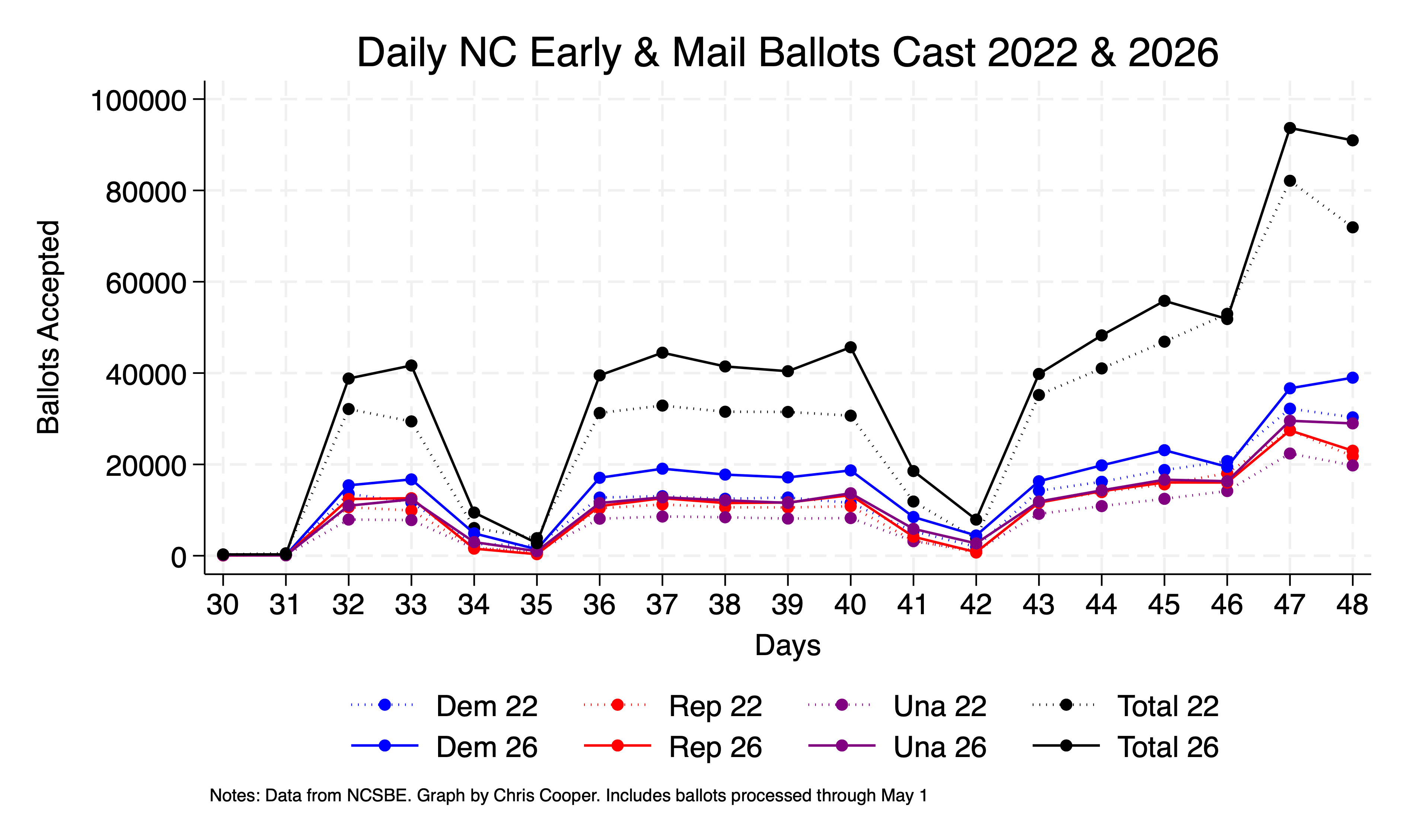
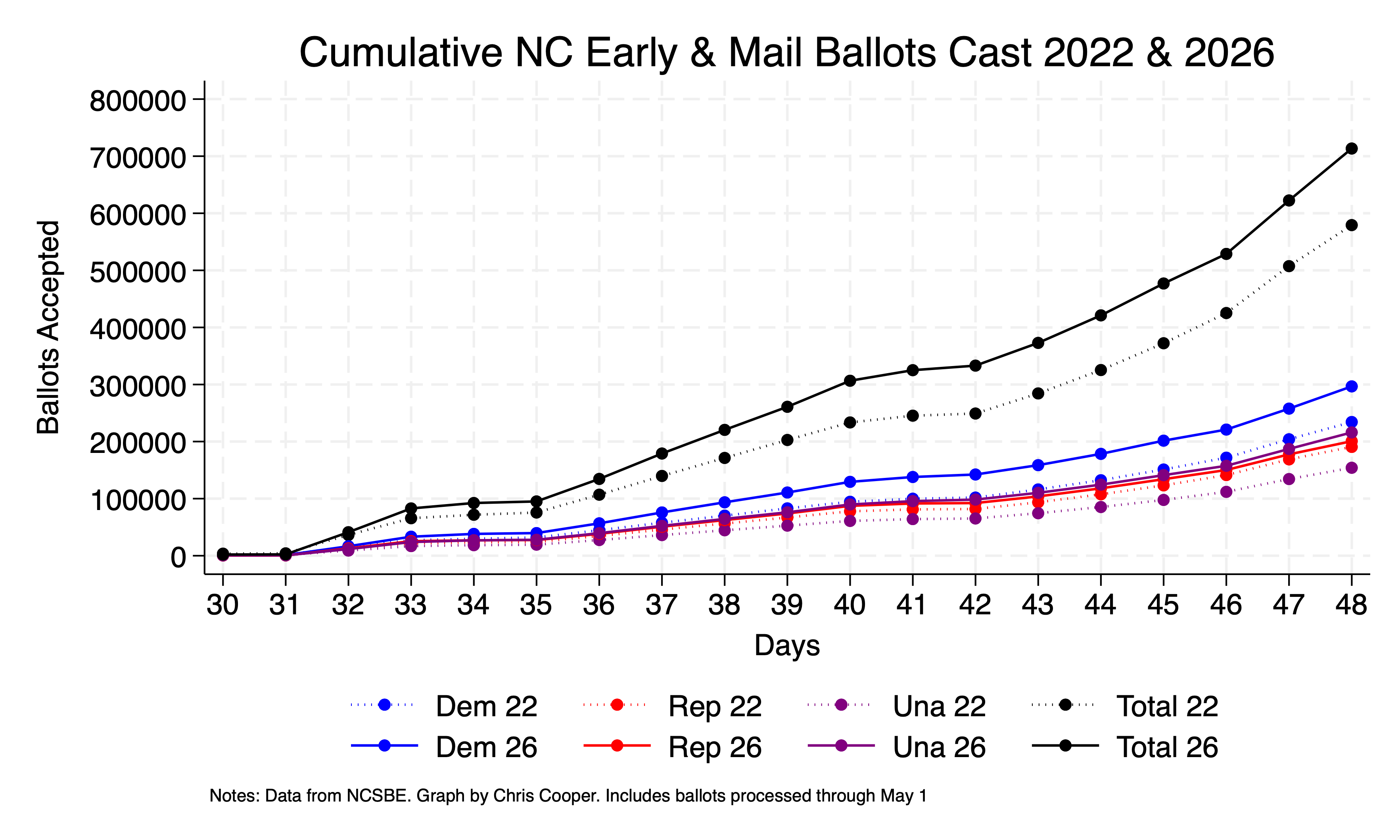
In terms of overall ballots cast, the total number of early votes cast in 2026 is about 23 percent higher than in 2022 (the last midterm primary). Democrats are 27 percent higher, Republicans are 5 percent higher and the number of Unaffiliated ballots cast are a whopping 40 percent higher than they were in 2022.
While these numbers are indeed impressive, they do overestimate turnout increases a bit. After all, there are many more registered voters in North Carolina in 2026 than in 2022. If we calculate voter turnout rate (# of votes divided by registered voters), early voting turnout is about one percentage point higher in 2026 than 2022 (9.2 percent in 2026 and 8.3 percent in 2022). One percentage point is important—critical even—but a far cry from the increase you see if you simply compute raw numbers.
If we compute voter turnout by party, we see that about nine percent of registered Republicans (almost identical to 2022), seven percent of registered Unaffiliateds (up about 8 tenths of a percentage point), and about thirteen percent of Democrats (up about three percentage points from 2022) cast an early or mail vote in North Carolina through the end of the early voting period.
The bottom line: early voter turnout is up since the last midterm primary—particularly among Democrats—but to get a true apples to apples comparison, we need to control for the size of the electorate. And, once we do that, we see important, but more modest effects.
Three more quick early voting items:
In one of the more durable changes, it does appear that Unaffiliated voters in 2026 are breaking much more heavily towards the Democratic primary than in the last midterm. In 2022, about 60 percent of Unaffiliated early voters chose the Republican primary. In 2026, about 55 percent of early voters chose the Democratic primary. There are a number of possible reasons for this shift, but the most likely is that in 2022, the most critical primary was on the Republican side for US Senate, whereas this cycle, neither party has a particularly competitive Senate primary.
Same day registration appears to be roughly where it was in 2022—or perhaps even down a bit. In 2022, .82 percent of all ballots cast were from people who completed same day registrations. In 2026, that number dropped to .72 percent.
All of these patterns vary considerably by county. In the 4th congressional district (Foushee/Allam) for example, Unaffiliated voters are overwhelmingly choosing the Democratic ballot, whereas in State Senate District 26 (Berger/Page), for example, Unaffiliated voters are overwhelmingly choosing the Republican ballot.
It’s important to remember that, while early voting data help us understand elections, they are pretty useless as a way to predict elections—winners, or eventual turnout. First, we don’t know who people voted for—only that they voted. Second, we only know what happened in early voting. It could be that all of these patterns will shift on election day. It will almost certainly be the case that some of them will.
A Few More Primary Election Items
Last week, the Democratic Congressional Campaign Committee (DCCC) named Jamie Ager, a Democrat running for NC-11, and 11 other Democrats to their “red to blue” campaign—an attempt to identify candidates who have the potential to flip a seat from…well…red to blue.
Not surprisingly, the other four candidates running for NC-11 didn’t appreciate that nod to Ager before the primary had concluded. Three of those candidates (Zelda Briarwood, Paul Maddox, and Richard Hudspeth) signed a letter opposing the DCCC’s intervention. They were joined by other Democrats in red-to-blue districts who were passed over, accusing the DCCC of “shaping fundraising pipelines, access, and perceived viability before voters have had the opportunity to evaluate the full field.”
This fight represents a fascinating tension in party politics. Is the role of a political party to identify the person they believe is the “best candidate” and help them win, or is it to sit out in the primaries, let the voters decide and jump in after the primary concludes? This tension isn’t new. The DCCC has engaged in the “Red to Blue” campaign since at least 2006. And February is not unusually early. In 2008, 2012, 2020, 2024, the initial “Red to Blue” campaign announcement was in January. This is not the first, or likely the last, time we’ll see this tension play out.
If you’re looking for a last minute cheat sheet for tonight, I’ve got you covered (pdf or html). It’s not the definitive list of races to watch (not sure what would be), but it’s as many as I could cram into four pages. Shout-out to Bolts Magazine—I modeled this after their “election night cheat sheet.” Speaking of Bolts, they’ve got a nice list of races to watch in North Carolina—as well as in Texas and Arkansas.
The inestimable Michael Bitzer had a good Substack on the early voting data the other day that’s worth your time.
I have a short write-up on the Berger/Page race that just posted on the London School of Economics American Politics blog.
Bryan Anderson reports that more than $10 million has been spent in support of Berger. You read that right. $10 million. For an office that pays $13,951
Can’t get enough of Berger/Page? Jeff Billman had a terrific piece in the Assembly about the race—and about Page in particular. Describing the reporting experience, he says “Interviewing Page can sometimes feel like catching water with a butterfly net. Soliloquies spiral into tangents that eventually return to his favorite subjects—Trump or border security. Along the way, he might or might not answer your question.” That’s one for Frank Bruni’s “For the love of sentences.” And a good way to end this missive.
