Last Thursday (February 12, 2026) marked the beginning of in person early voting in North Carolina. So, where do we stand and what should we watch?
Early Voting Through Saturday, February 14
After three days of early in person voting and a month of mail voting, roughly 92,000 ballots have been cast.1 A small number of ballots (around 275) were cancelled, were rejected, or are pending “cure.” About 89,000 (97%) of those votes were cast in person and the remainder (around 3,100) were cast by mail.2
This is running around 20,000 votes higher than 2022. Democratic, Republican, and Unaffiliated turnout are all up, as you can see in the graph below.3
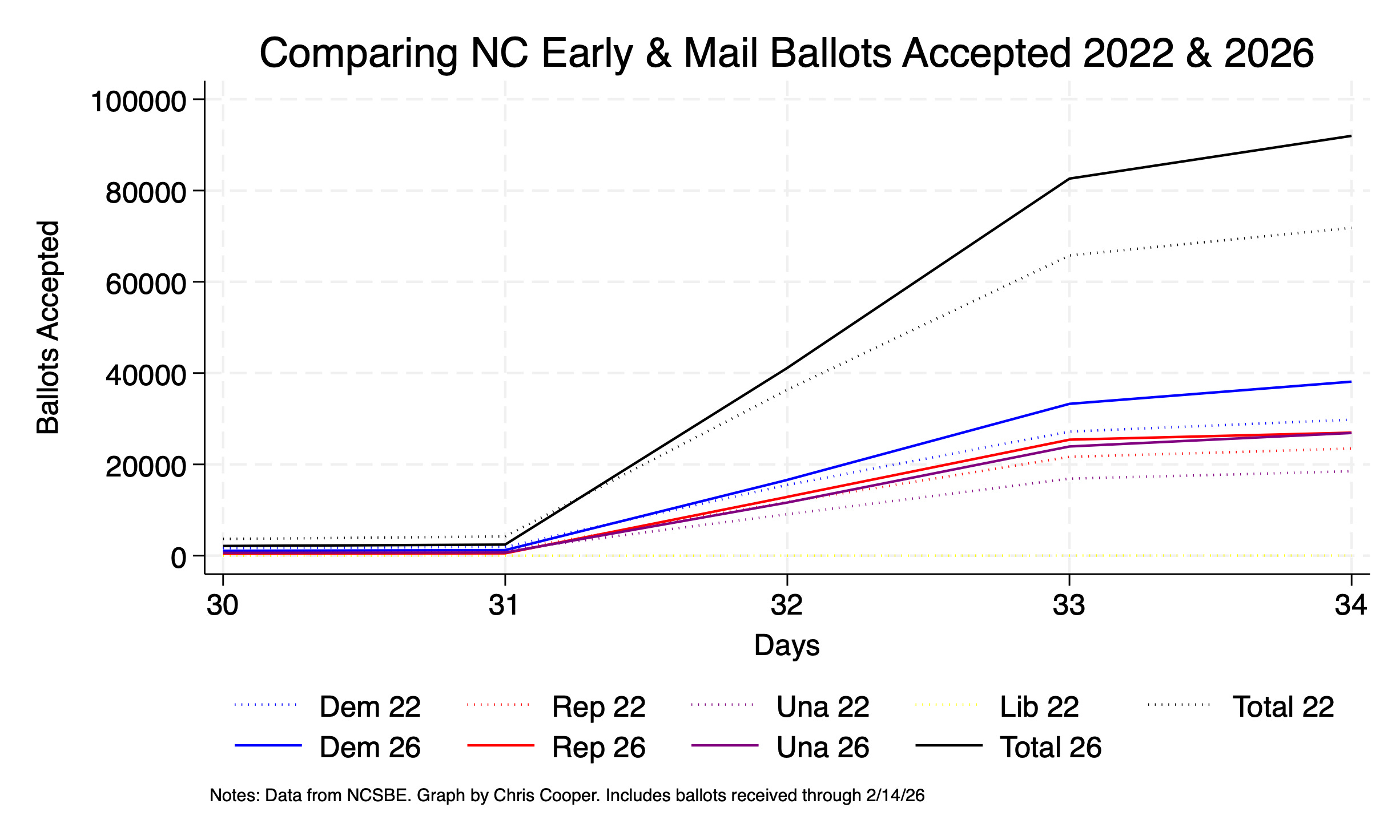
Democrats (at this ridiculously early stage) are punching a bit above their weight. About 41 percent of votes cast thus far are by Democrats, 29 percent by Republicans and 29 percent by Unaffiliated voters. Before you think this means the Democrats are going to win more elections as a result, remember that Democrats are most likely to use early and mail voting whereas Republicans are more likely to cast their votes on Election Day.4
In North Carolina, Unaffiliated voters can participate in either party’s primary (but not both).5 Thus far this critical group of voters have split roughly evenly—about 53 percent of them have cast their vote in the Democratic primary; around 47 percent in the Republican primary.
State Senate District 26
This is probably the most watched primary in North Carolina and likely the most important state Senate primary in North Carolina history. It even made the New York Times last week.
The incumbent, Phil Berger is the most powerful politician in North Carolina and the challenger, Sam Page has been Sheriff of Rockingham County since the second Clinton administration. Through the end of 2025, Berger had raised millions; Page had raised less than $30,000.6 Both are from Rockingham County, although more voters in the district come from Guilford than Rockingham.
Both the available polling and the available vibes suggest that this one might be close.
Thus far, voter turnout in SD-26 is high, but not extraordinarily so. In terms of raw turnout SD-26 is 10th in the state. Rockingham turnout is a little higher than the district as a whole (8th highest), but not enough to be meaningful.
Rockingham County voters seem to have gotten the message that one primary matters more than the other. Unaffiliated voters in Rockingham are breaking overwhelmingly for the Republican primary—87% (!) of them have chosen the Republican ballot. In 2022, early voters in Rockingham voters also preferred the Republican primary (77% to 33% for the Democratic primary), but a ten percentage point jump is huge (particularly from such a high base). We will see if this holds.
In the Guilford County portion of SD-26, however, the Democratic primary is the more popular choice for Unaffiliated voters (58% to 42%).7
These counties show starkly different political behavior—whether this signals a broader pattern or remains a local quirk won’t become clear until after Election Day.
Other Primaries to Watch: Focus on the West
Although it may be the highest profile primary in the state, SD-26 is far from the only primary to watch. Bryan Anderson of the Assembly had a terrific rundown on the 26 primaries to watch in 2026 (split into two separate posts). I recommend reading both and taking notes so you know what to watch on election night
Rather than till the same soil as Anderson just did, I’ll just offer a take on four elections in Western North Carolina that may be slightly off of the radar for folks in the rest of the state
NC-11 Democratic primary.8 Once considered just out of reach for Democrats, NC-11 is now the most competitive district in North Carolina. The district moved slightly left in 2024 while the rest of the state moved right, and the redrawing of NC-1 to favor Republicans has focused Democratic attention in this mountain district. Five candidates are running for the opportunity to face (what is likely to be) incumbent Republican Chuck Edwards in November. The favorite is Jamie Ager, a farmer, who is from a family that has had its share of political success in Western North Carolina, but Richard Hudspeth, a Doctor who entered the race after Ager, has been punching hard—calling out Ager and local Democratic leaders for what he terms “pay to play.” Hudspeth faces an uphill battle—at the end of 2025 Ager had raised more than the combined sum of the rest of the Democratic field. He has also raised more than the Republican incumbent Chuck Edwards.
HD 113 Republican Primary: This one features a current member of the House leadership (Jake Johnson) against a former member of the House leadership (Mike Hager). Hager retired from the General Assembly in 2016 and soon moved into political consulting/lobbying; Johnson was elected two years later. Johnson seems to be garnering support from many of the major players in the party (including $20,000 from the NCGOP House Caucus), but Hager has a cash on hand advantage, which he gained by loaning his campaign about $185,000. Given his name recognition and current power, Johnson has to be considered the favorite. But without reliable polling, predicting how competitiveness this actually is amounts to guesswork.
NC-119 Republican primary. This mountain district (Jackson, Swain, and Transylvania counties) is represented by Republican Mike Clampitt, who is running for re-election. Mike Yow and Anna Ferguson have also filed for the seat. While Yow (who recently switched parties to become a Republican) is unlikely to gain much support, Ferguson might be different. Clampitt has never been a prodigious fundraiser and this year looks to be no different. Through the end of 2025, Clampitt had about $2,500 cash on hand and had received just three donations—a $1,000 donation from the NC Nurse Anesthetists PAC and individual donations totaling $150. Ferguson’s campaign finance reports aren’t up, but she appears to be running an active campaign and has mailers paid for by the “NC Jobs PAC.” I have no idea whether or how this activity will translate into votes, as Clampitt has endured other credible challenges in the past. But it’s perhaps one worth watching.
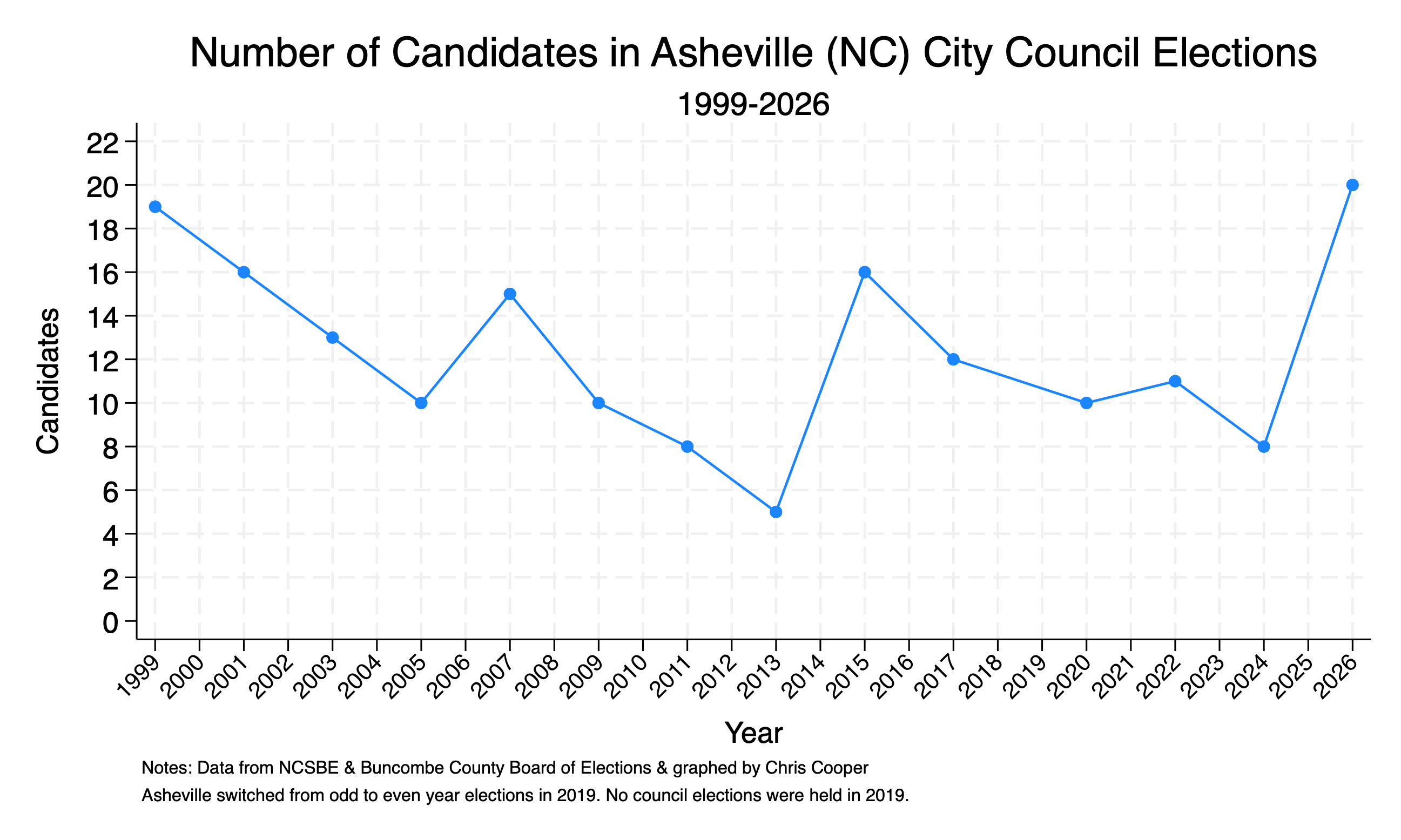
Asheville city council. A whopping 20 (!) candidates are running for three seats on the Asheville City Council. Voters select three candidates; the top six vote-getters9 will advance to November’s General Election. These elections are non-partisan (there won’t be a D or R on the ballot), but in reality, this is a pretty left-leaning bunch. Incumbents Maggie Ullman, Sheneika Smith and Antanette Mosley are running for re-election but it’s hard to handicap their odds, given the size of the field. Mosley has been accused of, among other things, not living in the city (or in the state) and voting in multiple states. Primaries are always unpredictable—primaries with 20 candidates? Your guess is as good as mine.

Quick Takes On Early voting Sites, The North Carolina Constitution, and the Joy of a Good Rock Show
Last week, a federal judge ruled against the College Democrats who were challenging the elimination of a site at Western Carolina University and the decision not to place sites at UNCG and NC A&T (neither of which had sites in the 2022 primary). Keep in mind that early voting site decisions apply to one election at a time. This summer, the county boards will decide about site placement for the General Election. I expect many of the same issues, arguments and data to come up again.
Mecklenburg County Sheriff Garry McFadden testified before the North Carolina General Assembly and made a few statements that went viral (and not in a good way). Yesterday Michael Graff wrote about McFadden the human. It’s a must-read. I have little to add about this controversy, except that one of McFadden’s supposed “gaffes” wasn’t really a gaffe at all. McFadden was asked which branch of government he “operated under.” He answered “Mecklenburg County.” The questioning continued in a way that did not go well for McFadden (and that’s putting it kindly). McFadden gave many answers that were downright wrong but at least this one answer was, according to the NC Constitution, correct.
North Carolina sheriffs don't fit neatly into the three-branch framework; they are not mentioned in Article III of the NC Constitution (the one about the Executive), but rather in Article VII, which covers local government. According to John Orth and Paul Newby (yes, the same Paul Newby who is Chief Justice of the NC Supreme Court) in their seminal book on the North Carolina constitution, “the sheriff is neither a constitutional executive nor a10 judicial officer, but an agent of local government.”
To be clear, sheriffs do exercise executive power in the ordinary sense—they enforce the law. But constitutionally speaking, they are local officers established under Article VII, not members of the state executive branch created in Article III. If the question was about the state constitutional structure, “Mecklenburg County” was a correct answer.
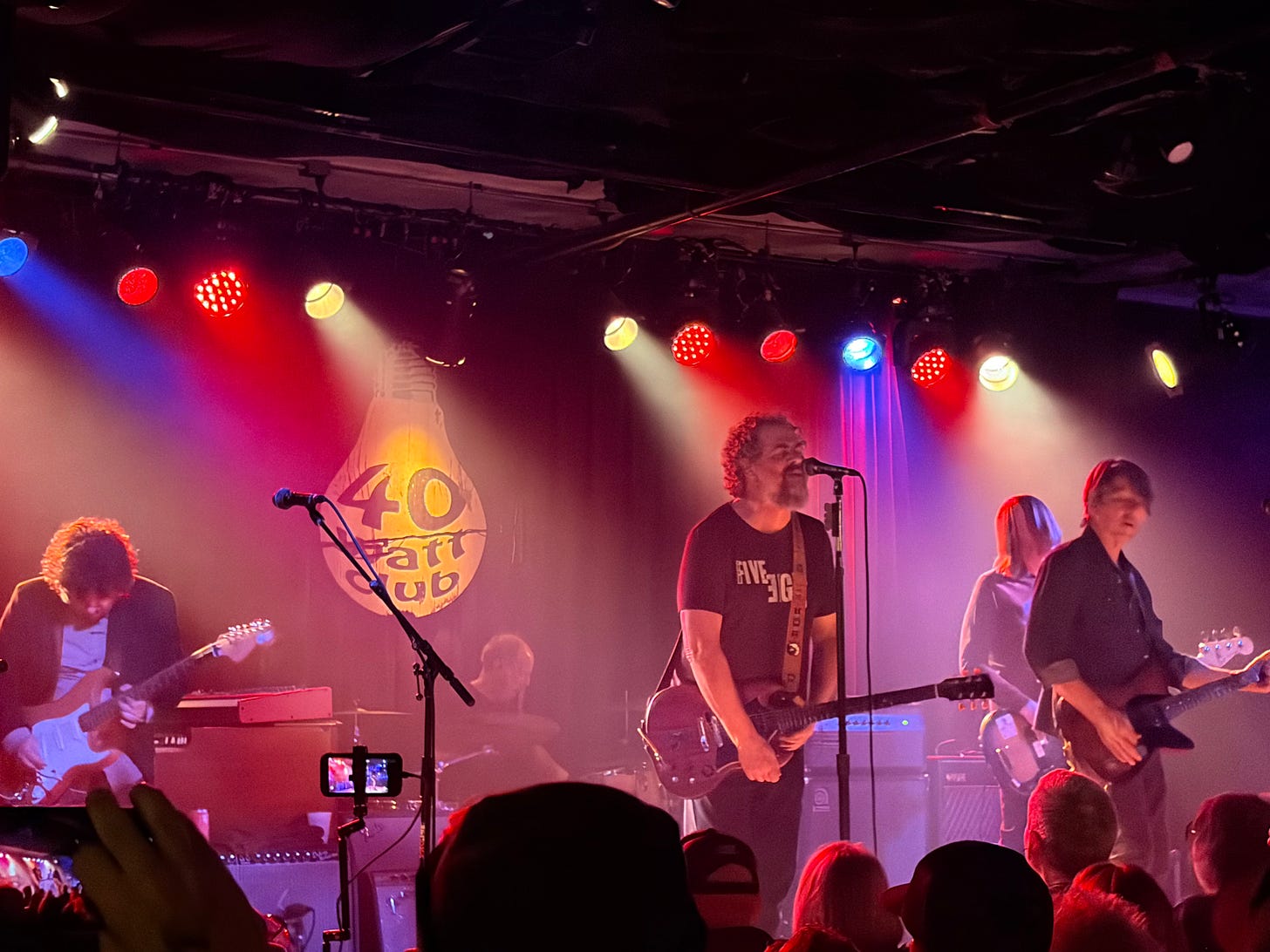
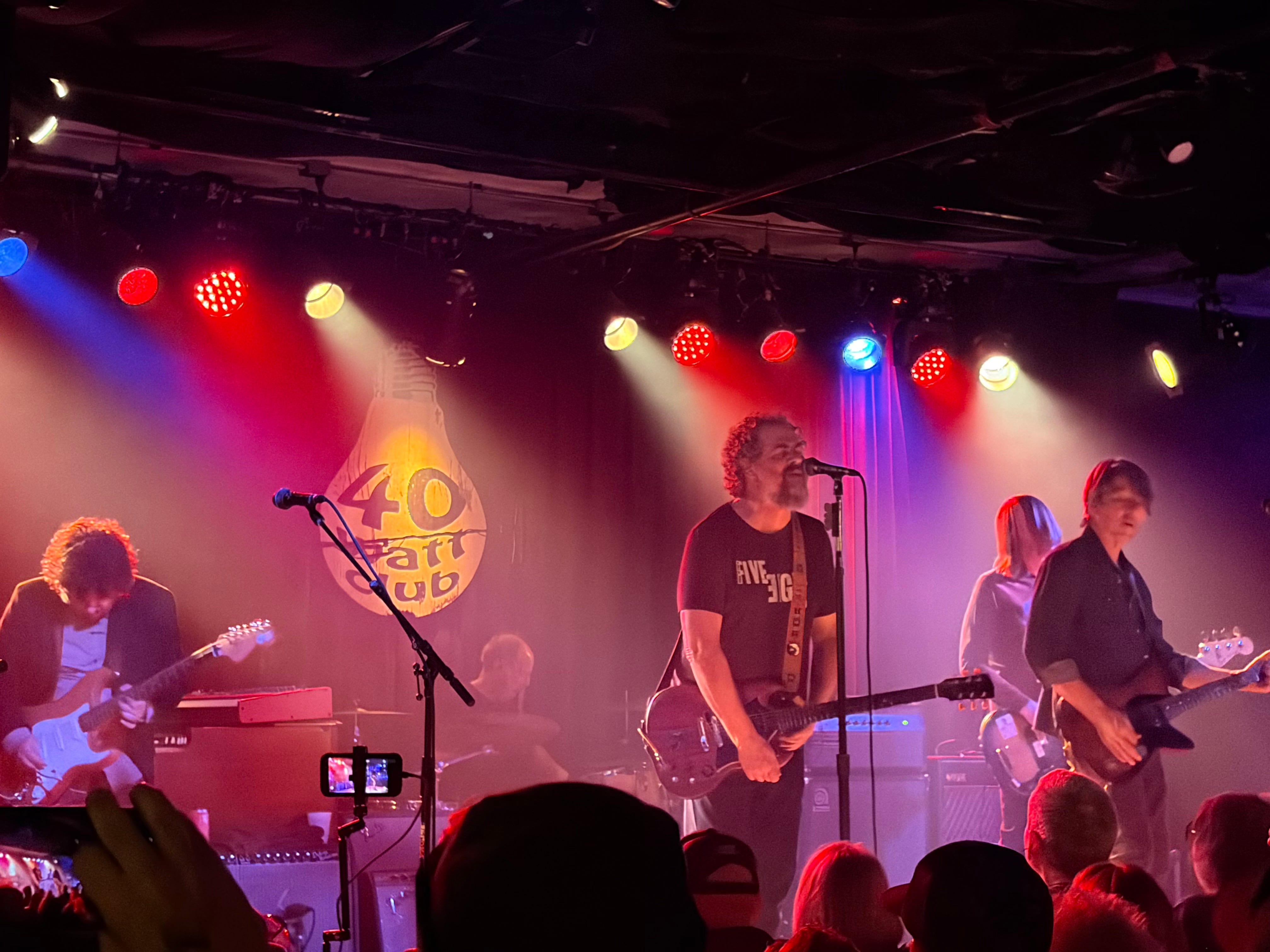
I took a quick trip down to Athens, GA Friday night to catch the Drive by Truckers at the 40 Watt. I’ve seen countless Truckers shows over the years, and they’re still bringing it just as hard—one of the great rock bands of the last quarter century. There’s something about standing in a crowded room watching, listening to, and feeling real people play live music that can’t be replicated. It’s hard to make the time, but it’s always worth it.

This number increased by about 2,500 votes by Monday morning.
I’m rounding off all of these numbers because, for a variety of (very good) reasons, some ballots take longer to report (ex. same day registrations), so although I download these raw data every morning, they are best considered a very reliable estimate, not correct to the single digit. Plus, rounded off numbers are easier to understand.
Andy Jackson at the John Locke Foundation does a terrific job maintaining and posting about their vote tracker, which allows you to learn about these patterns with a few clicks, rather than time with spreadsheets.
See chapter 6 of Anatomy of a Purple State
See chapter 7 of Anatomy of a Purple State
Two notes on these campaigns finance numbers—and the ones that follow. These figures do not include the independent expenditures (groups that spend, but cannot coordinate with the candidates), nor do they include anything raised or spent after December 31, 2025.
The majority of the registered voters in SD-26 are in Guilford County.
This one is in the second of Bryan Anderson’s primary rundowns; The Hager/Johnson election is in the first.
Or votetainers, if you prefer (h/t Pete Kaliner)
In a previous version of this I neglected to include “nor a” in the quote.
