by Christopher Cooper
North Carolina’s 2026 early voting plans for the primary election, which determine when, where and how easily North Carolinians can cast their ballots before election day, are now set and the final list of sites is posted to the North Carolina State Board of Elections web site.
What does the 2026 primary plan say and how does it compare1 to previous years?2
Total Sites
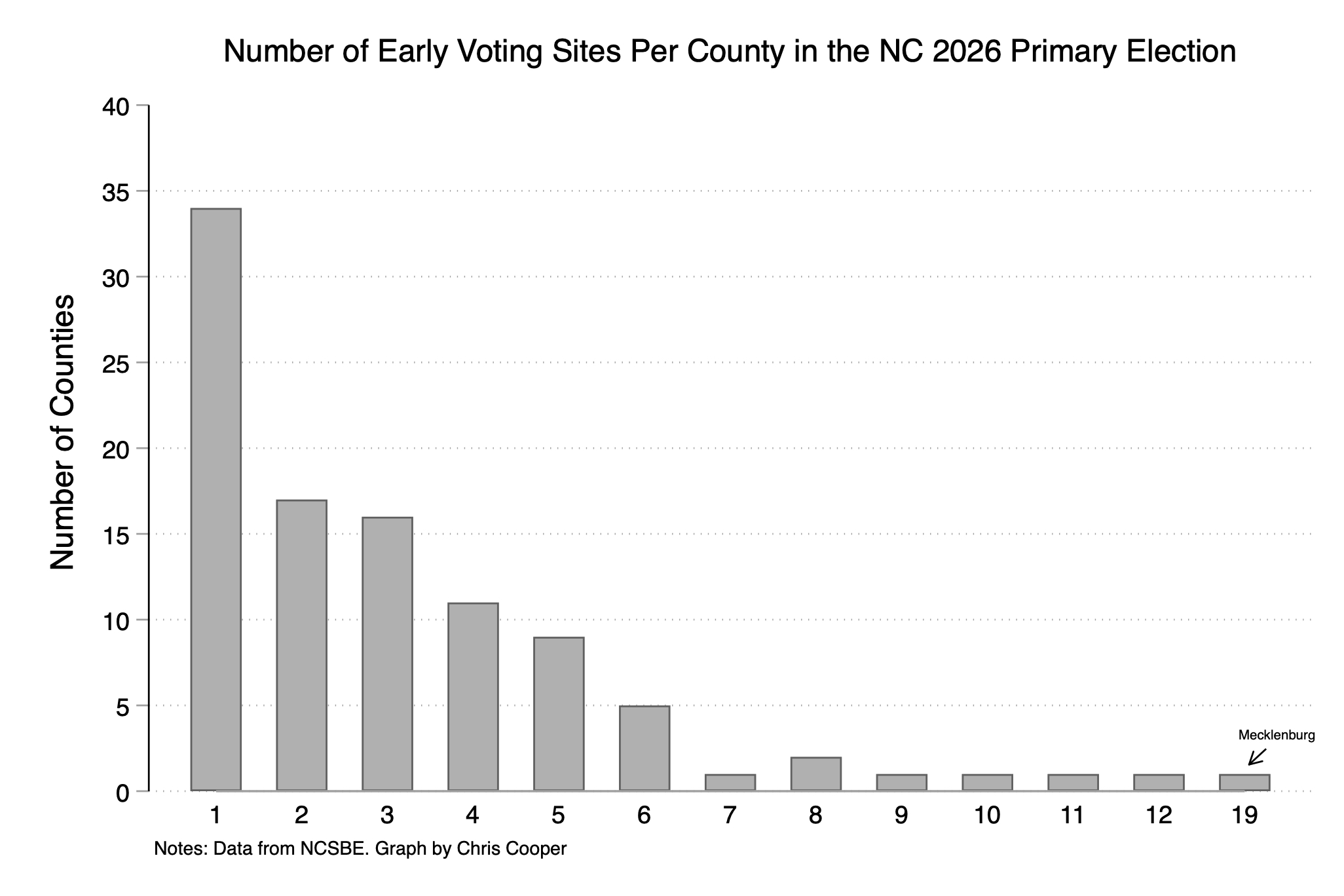
There will be 319 early voting sites in the primary, spread across all 100 counties. That represents an increase of 6 percent from 2022.3 By comparison, between 2018 and 2022, there was an increase of 3.4 percent (from 291 sites to 301), and between 2014 and 2018 there was an increase of 1.4 percent (from 287 to 291). About a third of counties have one site (the minimum allowable), while Mecklenburg has the most at 19. See the figure below for more details on the distribution of sites by county.
It is important to note that early voting has increased dramatically over that same period. There were 52 percent more early votes cast in 2022 than 2018, 31 percent more cast in 2018 than 2014, and 31 percent more cast in 2014 than 2010. In other words, despite the increase in the number of early voting sites, a normal increase in early votes would mean that there might still be fewer sites per votes in the 2026 primary than there were in previous years.
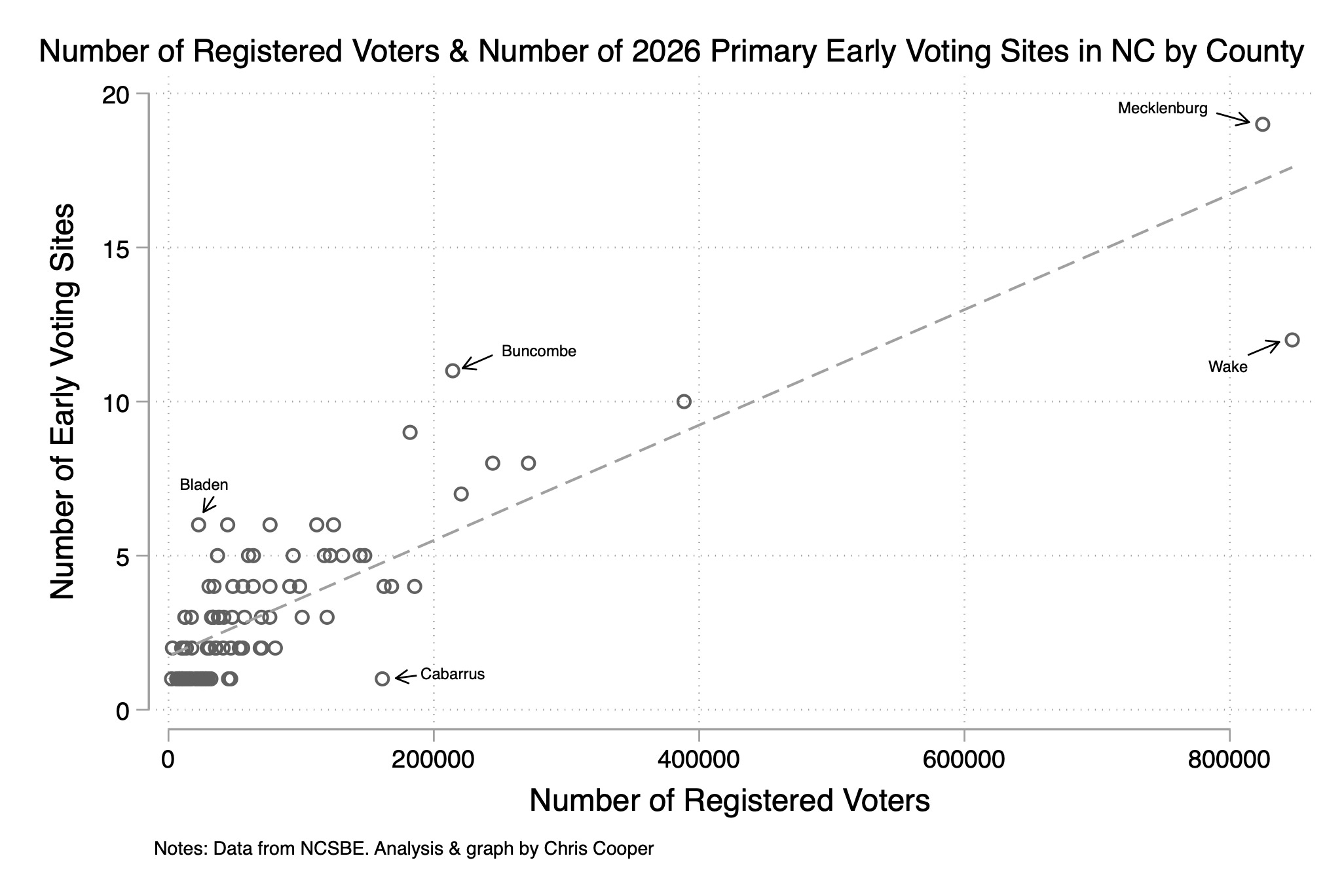
Not surprisingly, the larger counties tend to have the most sites. To illustrate this pattern, the graph below shows a scatterplot with the number of registered voters on the horizontal (X) axis and the number of early voting sites on the vertical (Y) axis. The dots represent counties and the dashed diagonal line is the line of best fit (a way to see the general pattern if you don’t want to mess with the circles).
Buncombe, Bladen, and to a lesser degree Mecklenburg have more sites per registered voter than other counties while Cabarrus and Wake have fewer sites than you’d expect given the number of registered voters.
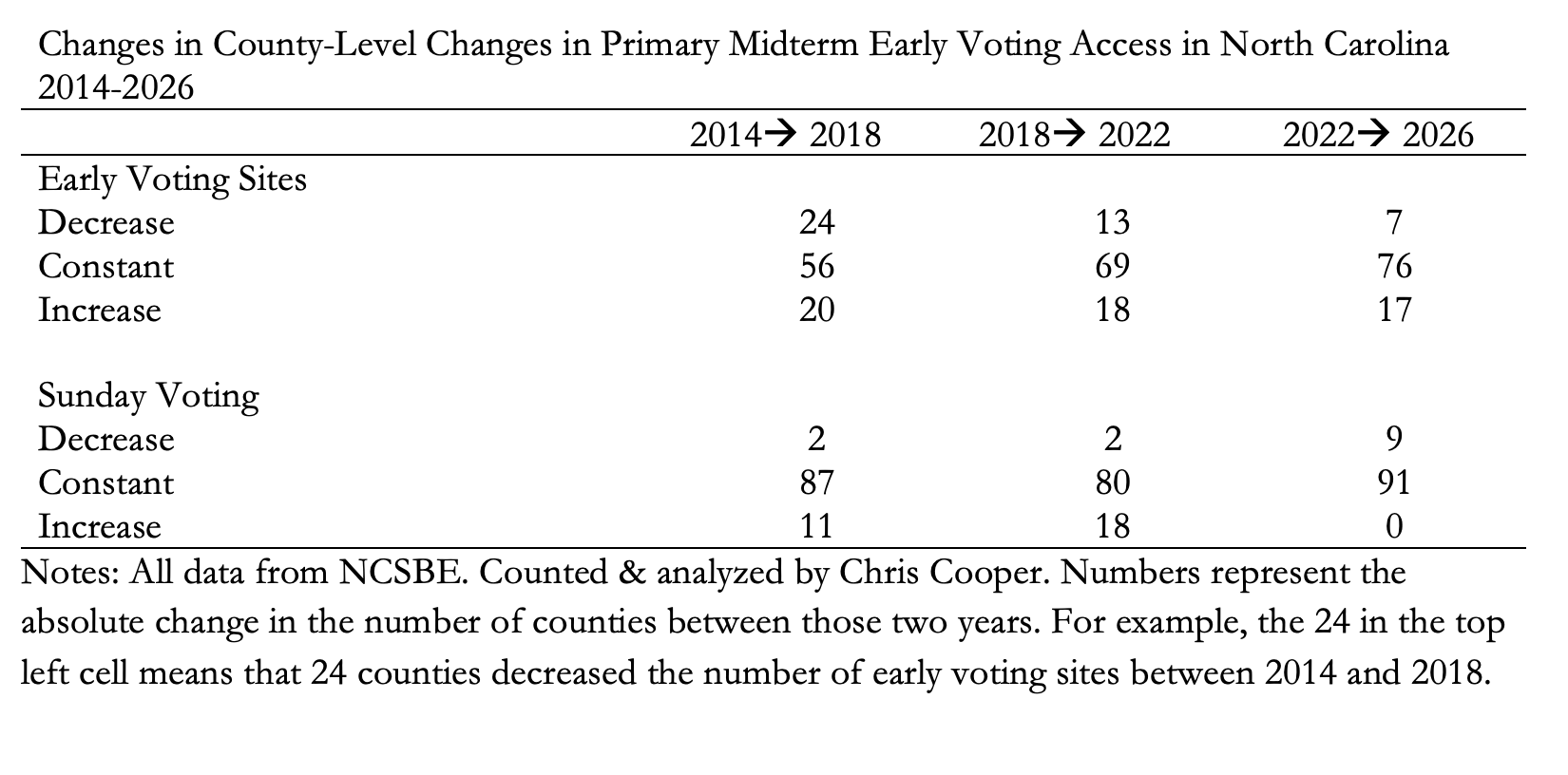
In all, 17 counties increased the number of early voting sites from 2022 to 2026, while seven reduced the number: Jackson, Lenoir, Lincoln, Madison, Nash, New Hanover, and Stanly. For comparison, between 2018 and 2022, 13 counties decreased the number of sites while 18 increased them.
Sunday Voting
County boards of elections also have discretion over whether to open early voting on two Sundays, one Sunday,4 or neither Sundays.5 The number of counties that have Sunday voting dropped from 29 in 2022 to 20 in 2026. Columbus, Gaston, Greene, Harnett, Lenoir, Moore, Pitt, Randolph and Wayne counties all had Sunday voting in the 2022 primary, but voted to eliminate Sunday voting in the 2026 primary. For comparison, there were 13 counties with Sunday voting in 2018 and four in 2014.6
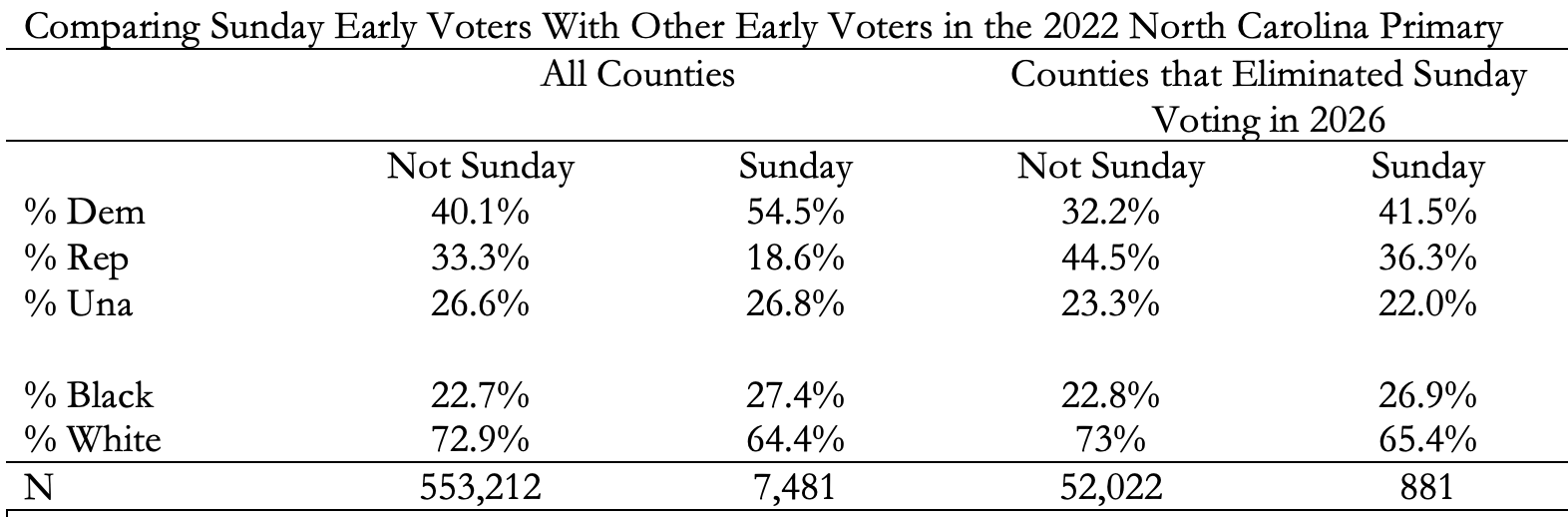
To better understand who is most likely to be affected by these changes, the table below shows the racial and partisan characteristics of people who cast their early vote on Sunday in the 2022 primary v. those who cast their early votes on other days of the week. The results are broken up into two sections—the left two columns of data simply show the results for all counties, while the two columns on the right show the racial and partisan breakdown just for the nine counties that had Sunday voting in 2022 and eliminated it in 2026.
As you can see, using either metric, Democrats and Black voters are more likely to cast their votes on Sundays, as compared to White voters and Republicans.
College Campus Voting
There has been a lot of press coverage over the closure of the early voting site at Western Carolina University as well as the decision not to host sites at NC A&T and the University of North Carolina Greensboro. But, overall, how does college and university voting sites compare to previous years?7
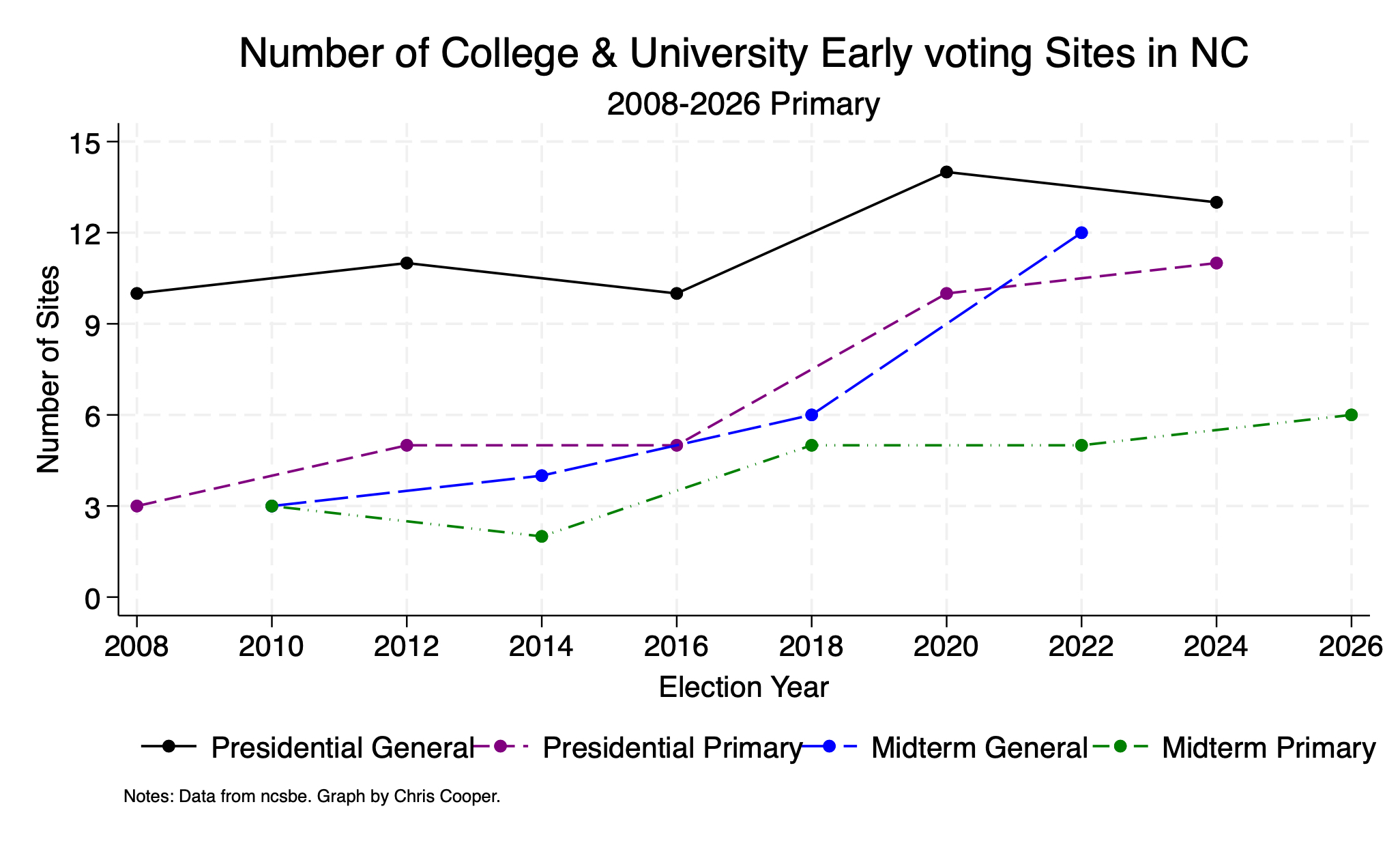
The graph below features the number of college and university early voting sites in North Carolina from 2008 to present. As you can see, the midterm primary always has the fewest sites of the four election cycles.
The 2026 primary will have one more college and university site than the 2022 primary. Western Carolina lost its site, but NC A&T and UNCG did not have sites in the previous primary. Duke and NC State added sites that were used in previous general elections, but had not been used in previous midterm primaries.8
TL;DR?
In all, there will be slightly more early voting sites and college and university voting sites in North Carolina in 2026 than in any previous midterm primary, but the number of counties offering Sunday voting will see a notable decrease. No county added Sunday voting in the 2026 primary that did not previously have it, while nine counties dropped Sunday voting altogether.
These decisions aren't permanent—county boards will vote on general election plans this summer, giving voters a chance to weigh in before the next plans are set. As a result, it will be important to study not just the raw number of sites, but the distribution of these sites and the effects that changes have on who exercises their right to vote.
I’ve demonstrated previously that the addition of some college student voting sites, for example, can lead to the expansion of youth voting—without altering local partisan outcomes. We will be able to apply similar metrics to assess to the changes in 2026.
Hopefully election boards will take these results—no matter what they show—into account when approving their 2026 general election plans this summer.
All comparisons are to previous primary midterms. These data are harder to wrangle than you might think. I checked and rechecked everything, but if you see any mistakes, please let me know.
These plans are decided by each county’s board of elections. If the boards come to unanimous agreement, the plans are implemented. If they have one or more negative votes, the competing plans go to the State Board of Elections who makes a final determination. All 100 county boards as well as the state board are comprised of 3 Republicans and 2 Democrats. In 2026, 88 of 100 counties had unanimous agreement. The 12 counties that did not presented their plans to the NC State Board of Elections. In 10 of those 12 cases, the State Board approved the majority plan. In one case, the state approved the minority plan (in that county, one Republican had sided with the Democrats to produce the majority) and in Madison County, the majority wanted one site, the minority wanted three sites and the State Board compromised with two sites.
Of course, not all sites are created equal. A county may opt for fewer sites in larger spaces for very good reasons. Nonetheless, the empirical evidence is clear that the number of sites matters. Namely, the closer people live to a polling place (early or election day), the more likely they are to cast a vote.
In the 2026 primary, those are February 15 and February 22
In a 2024 survey, Michael Bitzer asked North Carolinians about Sunday voting and found the following:
“When asked about the two Sundays occurring during early voting period, a majority—54 percent—of respondents said all 100 North Carolina counties should offer voting for each of the Sundays, while 31 percent said it should be left up to the individual counties if they should offer Sunday voting.
Among Democratic respondents, 72 percent said all 100 counties should offer voting on both Sundays, while only 37 percent of Republicans said so. Republican respondents had the largest percentage (29 percent) who said none of North Carolina’s counties should offer Sunday voting.”
This is, of course, just one way to measure Sunday voting. One could count how many Sundays at how many sites, or the total number of Sunday voting hours. I opt here for the simplest measurement—either the county offers it in some form, or it doesn’t.
I only examine four year colleges and universities because, unlike community colleges, they have a large proportion of students who live on campus.
For the 2026 primary elections, there will be sites at Duke, NC State, UNC, Appalachian State, East Carolina University, and NC Central University. There is also a case to be made that the site at Smith Recreation Center is close enough to the Fayetteville State University campus to count as a campus site (similar to Chapel of the Cross at Chapel Hill). The same site was used in the 2022 primary, so the decision to “count” Smith Recreation Center does not affect the data on change.
