by Christopher Cooper
Sometime today, the first mail ballots for the 2026 primary were sent out to North Carolina voters, marking the official beginning of the 2026 elections.
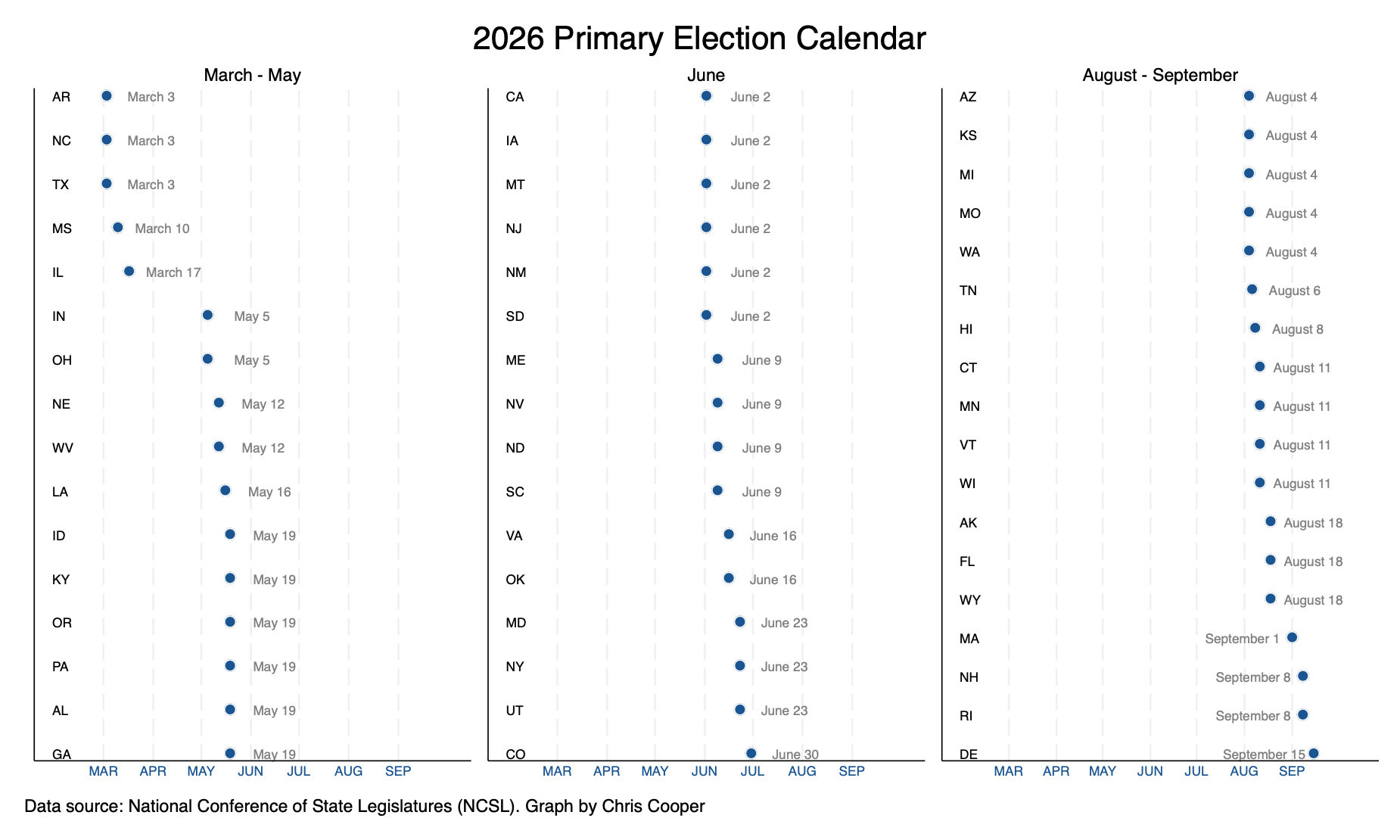
If this seems early, that’s because it is. North Carolina, Arkansas, and Texas hold their elections on March 3—the first in the nation. North Carolina sends out the first match of mail ballots 60 days before the election, whereas Texas and Arkansas wait until 45 and 46 days before the election, respectively. In person early voting begins in North Carolina on February 12, four days before Arkansas and five days before Texas.
No matter how you slice it, the 2026 election election begins in North Carolina. And it begins today.
Just because ballots are going out does not mean that all is set for the 2026 primary elections in North Carolina. Tomorrow, the North Carolina State Board of Elections will make final decisions about the placement of early voting sites.1
In 88 of North Carolina’s 100 counties, county boards of elections adopted2 a unanimous plan for early voting (meaning all five county board of election members voted for the plan). An analysis from Common Cause NC found that, among those 88 unanimous plans, five counties decreased the number of sites and ten increased the number of sites, 19 counties dropped a Sunday or Saturday voting location, while eight added at least one weekend voting day.
Some of this churn is normal. Between the 2018 and 2022 primaries3, for example, 13 counties decreased the number of sites, 17 counties increased the number of sites, and the remainder remained constant.
The 12 counties that have non-unanimous plans will be decided by the NC State Board of Elections on Tuesday. The disagreements are over the (1) number of sites (4 counties), (2) the placement of sites (4 counties), and (3) Sunday voting (64 counties).5 Here’s a brief summary of those plans (the plans themselves are linked with each county name)6:
Alamance. Both the majority & minority plans in Alamance have three sites (one more than in 2022). They agree on the hours and they agree on the placement of two of them—the Graham Recreation Center and the Mebane Arts and Recreation Center. The disagreement is about the third site. The majority plan recommends the Kernodle Senior Center in Burlington while the minority voted for the Elon South gym, located on the Elon University Campus. Elon did not have a site in the 2022 primary or 2024 general, but was a site in the 2022 general and 2024 primary.
Brunswick. Both plans recommend five sites and both party’s plans are in agreement on all five of them.7 The other difference of opinion is that the Democratic plan includes more opportunities for Sunday voting8 than the Republican plan.
Columbus. Both plans recommend five sites (the same number as the 2022 and 2018 primaries) at the same five locations. The difference is is entirely due to Sunday voting. The majority plan has it, the minority plan doesn’t. In this case, the Republican chair voted with the Democrats.
Craven. Both plans agree on the same four sites (the same number as 2022); the debate here is again, over Sunday voting with the majority plan having no Sunday voting and the minority plan having one Sunday voting opportunity (February 15).
Cumberland. Cumberland county submitted three plans. The majority and minority plans includes seven sites and the Director’s plan includes five (they had five in 2022 and six in 2018). The point of contention is over placement at the Kiwanis Recreation Center in Fayetteville (majority plan) v. the Smith recreation Center in Fayetteville (minority plan). The Director’s plan proposes using the Kiwanis Recreation Center, but not the Smith Recreation Center.
Greene. Both the majority and minority plans allow for a single site—the Elaney Wood Heritage Farmer’s Market in Snow Hill (Greene had one site in the 2022 and 2018 primaries). The sole difference is Sunday voting—the minority plan wants it, the majority plan doesn’t.
Guilford. The majority plan recommends 10 sites while the minority plan recommends 15 (Guilford had eight in the 2018 and 2022 primaries). Although the difference of whether to include sites on the UNCG and NC A&T campuses has gotten the majority of the attention, it’s worth noting that a five site difference of opinion is the largest of the 12, and the majority plan (but not the minority plan) includes sites at Barber Park and Washington Terrace, which are near larger concentrations of African American voters. While UNCG and NC A&T have had sites in previous Presidential election years, they have not in midterms.
Harnett. Both plans include five identical sites (one more than in 2022, but the same number as in 2018). The point of disagreement here is over Sunday voting, with the majority plan allowing for none and the minority plan allowing for both Sundays at all five sites.
Jackson. This is one of two counties that has not two, but three proposed plans. The majority plan includes four sites, the minority’s plan A includes five sites and the minority’s plan B includes four sites (previous year’s midterm primaries have had five sites). Minority plan A includes the identical five sites from the last few election cycles. Minority plan B moves from the traditional two sites in Cullowhee to one site, and places it not at the Jackson County Parks and Recreation Center, or the Western Carolina University (WCU) University Center (the traditional sites since 2016), but rather at the Health and Human Sciences Building on the edge of the WCU campus.9 The majority plan offers no site at WCU. None of the three plans allow for Sunday voting.
Madison. The majority plan has a single site at the Madison County branch of Asheville-Buncombe Technical College in Marshall. The minority plan includes that site as well as sites at the Mars Hill Public Library and the Hot Springs Senior Center. Neither plan includes Sunday voting. In 2018 and 2022 primaries, Madison had three sites.
Pitt. The majority plan has six sites, whereas the minority plan includes five (Pitt had seven in 2028 and five in 2022). The additional site proposed by the majority is at the Village of Simpson Town Hall. There is some media coverage suggesting that there is also disagreement over Sunday and Saturday voting, but my read of the spreadsheet is that both plans are identical on that criteria.10
Wayne. Both the majority and minority plans agree that there will be early voting sites at the Wayne County Public Library, the Farm Credit Farmer’s Market and the Mount Olive Train Depot (an increase of two from 2022 and 2018). The disagreement is over whether there should be Sunday voting on February 22nd—the minority thinks there should be and the majority thinks there shouldn’t be.
Keep in mind that, no matter the decisions tomorrow, these plans only apply to the 2026 primary election. Counties will make new plans for the general election (with the same process for state board approval of non-unanimous plans). And (contrary to information in at least one of the plans), the counties do not have to have the same number of sites open if there is a second primary (runoff) election.11
The meeting to decide the non-unanimous plans for the 2026 primary will be held at 9 AM tomorrow (Tuesday, January 13, 2026). Here are the details if you want to watch.
I know I will.
There are also candidate challenges that are ongoing in a few places. See this piece from the Asheville Watchdog about one for the City of Asheville Council.
County boards of elections all include two Republican members, two Democratic members and a Republican chair.
Both years where the Democrats controlled all county boards of elections, as well as the State Board of Elections.
these don’t add up to 12 because two counties have disagreements about both the number of sites and site placement.
All of these decisions are up to the purview of the county boards of elections (within some guardrails). Non-unanimous decisions go to the State Board for final determination regardless of the details of the vote (4-1, or 3-2). The State Board can adopt a majority plan, adopt a minority plan, or come up with their own plan.
These may seem like trivial decisions, but they can be incredibly consequential for who turns out to vote and the method of voting they choose.
It’s a little confusing at first glance because one of the sites—although it has identical addresses—is listed with two different names, depending on the plan.
There’s not a lot of polling on Sunday voting, but Michael Bitzer’s Catawba College/Yougov Poll did find that a slight majority (54%) of North Carolinians believe that all 100 counties should offer early voting on both Sundays during the early voting period. About a third believe it should be up to the individual counties and just 16 percent believe that no counties should have Sunday voting.
I wrote previously about the effectiveness of this site at WCU.
Please let me know if you read these data differently. The spreadsheet is linked to the county name. I’ve looked at it until my eyes are blurry and crossed and to my eyes, they’re the same.
See, for example, the list of sites from the 2024 second primary (runoff). For more about second primaries in North Carolina, see here.
